What Makes an AI Agent “Good”? A Practical Evaluation Framework
Defining the 'Good' AI Agent
In the rapidly evolving landscape of artificial intelligence, an AI agent is more than just a large language model (LLM) that produces text. It is a system designed to perceive its environment, reason through complex instructions, and execute actions to achieve a specific goal. Because these systems operate autonomously, traditional unit testing is insufficient. To understand what makes an AI agent truly “good,” we must move beyond simple output validation and embrace a comprehensive AI agent evaluation framework that measures the agent's ability to navigate ambiguity, utilize tools, and deliver consistent results.
This guide is designed for developers, product managers, and AI engineers tasked with moving agents from prototype to production. By the end of this article, you will have a clear, actionable checklist to measure agent success and build systems that users can trust.
The Core Pillars of Agentic Performance
Evaluating autonomous agents requires a focus on three fundamental pillars: task completion, reasoning transparency, and error recovery. While a model might be grammatically correct, an agent is only as good as its ability to affect its environment successfully.
Task Completion Rate
This is the most critical metric. Does the agent actually achieve the end state requested by the user? In a multi-step workflow, task completion is rarely binary. It requires tracking progress through intermediate steps, where failure at any point—such as a failed API call or a misinterpreted instruction—can derail the entire process.
Reasoning Transparency
An agent must be able to explain its “thought process.” This is often achieved through Chain-of-Thought (CoT) prompting or structured logging. If an agent takes an action, the developer should be able to audit exactly why that action was selected. Transparency is the precursor to reliability; without it, debugging becomes an exercise in guessing.
Error Recovery
Autonomous agents will inevitably encounter errors, such as a 404 response from an API or a hallucinated parameter. A “good” agent does not simply crash; it identifies the error, assesses the state, and attempts a self-correction or notifies a human for intervention. This resilience is what separates toys from enterprise-grade tools.
Quantitative Metrics for Agent Success
When moving to production, you must balance performance with operational costs. Developers often find themselves navigating a trade-off between the complexity of the agent’s reasoning and the bottom-line profitability of the system, as discussed in our guide on how AI agent builders are actually making money. To measure this, consider the following metrics:
Cost-per-task: The total compute and API spend required to complete a single goal.
Latency: The time elapsed from the initial prompt to the final execution, including all tool-use cycles.
Tool-use Efficiency: The ratio of successful tool calls to total attempts; high failure rates here often signal poor prompt engineering or inadequate tool documentation.
Turn-count: The number of interactions required to finish a task. Excessive turns often indicate that the agent is struggling to maintain context or is getting stuck in loops.
Qualitative Assessment: Reliability and Safety
Quantitative data tells you what happened, but qualitative assessment tells you why it happened. How do you test autonomous AI agents for reliability? You must simulate failure modes. Testing for hallucination is vital. Similarly, you must ensure strict adherence to guardrails, especially when the agent has access to sensitive data or external systems.
Human-in-the-loop (HITL) validation remains the gold standard for high-stakes agents. By incorporating periodic human reviews into the development cycle, you create a feedback loop that validates whether the agent’s “reasoning” aligns with business logic and safety standards. This shift from simple 'prompt engineering' to rigorous 'agent evaluation engineering' is defining the next phase of AI development.
The Role of Infrastructure and Tooling
The quality of an agent is heavily dependent on the environment in which it operates. A well-designed agent cannot perform well in a poorly defined environment with ambiguous tool definitions. The industry is currently moving away from fragmented, custom-built environments toward standardized protocols. This shift is crucial, as evidenced by the industry's interest in how Nvidia is planning to launch an open-source AI agent platform to help standardize how agents interact with software tools.
Standardized evaluation environments allow for reproducible testing. By using consistent sandboxes, you can ensure that your AI agent performance metrics are not influenced by environmental noise, but rather reflect the true capabilities of the agent's logic.
A Practical Evaluation Checklist
To implement your own evaluation cycle, follow this step-by-step framework:
Define the Ground Truth: Create a set of golden-standard inputs and expected outcomes.
Establish Guardrails: Define clear boundaries for what the agent is allowed to do and which data it can access.
Run Simulation Tests: Use a test harness to run your golden-standard inputs through the agent, measuring success rates.
Audit Reasoning Logs: Manually review the “thought process” of the agent for 5-10% of test cases to identify logical fallacies.
Measure Operational Impact: Track cost, latency, and error rates in a staging environment before full deployment.
For further reading on standardized testing methodologies, the National Institute of Standards and Technology (NIST) AI Risk Management Framework provides excellent guidance on building safe, trustworthy systems.
Conclusion
Evaluating an AI agent is an iterative process that requires moving beyond simple accuracy scores. By focusing on task completion, reasoning transparency, and robust error recovery, you build agents that are not just clever, but reliable. As the ecosystem matures, the focus will continue to shift toward standardized testing and rigorous evaluation engineering. Ready to build more reliable agents? Download our comprehensive evaluation template to start tracking your agent's performance today.
Related Articles
View all articles
The Future of AI Reliability: Understanding Agent Stress Testing
Learn how AI agent stress testing works and why simulated digital worlds are becoming the industry standard for ensuring safe, reliable autonomous AI operati...

How to Compare AI Agents Before Using Them in Your Business
Learn how to compare AI agents effectively. Evaluate performance, integration capabilities, and security to choose the right automation tools for your business.
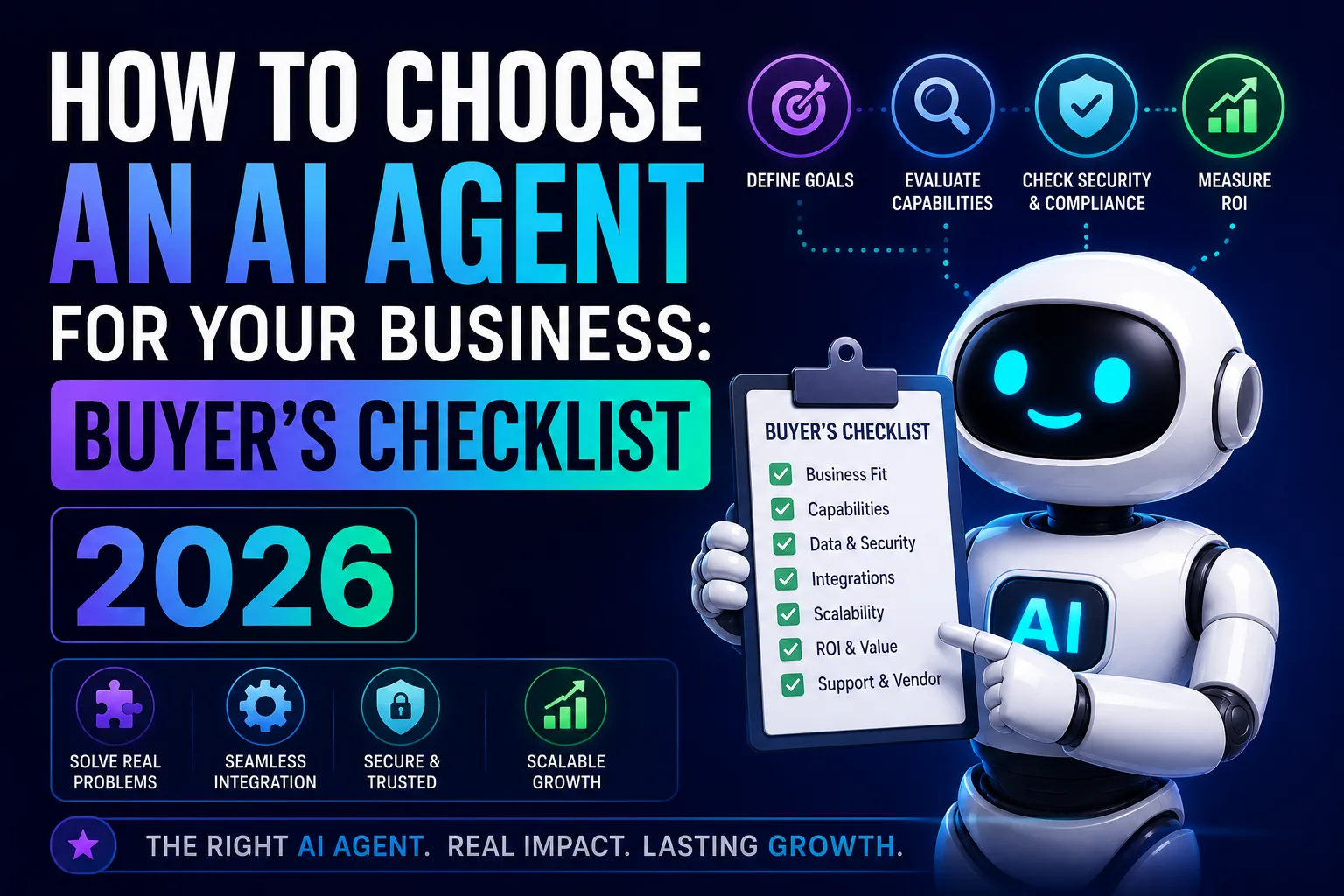
How to Choose an AI Agent for Your Business: Buyer’s Checklist 2026
Navigate AI agent selection for your business with our comprehensive checklist. Discover key criteria, essential features, and how to find the right fit.
Continue exploring
Find AI agents by workflow
More in Industry Insights
Browse more articles in the Industry Insights category.
AI Agents articles
Explore more guides and insights tagged AI Agents.
LLMs articles
Explore more guides and insights tagged LLMs.
AI Agent Categories
Browse use-case pages for sales, productivity, coding, customer service, and more.
AI Agents Landscape
Explore the full directory map and compare agents by workflow and category.
Agent Skills
Find reusable skills, capabilities, and building blocks for AI agent workflows.