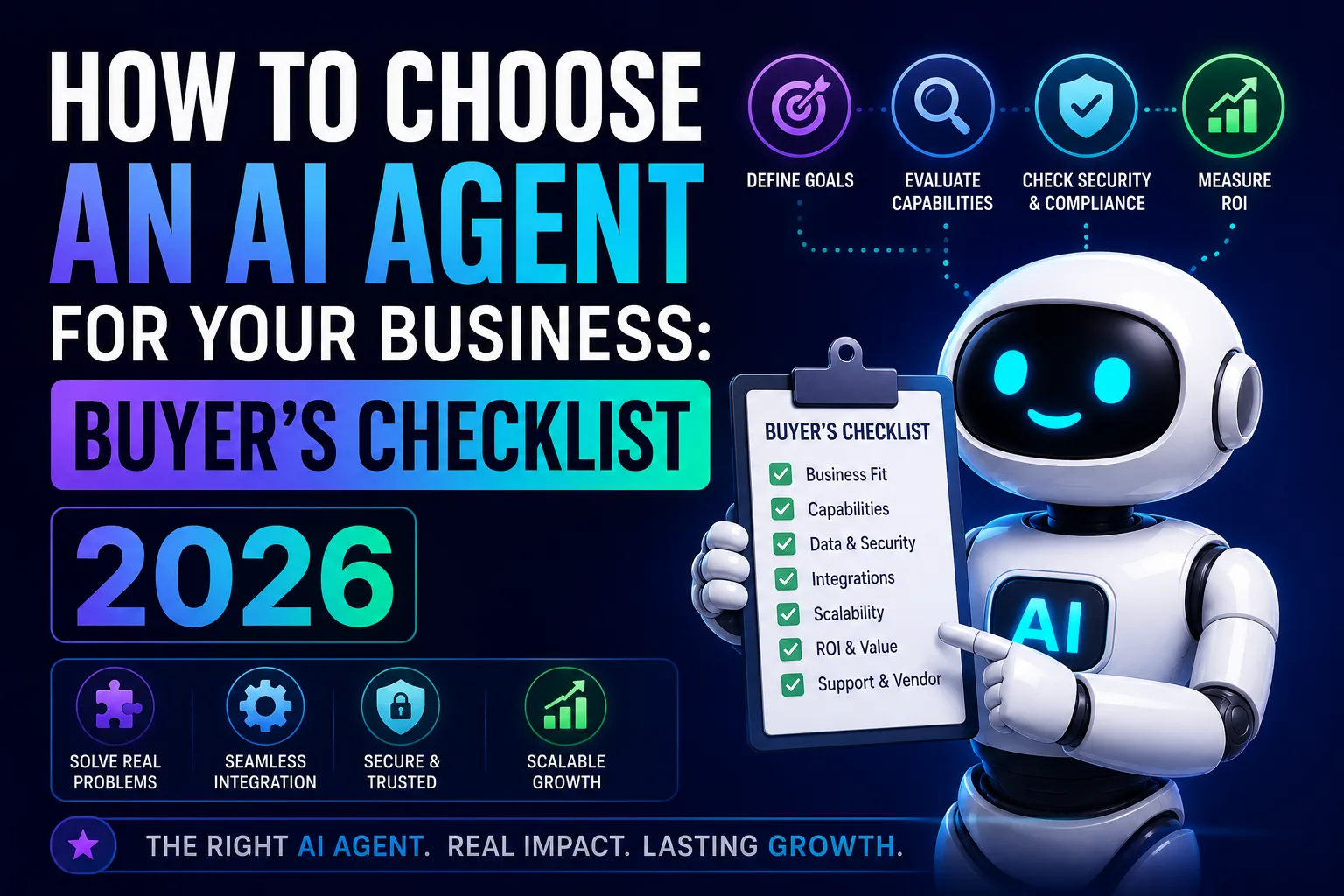
How to Choose an AI Agent for Your Business: Buyer’s Checklist 2026
Understanding AI Agents in a Business Context
As artificial intelligence continues its rapid evolution, AI agents are emerging as powerful tools capable of performing complex tasks autonomously or semi-autonomously. For businesses, understanding what an AI agent is and how it can be leveraged is the first crucial step in harnessing this technology. An AI agent is essentially a software program designed to perceive its environment, process information, and take actions to achieve specific goals. In a business setting, these agents can range from simple chatbots that handle customer inquiries to sophisticated systems that manage supply chains, analyze market trends, or even assist in complex decision-making processes. The rise of specialized AI agents for niche business functions, such as customer service, sales enablement, and human resources, means there's a growing opportunity for businesses of all sizes to find solutions tailored to their unique needs.
The benefits of using AI agents in business are numerous. They can drive efficiency by automating repetitive tasks, improve accuracy by reducing human error, enhance customer experiences through personalized and immediate support, and provide valuable insights through advanced data analysis. As AI agents become more sophisticated, they are increasingly seen as collaborators with human employees, augmenting their capabilities rather than simply replacing them. This symbiotic relationship allows human teams to focus on higher-level strategic thinking and creative problem-solving, while AI agents handle the execution and data-intensive aspects of their roles.
Defining Your Business Needs and Objectives
Before diving into the market for AI agents, a thorough self-assessment of your business needs and objectives is paramount. This foundational step ensures that your investment in AI will yield tangible results and align with your overall strategic goals. Ask yourself: What specific problems are we trying to solve? What processes are inefficient or costly? What opportunities are we missing due to limitations in our current capabilities?
Identifying Pain Points and Opportunities
Consider areas such as:
Customer Service: Are response times too slow? Is agent workload too high? Can we offer 24/7 support?
Sales and Marketing: Can we automate lead qualification? Personalize outreach at scale? Analyze campaign performance more effectively?
Operations and Logistics: Can we optimize inventory management? Predict demand more accurately? Streamline supply chain operations?
Human Resources: Can we automate initial candidate screening? Onboard new employees more efficiently? Provide internal support for HR queries?
Data Analysis: Do we need to process and analyze vast amounts of data for insights?
By clearly defining these pain points and identifying the opportunities that AI agents can unlock, you establish a clear mandate for your search. This clarity will guide your evaluation of potential AI solutions, ensuring you prioritize features and functionalities that directly address your business challenges. Understanding how to choose the right AI agent for small business or enterprise solutions starts with this introspection.
Setting Measurable Goals
Once you've identified your needs, set specific, measurable, achievable, relevant, and time-bound (SMART) goals. For instance, instead of aiming to 'improve customer service,' a SMART goal might be 'reduce average customer response time by 30% within six months using an AI-powered chatbot.' This allows you to measure the ROI of an AI agent for your company effectively.
Key AI Agent Capabilities to Consider
With your business needs defined, you can now focus on the core capabilities that make an AI agent effective. The landscape of business AI tools is diverse, and understanding what to look for in a business AI agent is critical for making an informed selection.
Core Functionalities and Features
When evaluating AI agents, consider the following capabilities:
Natural Language Processing (NLP) and Understanding (NLU): The ability to understand and interpret human language, whether written or spoken, is fundamental for most AI agents interacting with customers or employees. This includes understanding intent, sentiment, and context.
Task Automation: The agent's capacity to perform specific, often repetitive, tasks without human intervention. This could range from scheduling meetings to processing invoices.
Learning and Adaptability: Does the agent learn from interactions and data to improve its performance over time? This is crucial for agents that need to adapt to evolving business processes or customer needs. The increasing demand for AI agents that can handle complex, multi-step tasks and adapt to evolving business processes highlights this capability.
Data Analysis and Reporting: The ability to process, analyze, and generate insights from data. This is vital for agents involved in market research, performance monitoring, or predictive analytics.
Integration Capabilities: How well can the AI agent connect with your existing software and systems? This is a critical consideration for seamless workflow integration.
Explainable AI (XAI): For critical decision-making or compliance-heavy tasks, the ability of the AI agent to explain its reasoning is becoming increasingly important. This fosters trust and transparency, which are key concerns in business AI adoption.
The Role of Generative AI
The impact of generative AI is significantly expanding the potential applications of business AI agents. Generative AI capabilities allow agents to create new content, such as marketing copy, code, or even synthetic data, and to engage in more fluid and context-aware conversations. When evaluating agents, consider how generative AI features might enhance their utility for your specific use cases.
Specialized vs. General-Purpose Agents
The rise of specialized AI agents for niche business functions means you can often find solutions highly optimized for specific tasks. For example, an AI agent designed exclusively for sales enablement might offer features far beyond a general-purpose AI assistant. Weigh the benefits of a specialized agent against the flexibility of a more general one.
Technical and Integration Requirements
Choosing an AI agent involves more than just assessing its features; it also requires a practical understanding of the technical infrastructure and integration needed to deploy and manage it effectively. This is a key part of AI agent evaluation for enterprise and smaller businesses alike.
Integration with Existing Systems
A fundamental question is: How do I integrate an AI agent into my existing business systems? The best AI agents will offer robust APIs and pre-built connectors for popular CRM, ERP, marketing automation, and communication platforms. Seamless integration ensures that the AI agent can access the data it needs and feed its outputs back into your established workflows, preventing data silos and maximizing efficiency. Consider the technical expertise required for integration and whether the vendor offers support or managed services.
Deployment Models
AI agents can be deployed in various ways:
Cloud-based (SaaS): Easiest to implement and scale, with the vendor managing infrastructure.
On-premises: Offers greater control over data and security but requires significant IT investment and maintenance.
Hybrid: A combination of cloud and on-premises, offering flexibility for specific security or performance needs.
Your choice will depend on your organization's IT strategy, security policies, and budget.
Scalability and Performance
As your business grows, your AI agent needs to scale with you. Ensure the chosen solution can handle increased volumes of data, users, and tasks without performance degradation. Look for vendors that offer clear scalability roadmaps and performance metrics.
Security, Privacy, and Ethical Considerations
Implementing AI agents, especially those handling sensitive data, necessitates a strong focus on security, privacy, and ethical deployment. These are not afterthoughts but critical components of responsible AI adoption.
Data Security and Compliance
Understand how the AI agent and its provider handle your data. Key questions include:
Where is data stored and processed?
What encryption methods are used?
What are the vendor's compliance certifications (e.g., GDPR, HIPAA, SOC 2)?
What are the risks associated with implementing AI agents in a business, particularly concerning data breaches or misuse?
Ensure the solution aligns with your industry regulations and internal data governance policies.
Ethical Use and Bias Mitigation
AI algorithms can inadvertently perpetuate or amplify existing biases present in the data they are trained on. It's crucial to inquire about the vendor's approach to bias detection and mitigation. Discuss how the AI agent is designed to ensure fairness, transparency, and accountability. The trend towards explainable AI (XAI) is directly related to these ethical considerations, providing insight into how decisions are made.
Transparency and Accountability
When an AI agent makes a decision or takes an action, there should be a clear line of accountability. For complex tasks, understanding why an AI agent arrived at a particular conclusion (explainability) builds trust and allows for intervention or correction when necessary. This also relates to what to look for in a business AI agent beyond just its functional capabilities.
Vendor Evaluation and Support
Selecting the right AI agent also means selecting the right partner. Thorough vendor evaluation is essential for long-term success.
Vendor Reputation and Expertise
Research the vendor's track record, customer reviews, and case studies. Do they have a deep understanding of your industry and its specific challenges? How long have they been developing and supporting AI solutions?
Support and Training
What level of technical support does the vendor provide? Is it available 24/7? What training resources are offered for your team to effectively use and manage the AI agent? Consider the importance of ongoing support, especially as AI technologies evolve rapidly.
Roadmap and Future Development
Inquire about the vendor's product roadmap. Are they actively investing in research and development? Will the AI agent continue to evolve and improve to meet future business needs? This is particularly relevant for understanding how to make AI agents work for your business in the long term.
The AI Agent Buyer's Checklist: A Summary
To consolidate your evaluation process, use this checklist when choosing an AI agent for your business:
Define Clear Objectives: What specific business problems will the AI agent solve? What are your measurable goals?
Assess Core Capabilities: Does it offer strong NLP/NLU, task automation, learning/adaptability, data analysis, and integration features?
Evaluate Technical Fit: Does it integrate with your existing systems? What is the deployment model? Is it scalable and performant?
Review Security & Ethics: What are the data security protocols and compliance measures? How is bias mitigated? Is there a commitment to transparency?
Examine Vendor Support: Does the vendor have a strong reputation? What level of ongoing support and training is provided? What is their product roadmap?
Consider Cost & ROI: Understand the pricing model and estimate the potential return on investment. Pricing models vary sharply between vendors, and the headline number is rarely the full picture. GoHighLevel, for example, bundles five AI tools into one plan but bills its Plus features separately, and an independent breakdown of what GoHighLevel's AI Employee actually costs shows how the $50 and $97 tiers compare once usage billing is included
By systematically working through these points, you can make an informed decision that empowers your business with the right AI agent. Remember to also consider the different types of AI agents available for businesses, such as those focused on voice interactions, and evaluate them accordingly. For instance, if voice is a key channel for your business, you might want to explore how to evaluate AI voice agents for business.
Choosing an AI agent is a strategic decision that can significantly impact your business operations, customer engagement, and overall competitiveness. By approaching the selection process with a clear understanding of your needs, a focus on essential capabilities, and a thorough evaluation of technical, security, and vendor factors, you can find an AI solution that drives real value and positions your business for future success. Embrace the potential of AI agents as collaborators and tools to augment human capabilities, paving the way for innovation and growth.
Related Articles
View all articlesBest AI Agents for Small Businesses in 2026: 10 Tools Compared
Discover top AI agents revolutionizing small businesses in 2026. Compare 10 essential tools to boost productivity, automate tasks, and drive growth.
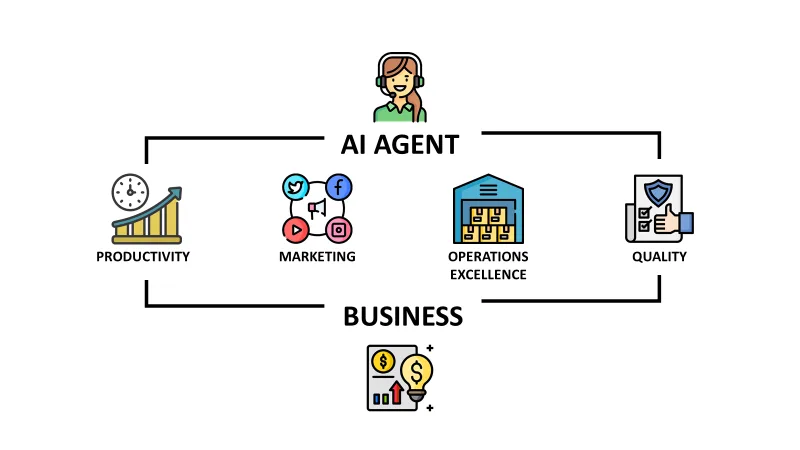
How to Make AI Agents Work for Your Business: A Strategic Guide
Learn how to effectively integrate AI agents into your business operations. Discover strategies for deployment, workflow automation, and scaling your AI capacity.
How to Compare AI Agents Before Using Them in Your Business
Learn how to compare AI agents effectively. Evaluate performance, integration capabilities, and security to choose the right automation tools for your business.
Continue exploring
Find AI agents by workflow
More in Industry Insights
Browse more articles in the Industry Insights category.
AI Agents articles
Explore more guides and insights tagged AI Agents.
Business Technology articles
Explore more guides and insights tagged Business Technology.
AI Agent Categories
Browse use-case pages for sales, productivity, coding, customer service, and more.
AI Agents Landscape
Explore the full directory map and compare agents by workflow and category.
Agent Skills
Find reusable skills, capabilities, and building blocks for AI agent workflows.