7 Mistakes AI Agent Builders Make
Introduction to AI Agent Development
The transition from simple LLM wrappers to complex, autonomous agents represents the next frontier in software engineering. However, the gap between a promising prototype and a production-ready system is cavernous. Many developers find that while their agents work well in a chat interface, they collapse under the weight of real-world requirements. This guide explores the seven most common mistakes AI agent builders make, providing a roadmap for those looking to move beyond basic prompt engineering toward robust, reliable autonomous systems.
Whether you are building for enterprise automation or consumer-facing interfaces, success depends on understanding that an agent is not just a chatbot. While a chatbot responds to queries, an agent is an autonomous agent architecture designed to perceive, reason, and take action. If you are struggling with reliability, this post will help you refine your design patterns and avoid the pitfalls that stall production deployments.
1. Over-relying on Prompt Engineering
The most frequent error in AI agent development is assuming that a perfect system prompt is a substitute for rigorous engineering. While natural language instructions are essential, relying on them to manage complex logic leads to fragile systems. Instead, you should focus on structured function calling and explicit API integrations. By treating the LLM as a reasoning engine rather than a logic controller, you ensure that the agent interacts with your codebase predictably, reducing the risk of hallucinated tool usage.
2. Ignoring Error Handling and Fallback Mechanisms
Why do AI agents fail in production? Often, it is because developers treat LLM calls as deterministic code. In reality, LLMs are probabilistic, and they will eventually fail to follow instructions or hit rate limits. Building graceful degradation is non-negotiable. If an agent fails to parse a JSON response, your system must have a fallback mechanism such as a retry loop with a simpler model or a hard-coded default path to prevent the entire process from crashing.
3. Failing to Define Clear Scope and Constraints
A common pitfall is the attempt to build a "generalist" agent that can handle any query. In practice, specialized, domain-specific agent architectures significantly outperform broad models. By constraining the scope of your agent, you reduce the search space for potential errors and improve the reliability of its reasoning. Define clear boundaries for what the agent can and cannot do, and use system-level constraints to prevent it from drifting into irrelevant topics.
4. Neglecting Multi-Agent Orchestration
As tasks grow in complexity, a single agent often becomes a bottleneck. Many builders fail to realize that complex workflows require structured coordination rather than a single "god-agent." If you are managing multiple sub-tasks, you should consider how 2026 will be the Year of Multi-agent Systems, as the industry moves toward specialized teams of agents working in concert to solve high-level problems.
5. Poor Context Management and Memory Design
Context window overflow is a silent killer of agentic workflows. When an agent loses track of the initial objective because the conversation history is too long, performance degrades rapidly. Effective long-term memory retrieval requires more than just dumping logs into the prompt. Implementing RAG (Retrieval-Augmented Generation) patterns or structured vector databases allows the agent to recall only the relevant facts, keeping the context window clean and the reasoning focused.
6. Skipping Rigorous Evaluation Frameworks
Subjective "vibes-based" testing is insufficient for production-grade AI systems. To ensure AI system reliability, you must implement automated evaluation pipelines. This includes:
Unit testing for tools: Verify that your function calls return the expected schema.
Regression testing: Ensure that new prompt changes don't break existing capabilities.
Evaluation datasets: Create a golden set of queries and expected outputs to measure performance changes over time.
For more on establishing these benchmarks, refer to the OpenAI Evals documentation, which provides a standard for measuring model capabilities.
7. Forgetting the Business Model
Perhaps the most overlooked mistake is building a technical marvel that lacks a clear path to value. You might have the most sophisticated agent, but if it doesn't solve a high-value problem, it will remain a hobby project. Understanding how AI agent builders are actually making money is essential for prioritizing features that move the needle for your users rather than just optimizing for technical elegance.
Conclusion: Building for the Long Term
Building reliable AI agents requires a shift in mindset: move away from treating LLMs as magic boxes and toward treating them as components in a larger, engineered system. By focusing on observability, structured communication, and specialized workflows, you can overcome the common pitfalls that derail production deployments. Remember, the goal is not to build the most complex agent, but the most useful one. Ready to build better agents? Subscribe to our newsletter for deep dives into AI architecture and production best practices.
Related Articles
View all articlesWhat Makes an AI Agent “Good”? A Practical Evaluation Framework
Learn how to evaluate AI agents beyond simple accuracy. Discover a practical framework for measuring reliability, decision-making, and operational success.
Top AI Agent Development Companies for Service Businesses in 2026
Compare top AI agent development companies for service businesses in 2026, including firms building support, scheduling, voice, sales, and workflow agents.
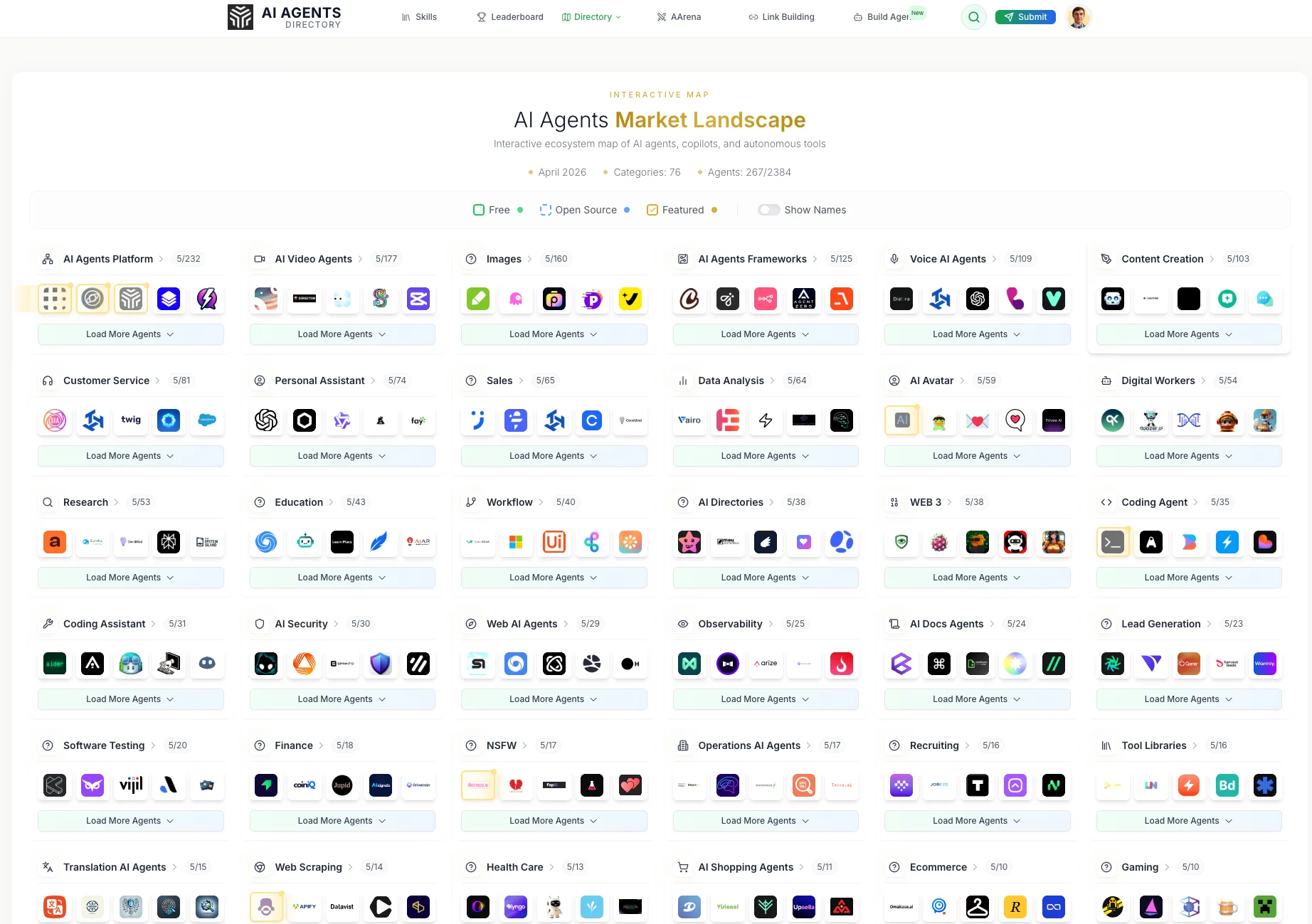
The Autonomous Marketplace: How AI Agent Directory is Building the Agentic Economy
Explore how AI Agent Directories are pioneering the Autonomous Marketplace, paving the way for the agentic economy and transforming how AI agents operate.
Continue exploring
Find AI agents by workflow
More in Industry Insights
Browse more articles in the Industry Insights category.
AI Agents articles
Explore more guides and insights tagged AI Agents.
LLM articles
Explore more guides and insights tagged LLM.
AI Agent Categories
Browse use-case pages for sales, productivity, coding, customer service, and more.
AI Agents Landscape
Explore the full directory map and compare agents by workflow and category.
Agent Skills
Find reusable skills, capabilities, and building blocks for AI agent workflows.