
Swap Launches the “Agentic Storefront”
Defining the Agentic Storefront
The landscape of online retail is undergoing a fundamental shift. For decades, e-commerce has relied on static interfaces, grids of products, search bars, and manual navigation paths. Swap’s recent launch of the Agentic Storefront signals a move toward a more dynamic, AI-driven environment. But what is an agentic storefront? At its core, it represents the transition from a passive website that users must navigate themselves to an active, intelligent interface that anticipates user intent and executes complex tasks on their behalf.
This post is designed for retailers, developers, and product managers looking to understand how autonomous shopping agents are moving from theoretical research into production-ready platforms. By the end of this guide, you will understand the mechanics behind these systems, the technical hurdles involved in their implementation, and the strategic tradeoffs required to adopt agent-first architectures in your own retail operations.
The Core Mechanics of Agentic Commerce
To understand the power of an agentic storefront, we must first define the agent itself. An AI shopping agent is a software entity capable of performing multi-step actions, such as comparing product specifications, checking inventory across multiple regions, or negotiating terms, without constant human intervention. In traditional e-commerce, the user does the heavy lifting: searching, filtering, and clicking. In agentic commerce, the user provides the goal—such as “find me a weather-proof running jacket under $150 that fits a specific size profile”—and the agent navigates the storefront to fulfill it.
These agents interact with storefront data through APIs and LLM-based reasoning engines. They do not just index keywords; they interpret the semantic meaning behind a user’s request. This is a significant leap from traditional recommendation engines that merely suggest items based on historical purchase data. Instead, these agents evaluate the current state of the store and make real-time decisions, effectively becoming a personalized concierge for every shopper.
Overcoming Integration Challenges in AI Retail
While the promise of autonomous shopping is high, the reality of implementation is often stalled by fragmented technical stacks. The biggest barrier to AI storefront success is technical interoperability. Retailers often manage legacy databases, custom inventory management systems, and third-party logistics providers that do not 'speak' the same language. If an AI agent cannot seamlessly query these disparate systems, it cannot perform its duties reliably.
The industry is actively working to solve these bottlenecks. Developers are increasingly moving toward standardized data schemas that allow agents to interpret product information, pricing, and availability regardless of the underlying infrastructure. Organizations like the World Wide Web Consortium (W3C) continue to push for standards that enable better data exchange, which is critical for these AI tools. Furthermore, companies are building middleware to bridge these gaps, as seen in how firms are trying to remove the integration bottleneck to ensure that agents have the reliable data access they need to function.
Broader Industry Shifts in Procurement and Sales
Swap’s entry into this space is part of a much larger trend: the move toward autonomous business tools. While the consumer-facing storefront gets the headlines, the backend of retail—procurement and supply chain—is experiencing a similar evolution. Autonomous agents are increasingly being deployed to handle high-frequency tasks that were previously manual.
The distinction between consumer-facing agents and B2B procurement agents is narrowing. Both rely on the same fundamental technology: LLMs that can reason through constraints and execute tasks. We are seeing this trend play out across the B2B sector, such as when Green Cabbage launched their agentic procurement platform to automate complex purchasing workflows. This convergence suggests that the future of retail is not just about a better customer experience, but about a more efficient, automated business core that links the front end to the back end.
Tradeoffs and Considerations for Retailers
Before rushing to implement an agentic storefront, retailers must weigh the risks and rewards. An agent-first architecture offers significant benefits, but it also introduces new complexities. When considering this shift, keep the following factors in mind:
Data Quality: Your agent is only as good as the data it accesses. Inconsistent product descriptions or faulty inventory feeds will lead to poor agent performance.
User Trust: If an agent makes a mistake—such as recommending an incompatible product—the user’s trust can be difficult to regain.
Cost of Compute: Running autonomous agents requires significantly more processing power than traditional page loads, which can impact your cloud infrastructure costs.
Security: Granting agents the ability to perform transactions requires robust authentication and authorization protocols to prevent unauthorized access.
Conclusion: The Future of Autonomous Shopping
The transition to agentic storefronts represents a fundamental shift from search-based discovery to agent-led discovery. As technology matures, these agents will likely become the standard interface for digital commerce, handling everything from initial product research to final checkout. For retailers, the path forward involves focusing on data hygiene, technical interoperability, and building systems that allow agents to act with high precision.
Related Articles
View all articles
Agentic Commerce 2026: AI Shopping Agents, UCP, and Zero-Click Shopping
Explore agentic commerce in 2026: AI shopping agents, Universal Commerce Platforms (UCP), and zero-click shopping. Discover the future of personalized retail.

Agentic AI Is Reshaping Commerce
Discover how agentic AI is reshaping commerce by moving beyond simple chatbots to autonomous agents that execute complex tasks and optimize supply chains.
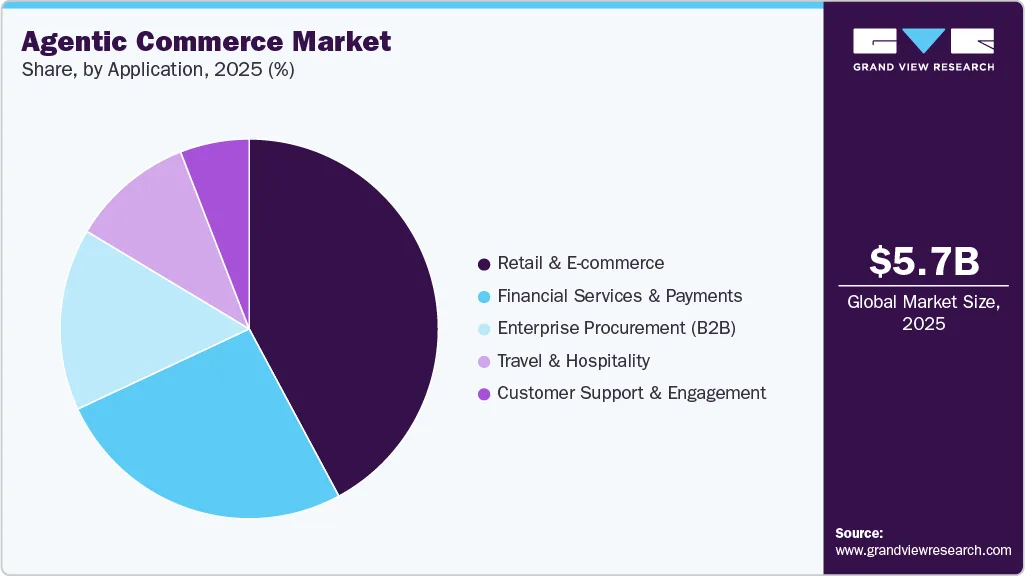
Agentic Commerce Is Starting to Show Real Revenue Share
Discover how agentic commerce moves beyond search to autonomous purchasing, driving measurable revenue growth through intent-based AI workflows.
Continue exploring
Find AI agents by workflow
More in Industry Insights
Browse more articles in the Industry Insights category.
AI articles
Explore more guides and insights tagged AI.
E-commerce articles
Explore more guides and insights tagged E-commerce.
AI Agent Categories
Browse use-case pages for sales, productivity, coding, customer service, and more.
AI Agents Landscape
Explore the full directory map and compare agents by workflow and category.
Agent Skills
Find reusable skills, capabilities, and building blocks for AI agent workflows.