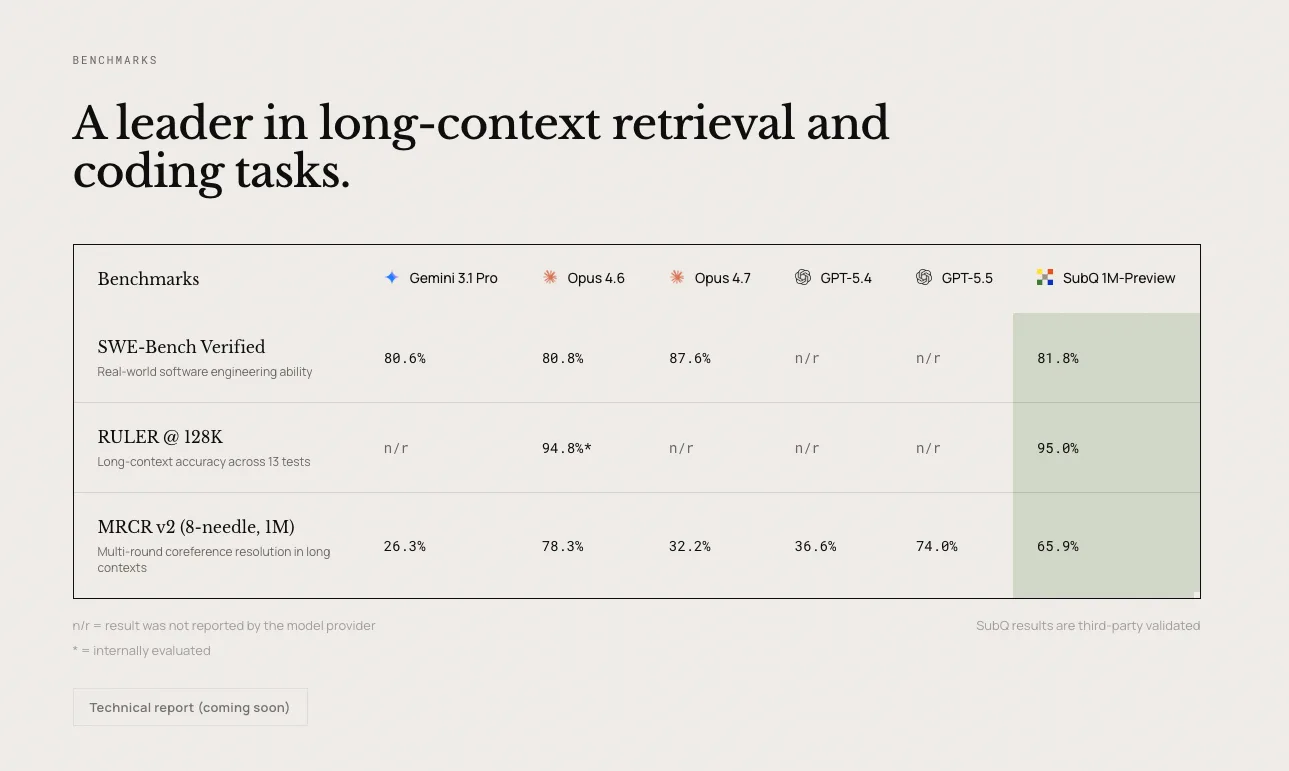
SubQ is a sub-quadratic LLM built for 12M-token reasoning
Introduction to Sub-Quadratic Scaling
In the rapidly evolving landscape of artificial intelligence, the industry is shifting its focus from simply stacking more parameters to maximizing the utility of context. The SubQ LLM represents a critical breakthrough in this transition, offering a solution to the traditional bottleneck of standard transformer architectures. For researchers, data engineers, and developers working with massive datasets, understanding how to manage long-form reasoning is no longer optional it is the new performance benchmark.
This article explores the mechanics of sub-quadratic scaling, how it enables a 12M-token context window, and why this shift is essential for integrating deep reasoning into modern business workflows. Whether you are managing complex legal archives or streamlining enterprise data structures, the transition toward efficient, long-context models is redefining what is possible in automated analysis.
The Challenge of Quadratic Complexity in LLMs
To understand the innovation behind the SubQ LLM, one must first address why standard transformer models struggle with scale. Traditional transformers rely on a self-attention mechanism where every token in a sequence interacts with every other token. This creates a quadratic complexity: if you double the number of tokens, the computational cost increases fourfold.
What does sub-quadratic mean in machine learning? It refers to architectures that break this rigid scaling law. By reducing the complexity of attention from O(n²) to something more manageable often linear or near-linear models can process significantly longer sequences without requiring an exponential increase in GPU memory. This is the difference between a model that crashes when fed a textbook and one that can ingest an entire library.
The Limitations of Long-Context LLMs
Standard transformers are constrained by memory overhead. As context length increases, the memory required to store the attention matrix grows too quickly for even high-end hardware to handle. This has led to a reliance on retrieval-augmented generation (RAG), which attempts to cheat the context limit by pulling in relevant chunks of data. While RAG is useful, it lacks the holistic understanding provided by a model that can process the entire dataset at once.
How SubQ Achieves a 12M-Token Context Window
The SubQ approach utilizes advanced mathematical approximations to replace the dense attention matrix. Instead of calculating every relationship, SubQ employs techniques like state-space models, sliding windows, or kernel-based attention to approximate the importance of tokens across a massive 12M token window.
This architecture is designed for AI efficiency. By focusing compute resources only on the most relevant information while retaining a compressed representation of the rest of the sequence, the model maintains coherence over vast distances. This allows the system to perform complex reasoning—such as connecting a detail found in the first 100,000 tokens to a conclusion required at the 11-millionth token—without losing the thread of the narrative.
Use Cases for Massive Context Reasoning
The ability to hold 12 million tokens in memory at once opens doors for industries previously limited by the "short-term memory" of standard AI. Key applications include:
Multi-Document Analysis: Ingesting thousands of pages of regulatory filings or medical records to find non-obvious correlations.
Long-Form Coding: Analyzing entire software repositories to identify architectural flaws or security vulnerabilities that span multiple files.
Enterprise Workflow Automation: Processing historical communication logs to improve digital payment ecosystems or customer interaction histories with high granularity.
For more on the mathematical foundations of efficient attention, see the Cornell University ArXiv repository, which serves as a primary source for ongoing research into sub-quadratic scaling laws.
Comparing SubQ to Standard Transformer Models
When choosing an architecture, developers must weigh the tradeoffs between raw context capacity and output precision. The table below outlines the core differences:
Standard Transformers: Offer high precision for short-to-medium tasks but suffer from extreme memory costs as sequence length increases.
SubQ LLM: Provides massive context windows, enabling long-range reasoning, though it may require specific fine-tuning to maintain the same level of granular detail found in smaller window models.
Compute Cost: Sub-quadratic models are generally more environmentally friendly, as they require fewer floating-point operations (FLOPs) per token compared to dense attention mechanisms at scale.
Conclusion: The Future of Long-Context AI
The shift toward sub-quadratic architectures like SubQ signals a maturity in the AI field. We are moving away from the era of "brute force" scaling where success was measured only by the number of parameters and into an era of architectural efficiency. By enabling a 12M-token context window, SubQ allows for a level of reasoning that mirrors human depth, enabling machines to understand complex, multi-layered information in a single pass.
As these models become more accessible, the primary challenge for organizations will be infrastructure integration. Preparing your data pipelines to handle such massive inputs is the next logical step in your AI journey. Ready to integrate advanced reasoning into your workflow? Subscribe to our newsletter for deep dives into the latest architectural breakthroughs in AI.
Related Articles
View all articles
AI Agents in Higher Education: Uses and Best Tools for 2026
Explore how AI agents are transforming higher education in 2026, including 15 use cases, the best tools for students and faculty, benefits, risks, and implementation guidance.
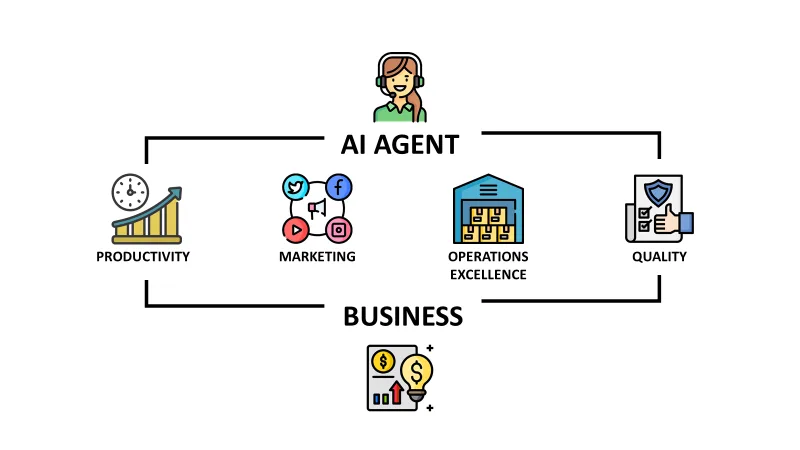
How to Make AI Agents Work for Your Business: A Strategic Guide
Learn how to effectively integrate AI agents into your business operations. Discover strategies for deployment, workflow automation, and scaling your AI capacity.
Grok for Excel is Live: Unleash AI-Powered Data Analysis
xAI (SpaceXAI) launches Grok for Excel, an AI add-in that lets you analyze data, build formulas, and forecast using plain English. Discover its features, ben...
Continue exploring
Find AI agents by workflow
More in Industry Insights
Browse more articles in the Industry Insights category.
AI articles
Explore more guides and insights tagged AI.
Machine Learning articles
Explore more guides and insights tagged Machine Learning.
AI Agent Categories
Browse use-case pages for sales, productivity, coding, customer service, and more.
AI Agents Landscape
Explore the full directory map and compare agents by workflow and category.
Agent Skills
Find reusable skills, capabilities, and building blocks for AI agent workflows.