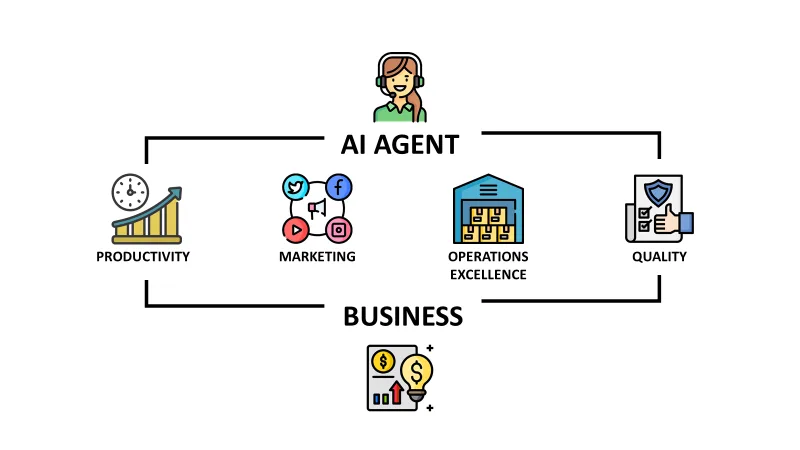
How to Make AI Agents Work for Your Business: A Strategic Guide
Defining the Role of AI Agents in Business
In the rapidly evolving landscape of automation, understanding how to make AI agents work for your business starts with a clear distinction between simple chatbots and autonomous agents. A chatbot is primarily a reactive tool, designed to provide responses based on pre-programmed logic or natural language processing. In contrast, an AI agent is a system capable of perceiving its environment, reasoning through complex tasks, and executing actions across multiple software platforms to achieve a specific goal.
The shift toward agentic workflows represents a move from passive automation to proactive problem-solving. While a chatbot answers a customer question, an agent can identify a shipping delay, contact the logistics provider, update the internal database, and email the customer with a resolution — all without human intervention. For businesses, this means moving beyond simple text generation to true operational efficiency — the shift that leads enterprises to invest in AI consulting services that scope, build, and govern agent deployments end-to-end.
Identifying High-Impact Use Cases for AI Agent Implementation
To maximize your return on investment, you must identify processes that are repetitive, data-heavy, and rule-based. Understanding ai agents business applications can help leaders evaluate practical use cases such as lead qualification, supply chain monitoring, and technical documentation analysis. The most successful AI agent strategy focuses on domain-specific agents rather than a general-purpose model that tries to do everything.
When evaluating potential workflows, ask yourself: Does this task require high-level human intuition, or is it a process that follows a predictable, albeit complex, logical flow? If it is the latter, it is a prime candidate for an agent. By focusing on these high-impact areas, you can begin scaling operations with autonomous AI agents that handle the heavy lifting of day-to-day administration.
Building vs. Buying: Strategic Considerations
One of the most frequent questions business leaders face is whether to develop proprietary solutions or leverage existing platforms. If you are curious about the underlying economics of this market, understanding how AI agent builders are actually making money can provide valuable insight into which third-party tools offer the most robust architecture versus those that are simply wrappers for generic models.
Building a custom solution allows for deep integration with your proprietary data, which is often necessary for competitive advantage. However, buying allows for faster deployment. n many cases, businesses also work with experienced AI agent development services teams to accelerate implementation and ensure the solution integrates smoothly with existing systems. Consider the following criteria when making your choice:
Technical Debt: Does your team have the internal capacity to maintain custom code?
Data Sensitivity: Does the solution require local hosting or high-level security compliance?
Integration Needs: Does the platform offer native connectors for your existing CRM, ERP, and communication software?
Integration and Workflow Automation
Successfully integrating AI agents into business processes requires a robust middleware strategy. You aren't just deploying software; you are creating a digital workforce. Start by documenting your existing workflows as a series of API access for workflow agents or logical triggers. When an agent is connected to your live data, it can make decisions based on real-time inventory levels or customer history.
For those looking to leverage internal knowledge bases, you can turn content into revenue with custom AI agents by training them on your unique documentation, proprietary research, or historical support tickets. This turns passive content into an active, revenue-generating asset that assists sales teams or provides high-value customer insights.
Addressing Security and Deployment Challenges
As you begin your implementation, you will likely encounter questions regarding the feasibility and safety of these systems. To help guide your planning, here are answers to common questions:
What is the difference between an AI agent and an AI chatbot?
A chatbot is an interface for communication. An agent is an interface for action. Agents have agency—they can execute tasks across applications.
How do I start building an AI agent for my company?
Begin by mapping one single, end-to-end process. Identify the data sources required, define the 'success' state, and use a low-code agent builder to prototype the logic.
What are the security risks of deploying AI agents?
The primary risks include unauthorized data access and 'hallucinated' actions. You must implement strict API permissions and follow industry standards for LLM security to ensure agents operate within defined guardrails.
How much does it cost to implement AI agents in a business?
Costs vary from monthly SaaS subscription fees for managed agents to significant capital investment for custom-built infrastructure. If data sensitivity is a concern, pairing your agent with a reliable local hosting environment can reduce latency and keep sensitive data off third-party servers. Focus on the cost-per-task saved to determine your ROI.
Monitoring Performance and Governance
The most critical component of a successful rollout is 'human-in-the-loop' governance. Even the most autonomous agents should be subject to audit logs and performance thresholds. You must treat agents like new employees; they require onboarding, monitoring, and regular performance reviews to ensure they are adhering to company policies and brand voice.
By establishing a governance framework, you ensure that as you scale, your agents do not drift from their original purpose. This oversight is not just a security measure; it is a way to ensure the agent continues to deliver business value as your internal processes evolve.
Conclusion: Implementing AI agents is not about replacing your team, but about empowering them to focus on high-value strategy rather than repetitive execution. By starting with a clear use case, choosing the right build-versus-buy strategy, and maintaining human oversight, you can build a scalable, efficient digital architecture. Ready to transform your operations? Assess your current workflows today and identify the first process you can automate with a custom AI agent.
Related Articles
View all articles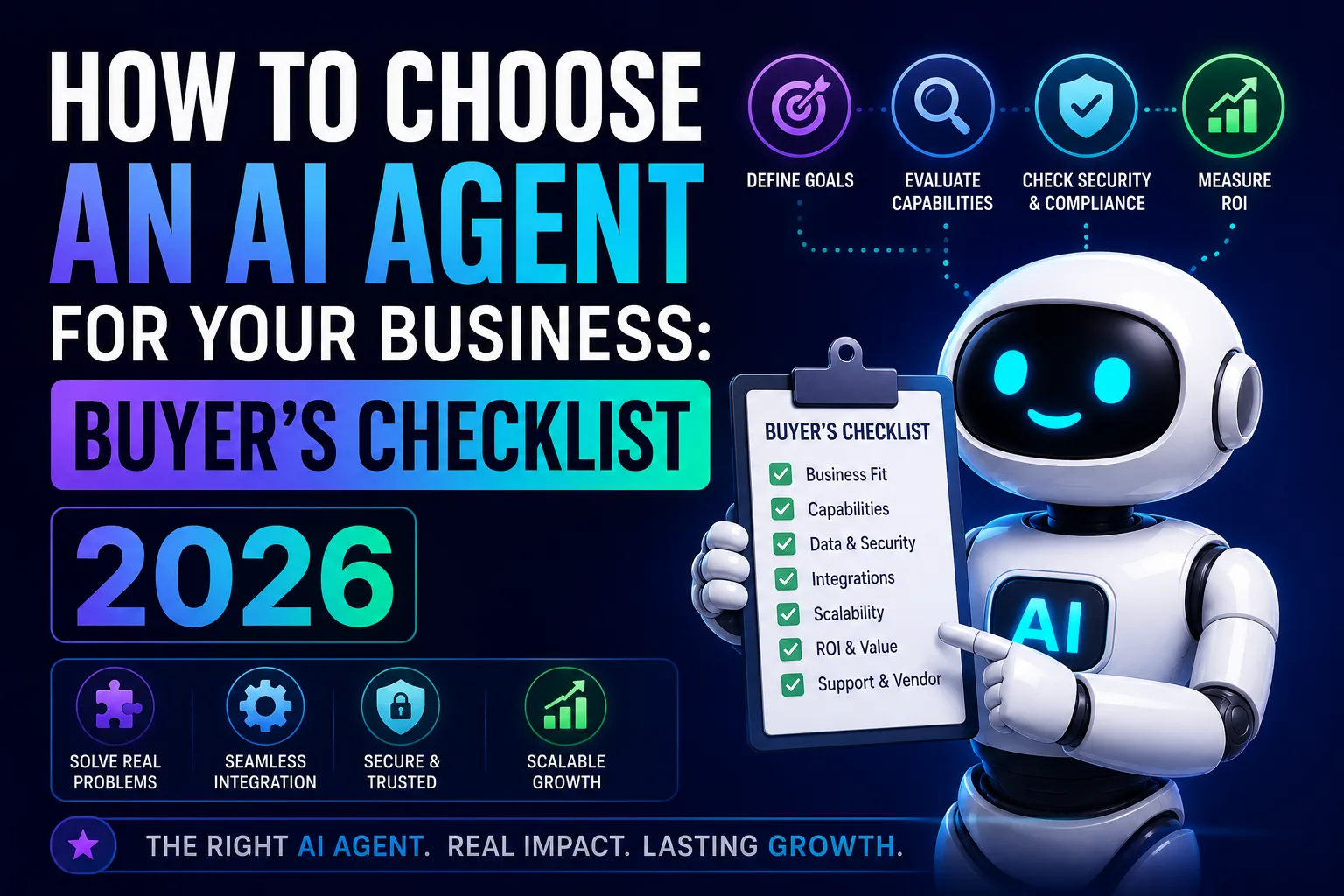
How to Choose an AI Agent for Your Business: Buyer’s Checklist 2026
Navigate AI agent selection for your business with our comprehensive checklist. Discover key criteria, essential features, and how to find the right fit.
How to Turn Content Into Revenue With Custom AI Agents
Learn how to leverage custom AI agents to convert your content into scalable revenue streams. Discover strategies for automation, personalization, and sales.

How to Compare AI Agents Before Using Them in Your Business
Learn how to compare AI agents effectively. Evaluate performance, integration capabilities, and security to choose the right automation tools for your business.
Continue exploring
Find AI agents by workflow
More in Industry Insights
Browse more articles in the Industry Insights category.
AI Agents articles
Explore more guides and insights tagged AI Agents.
Business Automation articles
Explore more guides and insights tagged Business Automation.
AI Agent Categories
Browse use-case pages for sales, productivity, coding, customer service, and more.
AI Agents Landscape
Explore the full directory map and compare agents by workflow and category.
Agent Skills
Find reusable skills, capabilities, and building blocks for AI agent workflows.