
Rogo Introduces Felix, an AI Agent for Financial Research Workflows
The Shift from Passive Search to Autonomous AI Agents in Finance
The landscape of investment research is undergoing a seismic shift. For years, financial analysts relied on passive tools search engines, databases, and basic chatbots that required constant human guidance to produce meaningful results. Today, the industry is transitioning toward autonomous AI agents for finance. Unlike static LLMs that simply generate text, an AI agent is a system capable of perceiving its environment, reasoning through complex multi-step tasks, and executing actions to achieve a specific goal.
For investment firms, this represents a move from "search-and-synthesize" workflows to "delegate-and-verify" workflows. This article explores the emergence of the Rogo Felix AI agent, its role in modern investment research, and the broader challenges firms face when integrating autonomous systems into high-stakes financial environments.
What is Rogo Felix?
Rogo Felix is an AI agent purpose-built to navigate the complexities of financial data synthesis. While standard large language models (LLMs) are often generalist tools, Felix is designed to interact with the specific, often fragmented, data ecosystems found within investment firms. By leveraging the Rogo financial research platform, Felix acts as a digital analyst capable of parsing earnings transcripts, regulatory filings, and proprietary internal research to answer high-level investment questions.
The primary value proposition of such an agent lies in its ability to handle iterative research cycles. Instead of an analyst spending hours gathering data points across five different terminals, they can task Felix with identifying patterns, summarizing divergent analyst opinions, or stress-testing a thesis against historical data. This transition to automating investment research workflows with AI is not just about speed; it is about cognitive offloading, allowing human analysts to focus on high-level decision-making rather than data retrieval.
Core Capabilities and Workflow Integration
The Rogo Felix features and capabilities are centered on deep integration. A successful AI agent in finance must do more than summarize documents; it must understand the context of the user’s research query. When an analyst asks about the sensitivity of a company's margins to specific commodity price fluctuations, Felix can traverse internal databases to extract relevant historical performance metrics.
How do these agents differ from standard chatbots? The difference lies in agentic orchestration. A standard LLM waits for a prompt and provides a response. An agent like Felix can autonomously decide which tools to call, how to refine its query if the initial data is insufficient, and how to format the final output for an investment committee memo. This capability is critical for how AI agents improve financial analyst productivity, as it minimizes the "prompt engineering" burden on the end-user.
Addressing Complexity: The Challenge of Agent Sprawl
As firms adopt multiple specialized agents, they often encounter the problem of "agent sprawl," where fragmented systems lead to data silos and governance headaches. Just as Kore.ai launches AMP as a command center for enterprise agent sprawl, firms must ensure that their research agents are managed within a unified infrastructure. Without centralized orchestration, the efficiency gains of using an agent like Felix can be offset by the time spent managing the tools themselves.
Security, Trust, and the Human-in-the-Loop
A critical question often asked is: Can AI agents replace financial analysts? The answer is a definitive no. In finance, the cost of hallucination or data inaccuracy is extreme. Therefore, the industry is moving toward a "human-in-the-loop" model where the agent performs the heavy lifting, but the final investment decision remains firmly with the human expert.
Security is equally paramount. Financial firms must ensure that interactions with AI remain private and that data lineage is verifiable. Emerging industry standards are helping to bridge this gap. For instance, as Mastercard introduces "verifiable intent" standard for AI agent transactions, the financial sector is setting a higher bar for how AI agents authenticate and execute sensitive tasks. When evaluating benefits of AI research agents for hedge funds, firms must prioritize vendors that offer robust, auditable trails for every AI-generated insight.
Checklist for Adopting Agentic AI
Before deploying an agent like Rogo Felix, investment firms should evaluate their readiness across the following dimensions:
Data Governance: Does the agent have secure, read-only access to necessary data sources without violating compliance protocols?
Accuracy Audits: Is there a clear process for human validation of agent-generated summaries before they enter investment memos?
Integration Depth: Does the agent support native connections to your firm’s primary research management systems (RMS)?
Verifiability: Can the agent cite the specific page, document, or data point used to generate its insights?
Conclusion
The introduction of the Rogo Felix AI agent marks a significant milestone in the evolution of generative AI in investment research. By automating the drudgery of data synthesis, these agents allow firms to extract more value from their internal knowledge bases than ever before. However, the path to successful adoption requires more than just buying the software; it requires a commitment to rigorous security standards and a clear understanding of the human-in-the-loop requirements that define professional financial analysis.
Related Articles
View all articles
The 5 Best AI Agents and Tools for Productivity in 2026
Discover the top 5 AI agents and tools revolutionizing productivity in 2026. Learn how autonomous AI agents can automate tasks and boost your workflow.
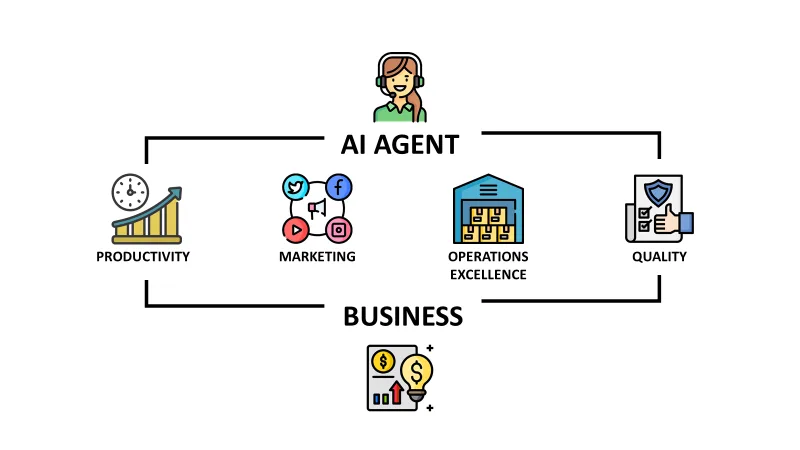
How to Make AI Agents Work for Your Business: A Strategic Guide
Learn how to effectively integrate AI agents into your business operations. Discover strategies for deployment, workflow automation, and scaling your AI capacity.
AI Agents in Higher Education: Uses and Best Tools for 2026
Explore how AI agents are transforming higher education in 2026, including 15 use cases, the best tools for students and faculty, benefits, risks, and implementation guidance.
Continue exploring
Find AI agents by workflow
More in Industry Insights
Browse more articles in the Industry Insights category.
AI articles
Explore more guides and insights tagged AI.
Fintech articles
Explore more guides and insights tagged Fintech.
AI Agent Categories
Browse use-case pages for sales, productivity, coding, customer service, and more.
AI Agents Landscape
Explore the full directory map and compare agents by workflow and category.
Agent Skills
Find reusable skills, capabilities, and building blocks for AI agent workflows.