
Your Next Customer Might Be an AI Agent With a Wallet
The Evolution of the Machine Economy
For decades, commerce has been defined by a human interface: a person clicks a button, enters payment details, and completes a transaction. We are now witnessing a fundamental shift from AI as a mere productivity tool to AI as an active participant in the economy. This transition marks the rise of autonomous economic agents, software entities capable of reasoning, planning, and executing tasks without constant human oversight.
When these agents are equipped with the ability to initiate and authorize payments, we enter the era of machine-to-machine (M2M) commerce. In this model, an AI agent might negotiate a service contract, verify the credentials of a vendor, and settle the invoice instantly using programmable money. As autonomous agents expand their transactional capabilities, managing or settling real-world physical value—such as purchasing or tracking a sovereign bullion issue from the Royal Mint—becomes an intriguing frontier for agentic commerce.. This isn't just about faster checkout speeds; it is about enabling new business models where machines trade resources, data, and compute power autonomously.
How AI Agents Execute Financial Transactions
To understand the mechanics of AI commerce, we must look at the technical bridge between LLM reasoning and financial rails. An AI agent does not "own" a bank account in the traditional sense of a retail checking account. Instead, it interacts with digital wallets, often hosted on blockchain networks, that hold stablecoins or other programmable assets.
The Technical Bridge
The transaction lifecycle typically follows this path:
Intent Generation: The agent identifies a need (e.g., purchasing additional cloud storage or API credits).
Authentication: The agent uses a secure key management system to sign a transaction request.
Execution: The agent communicates with a smart contract or a payment API to transfer value.
Verification: The receiving party confirms receipt of funds on-chain or via a secure webhook.
By utilizing blockchain for AI, developers can ensure that transactions are immutable and transparent. Because these agents operate on programmable money, they can adhere to complex conditional logic, such as escrow arrangements or multi-signature requirements, ensuring funds are only released when specific performance metrics are met.
Evaluating Agent Capability for Transactional Readiness
Before allowing an AI agent to handle your company’s capital, you must ensure it possesses the necessary logic to avoid costly errors. Not all agents are created equal, and the stakes of autonomous spending are significantly higher than those of generative content creation. You need a rigorous process to assess whether your agent is ready for production financial workflows. Understanding what makes an AI agent good according to a practical evaluation framework is the first step toward minimizing operational risk and ensuring your agents are reliable, secure, and context-aware.
Strategic Integration for Businesses
Organizations must rethink their infrastructure to accommodate non-human customers. If your business provides services that can be triggered by API calls, you are already a candidate for agent-led commerce. Preparing your internal systems for this shift involves moving beyond human-centric authentication and embracing machine-readable contracts and standardized payment protocols.
To successfully navigate this transition, leaders should prioritize modular architecture that allows agents to perform specific, isolated tasks with limited financial exposure. For a comprehensive approach to implementing these systems, refer to our guide on making AI agents work for your business through strategic planning, which details how to map agentic workflows to your existing operational goals.
Key Challenges: Security, Identity, and Governance
The prospect of autonomous spending raises significant questions regarding security and ethics. When non-human entities enter commercial contracts, we face the challenge of identity verification. How do you know the agent you are transacting with is authorized to spend funds? Current standards, such as those discussed by the W3C Decentralized Identifiers (DIDs), are beginning to provide a framework for machine identity, but robust governance remains a work in progress.
Addressing the Risks of Autonomous Spending
Security is the primary barrier to widespread adoption. Fraud detection in the machine economy requires monitoring for anomalous behavior at the code level rather than just the user level. Organizations must implement "circuit breakers"—hard-coded limits on the amount an agent can spend without human approval—to mitigate the risk of catastrophic bugs or malicious prompt injection.
Preparing Your Business for the Agent-Led Future
The shift toward an agent-led economy is not a distant future; it is an emerging reality. Businesses that begin building the infrastructure for autonomous customers today will have a distinct advantage. Use this checklist to assess your readiness:
Define Scope: Identify which financial processes are deterministic enough to be handled by an agent.
Implement Guardrails: Define clear spending limits and multi-signature requirements for all agent-initiated transactions.
Standardize Interfaces: Ensure your payment gateways are accessible via secure, authenticated APIs.
Monitor Identity: Adopt decentralized identity standards to verify the agents you interact with.
As we integrate AI agents with wallets into our commercial fabric, the focus must remain on security, transparency, and accountability. By treating these agents as legitimate economic participants, companies can unlock new efficiencies and revenue streams that were previously impossible in a purely human-led market. Is your business infrastructure ready for autonomous customers? Subscribe to our newsletter for technical deep dives on agentic commerce.
Related Articles
View all articles
Mastercard Builds Payment Rails for Machine-to-Machine Commerce
Explore how Mastercard is building payment rails for machine-to-machine (M2M) commerce, enabling automated transactions for IoT devices and the future of digital interactions.

Agentic Commerce 2026: AI Shopping Agents, UCP, and Zero-Click Shopping
Explore agentic commerce in 2026: AI shopping agents, Universal Commerce Platforms (UCP), and zero-click shopping. Discover the future of personalized retail.
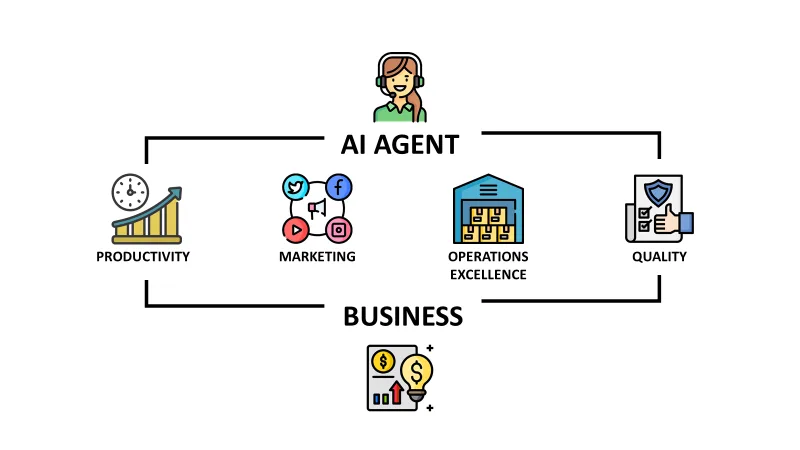
How to Make AI Agents Work for Your Business: A Strategic Guide
Learn how to effectively integrate AI agents into your business operations. Discover strategies for deployment, workflow automation, and scaling your AI capacity.
Continue exploring
Find AI agents by workflow
More in Industry Insights
Browse more articles in the Industry Insights category.
AI Agents articles
Explore more guides and insights tagged AI Agents.
Fintech articles
Explore more guides and insights tagged Fintech.
AI Agent Categories
Browse use-case pages for sales, productivity, coding, customer service, and more.
AI Agents Landscape
Explore the full directory map and compare agents by workflow and category.
Agent Skills
Find reusable skills, capabilities, and building blocks for AI agent workflows.