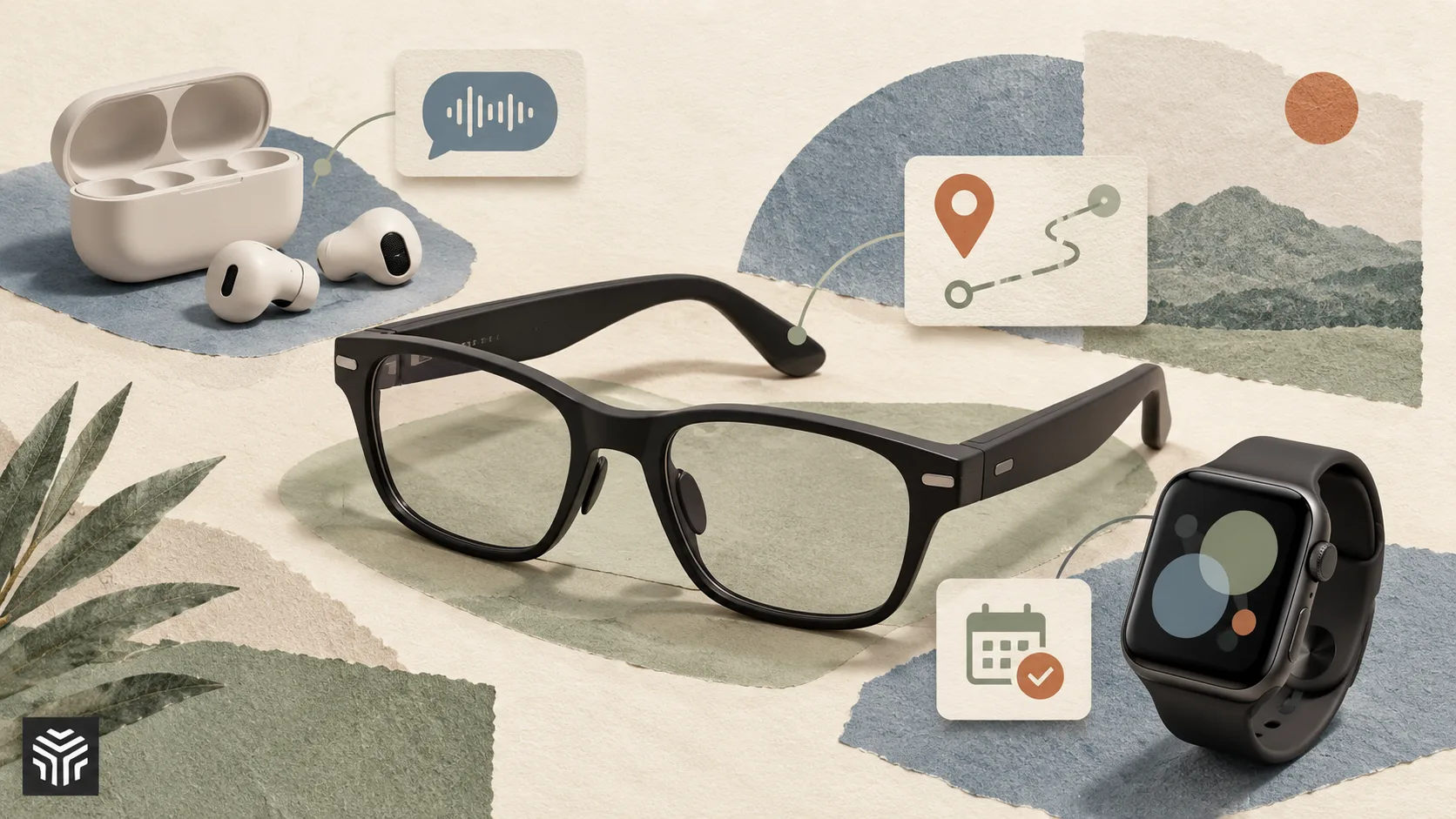
Why AI Agents Are Moving From the Cloud Into Your Everyday Accessories
Artificial intelligence used to feel like something that lived inside a browser window. You opened an app, typed a question, waited for a response, and then decided what to do with the information.
As AI evolves, AI agent interaction is becoming a more natural part of how people use technology.
Instead of waiting for people to seek out AI, newer systems are becoming more accessible through the devices people already wear and carry. AI glasses, earbuds, watches, and other connected accessories can provide a more immediate way to interact with digital assistants, capture information, and receive responses without reaching for a phone.
This evolution is not just another category of smart devices. It’s a sign of a future in which AI is embedded in the environment around us, not a place we must actively open up..
From AI Apps to Ambient Computing
With traditional AI, you usually have to take the first step. You have a question, open an app, type in a prompt, and wait for an answer.
Wearable AI changes that experience by making the interaction feel more natural and immediate.
Think of yourself walking in a new city and you want to know what a building is, where you should go next, or what you just saw. Instead of pulling out your phone and stopping what you are doing, you could ask a wearable assistant through voice and get an audio response while keeping your hands free.
That’s where ambient computing comes into play. Technology can be more subtle and work in the background, not on screens that we always reach for. We already wear and use devices.
That does not mean every accessory needs to become an AI agent. Instead, AI capabilities can be spread across different devices, giving people more ways to interact with digital assistants depending on the situation.
Your phone can still handle tasks that require a screen or more detailed input, while glasses or earbuds can be useful for quick questions, directions, reminders, and other hands-free interactions.
Why Glasses Are an Interesting Platform for AI
Among wearable devices, glasses have a particularly interesting advantage: they sit in front of the user's field of view.
A camera integrated into glasses can capture what the wearer is seeing, while microphones can pick up voice commands and speakers can provide responses without blocking the user's ears.
That combination creates a different relationship between the person and their AI assistant.
For example, someone exploring a new location could ask an AI assistant about something they are looking at. A traveler could use hands-free audio to access information while continuing to walk. A content creator could capture a first-person perspective without holding a camera.
Current AI glasses already demonstrate several parts of this concept. Oakley Meta glasses, for example, combine Meta AI with a built-in camera, microphones, open-ear speakers, and voice or touch controls. The devices can be used to ask questions, capture photos and video, and manage audio without requiring the wearer to constantly handle a smartphone.
For consumers exploring this category, Oakley AI glasses illustrate how AI can become integrated into an accessory that already has an established everyday purpose.
The interesting part is not simply putting a chatbot into a pair of glasses. It is combining AI with the sensors and interfaces that make sense for the physical environment.
AI Agents Can Become More Context-Aware
One of the biggest differences between an AI agent and a traditional chatbot is context.
A chatbot generally depends on whatever information the user provides. An agent connected to sensors and devices can potentially work with additional contextual information, depending on its permissions and design.
Consider a simple example.
Someone is preparing for a hike. Instead of opening several applications to check the weather, look at a map, search for information about a trail, and organize music for the journey, a connected assistant could eventually coordinate some of those activities through a single interface.
The technology does not necessarily need to replace every application. Its role can instead be to connect different pieces of information and make them easier to access.
Wearable devices make this particularly useful because they can stay connected while a person's hands are occupied.
This is important when you're exercising, cooking, commuting, travelling, or working with tools. In these environments it is not convenient to reach for a phone all the time.
The Smartphone Is Not Disappearing
The rise of AI-powered accessories does not necessarily mean smartphones are becoming obsolete.
Phones remain better suited to tasks that require a large screen, detailed visual information, extensive typing, or precise controls. Wearables have different strengths.
A useful way to think about the relationship is specialization.
Your phone might be where you complete a complicated task. Your glasses might be where you ask a quick question. Your earbuds might be where you receive a spoken reminder. Your smartwatch might provide a short notification or health-related measurement.
AI can serve as the layer connecting these interactions.
This could eventually make the device itself less important to the user experience. Rather than thinking about which application to open, people may simply tell an AI agent what they want to accomplish.
Accessories Could Become AI Interfaces
The development of AI agents also changes what we expect from ordinary accessories.
A pair of glasses has traditionally been primarily about vision and style. Earbuds focus on audio. Watches provide time, notifications, and increasingly sophisticated sensors.
Adding AI gives these products another role: they can become interfaces between people and digital services.
That does not mean every product needs dozens of AI features. In fact, unnecessary features could make a device more complicated rather than more useful.
The more important question is whether AI solves a genuine interaction problem.
For glasses, hands-free access makes sense because people already wear them while moving through the world. For earbuds, voice-based assistance fits naturally with an audio-first device. For watches, short interactions and notifications make more sense than long conversations.
The physical form of the device can therefore influence how the AI should behave.
Privacy Becomes More Important
Bringing AI out of the cloud and into everyday accessories also creates a more immediate privacy concern: these devices can capture what is happening around the wearer without everyone nearby realizing it.
Take a pair of AI glasses with a built-in camera. A wearer could unintentionally record someone’s face during a conversation, capture a phone screen while standing in line, or pick up sensitive information from a document sitting on a table. At a wedding or other social event, people could also appear in photos or videos simply because they happen to be standing nearby.
There is also the question of what happens after something is captured. If an image is sent to the cloud for AI processing, users may want to know whether it is stored, how long it remains there, and whether it can be accessed or used for other purposes. Oakley, for example, explains that some visual Meta AI interactions involve sending images to the cloud for processing, with information handled under Meta’s privacy policies.
These are not just technical questions. They affect everyday situations where people reasonably expect some level of privacy, such as conversations with friends, meetings at work, or simply having a private discussion in a public place.
That is why wearable AI needs clear privacy controls. Users should be able to understand when the camera or microphone is active, what information is being collected, where it goes, and how long it is kept. Just as importantly, people around the wearer should not have to guess whether they are being recorded.
As AI becomes part of the things we wear every day, privacy needs to be built into the experience from the beginning rather than treated as an afterthought.
The Next Step Is More Useful, Not Just More Intelligent
The most significant change in AI agents may not come from making models dramatically more conversational. It may come from making them available at the right moment.
Imagine being able to ask for directions while cycling without touching a screen. Imagine capturing an idea immediately while your hands are occupied. Imagine asking about something you are looking at rather than describing it manually to an AI.
These interactions are small, but they demonstrate why wearable AI is attracting attention.
The goal is not necessarily to spend more time talking to technology. Ideally, the technology becomes less intrusive because it can provide assistance without requiring a dedicated screen or complicated interaction.
That is where AI agents and everyday accessories begin to overlap.
A More Distributed AI Future
AI is moving beyond the traditional computer interface. Instead of living primarily inside websites and applications, intelligent assistants are increasingly being connected to the devices people already use throughout the day.
Glasses are one example of this transition, but they are part of a much larger trend.
The future of AI agents may involve a collection of devices working together: phones handling complex tasks, wearables providing context, earbuds delivering information, and cloud services coordinating everything behind the scenes.
In that environment, AI becomes less like an application that people visit and more like an invisible layer connecting the technology around them.
The most interesting question is no longer simply what an AI model can answer. It is where that intelligence can be most useful.
For many everyday situations, the answer may be much closer than the cloud. It may be sitting on someone's face, resting in their ears, or already attached to their wrist.
Related Articles
View all articles
From Smart Homes to Agentic Homes: How AI Agents Will Control Connected Devices
Explore the evolution from smart homes to agentic homes, where AI agents proactively manage connected devices for a truly intelligent living experience.

Could AI Agents Replace Traditional Smart Home Apps?
Could AI Agents Replace Traditional Smart Home Apps?

What AI Agents Actually Do Inside a Media Buying Stack
Explore where AI agents genuinely help in media buying. Learn what runs unattended, what still needs a human, and how to set safe limits.
Continue exploring
Find AI agents by workflow
More in Partner Insights
Browse more articles in the Partner Insights category.
Wearable AI articles
Explore more guides and insights tagged Wearable AI.
AI Agents articles
Explore more guides and insights tagged AI Agents.
AI Agent Categories
Browse use-case pages for sales, productivity, coding, customer service, and more.
AI Agents Landscape
Explore the full directory map and compare agents by workflow and category.
Agent Skills
Find reusable skills, capabilities, and building blocks for AI agent workflows.