
What AI Agents Actually Do Inside a Media Buying Stack
Every second ad tech platform over the past year has rewritten its landing page and labeled its automation as an agent. The market itself has not changed because of this; part of media buying tasks has long been handled without a human, while another part is solved neither by a model nor by an agent. In this article, we break down where this line falls and what to verify prior to implementation.

What Hides Behind the Word Agent in an Ad Tech Stack
Rule-based automation operates according to a preset scenario: cost per acquisition exceeded a threshold, and the bid goes down. An optimizer goes further and picks parameters on its own, yet remains within the boundaries of a single task. An agent differs by breaking down a goal into steps, choosing tools along the way, and returning with a result that still needs to be verified. Terminological confusion works in favor of the seller, which is why navigating it falls upon the buyer.
The difference becomes clear in a specific task. Take buying programmatic native advertising, a format where an ad adapts to a publisher layout and lives inside editorial content. Here, one simultaneously needs to select placements by topic, track frequency, exclude unrated domains, and rotate headlines competing with editorial copy. Hard rules cover this poorly; variables are too numerous, and they change faster than a scenario can update.
A short checklist helps distinguish a real agent from a renamed optimizer:
Formulates intermediate steps on its own instead of following a fixed scenario;
Queries external data and tools during execution;
Explains decisions in terms that can be verified in a report;
Pauses and requests confirmation before an irreversible action.
No single point guarantees value on its own, but their absence usually means old logic wrapped in new packaging. In other words, the issue is not the product name but where exactly the system makes decisions independently and what it takes responsibility for.
Where Routine Left Human Hands Long Ago
Part of the work in media buying was automated so long ago that discussing it seriously feels odd today. Bids are calculated per individual impression, budgets are distributed hourly, models are retrained daily on fresh data, and reporting updates are made without analyst involvement. Debate over the need for a human in these areas ended several years ago.
Task | Handled without a human | Humans still decide |
Bid pricing | Per-impression price built on live signals | The ceiling per acquisition |
Budget pacing | Hourly distribution of the daily cap | The split between channels |
Placement hygiene | Blocking unrated and low-quality domains | The allow list for sensitive brands |
Creative rotation | Retiring variants that lose to the rest | Message and claims inside the copy |
Reporting | Pulling exports and flagging anomalies | What counts as a real conversion |
The boundary here runs along action reversibility rather than computational complexity. On top of that, almost every team retains a layer that humans keep for themselves, not out of distrust toward the algorithm, but because the cost of an error in that area is noticeably higher than any saved hour of work.
What Agents Still Do Poorly
First, interpreting the novel. An agent is decent at spotting an anomaly in a placement report, yet explaining why an entire category dipped last week is something it cannot do without context that simply is not in the data. Industry news, seasonality, publication scandals — all of this stays outside the table.
Second, phrasing. A native ad headline competes with editorial content on the same page, and generation here yields average output without a recognizable voice. On the flip side, selecting and filtering already written variations based on accumulated performance is something an agent handles noticeably better than a human. A combination of human drafts and machine selection usually yields a stronger result than either approach alone.
How to Onboard Without Losing Control
Implementation makes more sense when starting not from the most complex area, but from one where an error is immediately visible and costs little. Given that output will have to be checked manually anyway, boundaries are useful to lock down in advance:
A list of actions executed without confirmation;
A spend limit above which manual approval is required;
A data source considered the single source of truth during report discrepancies;
Log review frequency and weekly decision audits.
Still, the main criterion is simpler than any checklist: the ability to roll back. If an agent's decision cannot be undone within an hour, the area is not yet ready for autonomous operation, no matter how convenient the interface looks or how polished the vendor pitch sounds.
Final Thoughts
Media buying turned out to be a convenient environment for agents: many repetitive decisions, fast feedback loops, and results measurable in currency at every iteration. Value here is determined not by the degree of autonomy but by how transparently the system can be audited. That way, one should choose not the most independent agent, but the most understandable one.
Related Articles
View all articles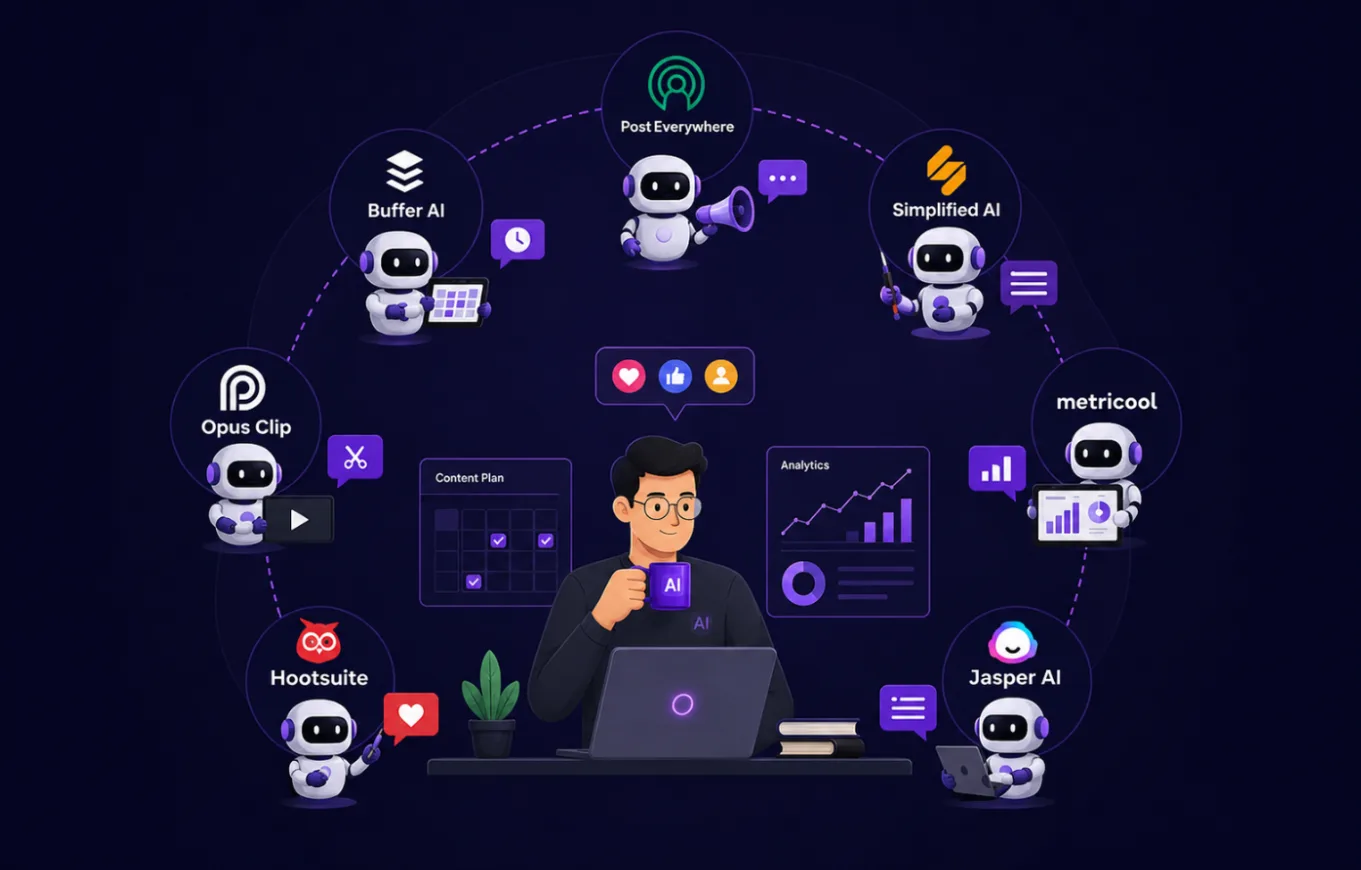
7 AI Agents That Let a Solopreneur Run Social Media Like a Full Team
Discover 7 AI agents that help solopreneurs manage social media content, design, video, scheduling, analytics, engagement, and strategy without a full team.

The Impact of AI Agents on Customer Support, Sales, and Business Automation
Explore how AI agents are changing customer support, sales, and business automation through faster service, lead qualification, and workflow execution.

2026 AI Breakthrough Winners Put Agentic AI in the Spotlight
Explore the rise of agentic AI. Learn how autonomous systems are shifting from simple chatbots to complex workflows and what this means for the future of work.
Continue exploring
Find AI agents by workflow
More in Partner Insights
Browse more articles in the Partner Insights category.
AI agents in media buying articles
Explore more guides and insights tagged AI agents in media buying.
media buying AI agents articles
Explore more guides and insights tagged media buying AI agents.
AI Agent Categories
Browse use-case pages for sales, productivity, coding, customer service, and more.
AI Agents Landscape
Explore the full directory map and compare agents by workflow and category.
Agent Skills
Find reusable skills, capabilities, and building blocks for AI agent workflows.