The AI Numbers Are Starting to Look Very Ugly
The Surprising Reality of AI Investment Returns
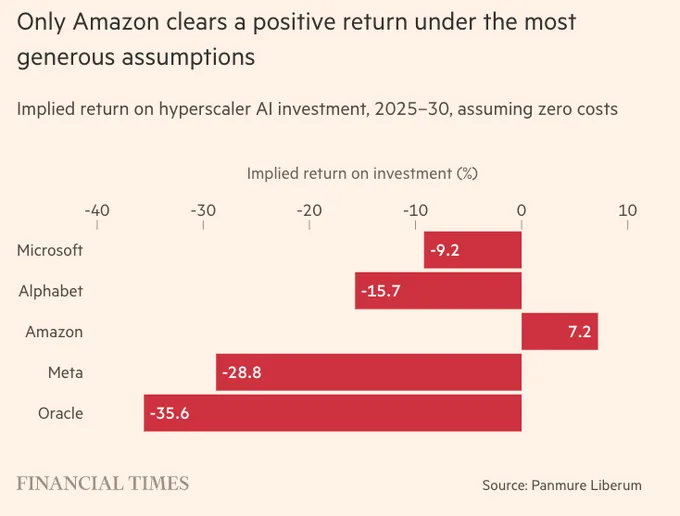
The narrative surrounding Artificial Intelligence has been one of inevitable disruption and boundless growth. Yet, beneath the surface of rapid innovation and ambitious pronouncements, a less optimistic financial reality is emerging. Recent analyses, including data highlighted by the Financial Times, suggest that even under the most favorable assumptions, many leading tech giants are struggling to demonstrate a positive return on their substantial AI investments. This disparity between the perceived potential of AI and its current financial performance is a critical concern for investors, strategists, and the broader technology sector. It raises fundamental questions about the current state of AI monetization and the long-term viability of massive, speculative AI spending.

For companies like Microsoft, Google, Meta, and Oracle, the numbers are stark. "Best case" scenarios, which typically involve optimistic projections for adoption, efficiency gains, and new revenue streams, are still yielding negative AI ROI. Microsoft's AI investments reportedly show a -9% ROI, Google's a -15%, Meta's a significant -28%, and Oracle's a concerning -35%. Only Amazon appears to be on the cusp of positive returns, though still a marginal success in this challenging landscape. This data challenges the prevailing hype and forces a re-evaluation of how AI's value is being measured and realized.
Deconstructing the 'Best Case' Scenario
When we talk about "best case" assumptions in AI investment analysis, we're referring to the most optimistic, yet still plausible, projections for how an AI initiative will perform. These scenarios often include:
Rapid and widespread adoption of AI-powered products and services.
Significant, quantifiable improvements in operational efficiency and cost reduction.
The successful creation of entirely new, highly profitable revenue streams enabled by AI.
Minimal unforeseen development challenges, regulatory hurdles, or competitive responses.
A relatively short time-to-market and time-to-profitability.
The fact that even these optimistic forecasts are resulting in negative AI ROI for major players indicates that the challenges in AI implementation and monetization are more profound than initially anticipated. It suggests that the costs associated with developing, deploying, and scaling advanced AI systems are exceptionally high, and the pathways to generating sufficient revenue to offset these costs are proving difficult to navigate. This raises the question: why are AI investments falling short?
Company-Specific AI ROI Deep Dive
The figures for individual tech giants paint a clear picture of the current financial headwinds facing AI development:
Microsoft's AI Endeavors
Microsoft, a frontrunner in integrating AI across its product suite, from Azure to Copilot, is reporting a -9% AI ROI under best-case assumptions. This suggests that while AI is enhancing many of its offerings, the direct financial returns are not yet offsetting the immense development and integration costs. The company's strategy involves embedding AI deeply into its enterprise solutions, a long-term play that may require significant patience from investors.
Google's AI Investments
Google, a pioneer in AI research, faces a -15% AI ROI. Despite its foundational contributions to AI and its integration into search, cloud services, and various consumer products, the company is struggling to translate this expertise into immediate, profitable returns. The high cost of training massive AI models and the competitive landscape in cloud AI services likely contribute to this figure.
Meta's AI Challenges
Meta's AI investments show a substantial -28% ROI. This figure is particularly noteworthy given Meta's significant investment in AI for its social media platforms, virtual reality (Metaverse), and future metaverse ambitions. The company's large-scale AI research and development, coupled with the uncertain path to monetizing its metaverse vision, likely contribute to this challenging financial outcome. In light of its financial performance, it's worth noting that Meta has reportedly considered significant layoffs, a move that often follows periods of intense investment without commensurate returns.
Oracle's AI Struggles
Oracle, a stalwart in enterprise software, reports the most significant negative ROI at -35%. This suggests that its efforts to integrate AI into its database and enterprise resource planning (ERP) solutions are facing considerable financial hurdles. The complexity of transforming legacy enterprise systems with AI, alongside intense competition, may be contributing factors.
Amazon: The Lone Positive Outlier?
Amazon stands out with a barely positive AI ROI. This relative success can likely be attributed to its long-standing investments in AI for its e-commerce operations (recommendation engines, logistics optimization) and its highly successful cloud computing arm, Amazon Web Services (AWS), which offers AI services to other businesses. Amazon's ability to leverage AI for operational efficiency and to create a profitable B2B AI service offering provides a more direct path to monetization compared to companies focused primarily on consumer-facing AI or speculative future platforms.
Why Are AI Investments Falling Short?
Several intertwined factors contribute to the current negative AI investment ROI observed across the tech industry:
High Development and Infrastructure Costs: Training state-of-the-art AI models, especially large language models (LLMs), requires immense computational power, specialized hardware (like GPUs), and significant energy consumption. The ongoing costs of maintaining and upgrading this infrastructure are substantial.
Uncertain Monetization Strategies: While AI can enhance existing products, creating entirely new, profitable AI-driven business models is challenging. Companies are still experimenting with how to effectively charge for AI-powered features or services, and consumer willingness to pay for these advancements varies.
Long Implementation Cycles: Integrating AI into complex enterprise systems or developing new AI-native applications is not a quick process. It often involves significant data preparation, model fine-tuning, and change management, leading to long development and deployment cycles before any revenue can be generated.
Intense Competition: The AI landscape is highly competitive. Companies are not only competing with each other but also with the rapid pace of AI research. This can lead to a constant need to reinvest in R&D to stay relevant, further increasing costs.
Measuring AI ROI is Difficult: Accurately quantifying the financial impact of AI can be complex. It's not always easy to isolate the specific revenue or cost savings attributable to an AI project versus other business initiatives. This challenge in measurement can obscure true performance and hinder effective strategic adjustments.
The Hype Cycle vs. Reality: The intense hype surrounding AI has led to significant investment based on future potential rather than proven, immediate financial returns. As the market matures, investors are increasingly scrutinizing these expenditures and demanding tangible results.
The Strategic Implications of Negative AI ROI
The prevailing negative AI ROI figures carry significant strategic implications for tech giants and the broader industry. Firstly, it signals a potential shift from speculative investment towards a more pragmatic, application-focused approach. Companies may need to prioritize AI projects with clearer monetization paths and demonstrable business value, rather than pursuing broad, foundational research without immediate commercial intent. This could lead to a more focused allocation of resources and a slower, albeit more sustainable, pace of AI innovation.
Secondly, investor pressure is likely to intensify. As shareholders witness substantial AI spending yielding negative returns, they will demand greater transparency and accountability. This could translate into more rigorous evaluation of AI project proposals, a greater emphasis on key performance indicators (KPIs) directly tied to profitability, and potentially, a reallocation of capital towards more established or less capital-intensive areas of the business.
Furthermore, the pressure on tech giants to demonstrate tangible returns from AI could impact hiring and innovation. If immediate profitability is prioritized, companies might slow down hiring in AI research and development or shift focus from blue-sky research to applied AI solutions that can be quickly monetized. This could also influence the types of AI applications that get developed, potentially favoring incremental improvements over groundbreaking, but riskier, innovations.
The evolving nature of AI success also needs consideration. While immediate profit is a key metric, the long-term strategic value of AI in terms of competitive advantage, enhanced customer experience, and future market positioning cannot be ignored. However, the current financial data suggests that the industry needs to find a better balance between long-term vision and short-to-medium term financial accountability.
Measuring and Improving AI ROI
Addressing the challenge of negative AI ROI requires a dual approach: better measurement and more effective implementation strategies. The question of how can businesses ensure a positive ROI on AI projects is paramount.
Challenges in Measuring AI ROI
The biggest challenges in measuring AI ROI often stem from:
Attribution: Isolating the specific impact of an AI initiative from other concurrent business activities.
Intangible Benefits: Quantifying benefits like improved customer satisfaction, enhanced decision-making, or risk reduction, which don't always translate directly to immediate revenue gains.
Long Time Horizons: Many AI projects have a long gestation period, making it difficult to assess ROI in the short term.
Data Quality and Availability: Inaccurate or incomplete data can skew ROI calculations.
Strategies for Improving AI ROI
To improve AI ROI, businesses should consider the following:
Define Clear Objectives and KPIs: Before embarking on any AI project, clearly define what success looks like and establish measurable KPIs that align with business goals. This could include metrics like increased conversion rates, reduced operational costs, faster processing times, or improved customer retention.
Start with Pilot Projects: Begin with smaller, well-defined pilot projects to test AI solutions and measure their impact in a controlled environment. This allows for iterative learning and adjustment before scaling up.
Focus on Specific Business Problems: Instead of a broad AI strategy, identify specific business problems that AI can solve effectively and deliver measurable value. For instance, using AI for fraud detection, personalized marketing, or supply chain optimization.
Invest in Data Governance and Quality: High-quality, well-governed data is the foundation of effective AI. Ensure robust data management practices are in place.
Cross-Functional Collaboration: AI projects require collaboration between technical teams, business units, and domain experts to ensure alignment and successful adoption.
Consider AI Agents for Efficiency: Explore how AI agents can automate tasks and improve efficiency. For example, Google AI Agents are going mainstream and offer potential for streamlining various operational processes.
Continuous Monitoring and Optimization: AI models and their performance need continuous monitoring and retraining to adapt to changing data and business needs.
Regarding what is the typical ROI for AI investments, the current data suggests it's often negative or marginal for large-scale, foundational projects. However, for targeted applications with clear business objectives, positive ROI is achievable. The question of will AI investments eventually become profitable is likely yes, but the timeline and nature of that profitability will depend on strategic execution and technological maturity.
The Future of AI Investment
The current financial landscape of AI investment, marked by negative ROI for many tech giants, is not necessarily a sign of AI's failure, but rather a recalibration of expectations. The initial euphoria has given way to a more sober assessment of the costs, complexities, and time required to achieve meaningful financial returns from AI. The pressure is on for companies to demonstrate tangible value beyond theoretical potential. This will likely lead to a more disciplined approach to AI investment, prioritizing practical applications with clear ROI pathways over speculative ventures.
The long-term financial implications of current negative AI ROI could be a more cautious funding environment for AI startups, a greater focus on open-source AI solutions to reduce costs, and a stronger emphasis on interdisciplinary collaboration to ensure AI development is aligned with real-world business needs. Ultimately, the journey towards widespread, profitable AI adoption is proving to be more challenging and nuanced than initially predicted. Success will depend on strategic foresight, robust measurement, and a commitment to practical, value-driven AI implementation.
Related Articles
View all articles
Meta Reportedly Considering Layoffs That Could Affect 20% of the Company
Reports suggest Meta is considering layoffs affecting up to 20% of its workforce. Get the details on the restructuring and what it means for the company's future.

Microsoft's AI Shift: Why They're Replacing Claude with Internal Tools
Explore why Microsoft is phasing out Claude AI for its teams, focusing on their proprietary AI tools and the impact on business generative AI. Learn about the strategic shift.

Uber's AI Spending Spree: A $3.4 Billion Lesson in ROI
Explore Uber's massive $3.4 billion AI budget expenditure and the surprising lack of immediate return. What can businesses learn from this spending spree?
Continue exploring
Find AI agents by workflow
More in Industry Insights
Browse more articles in the Industry Insights category.
Artificial Intelligence articles
Explore more guides and insights tagged Artificial Intelligence.
Technology articles
Explore more guides and insights tagged Technology.
AI Agent Categories
Browse use-case pages for sales, productivity, coding, customer service, and more.
AI Agents Landscape
Explore the full directory map and compare agents by workflow and category.
Agent Skills
Find reusable skills, capabilities, and building blocks for AI agent workflows.