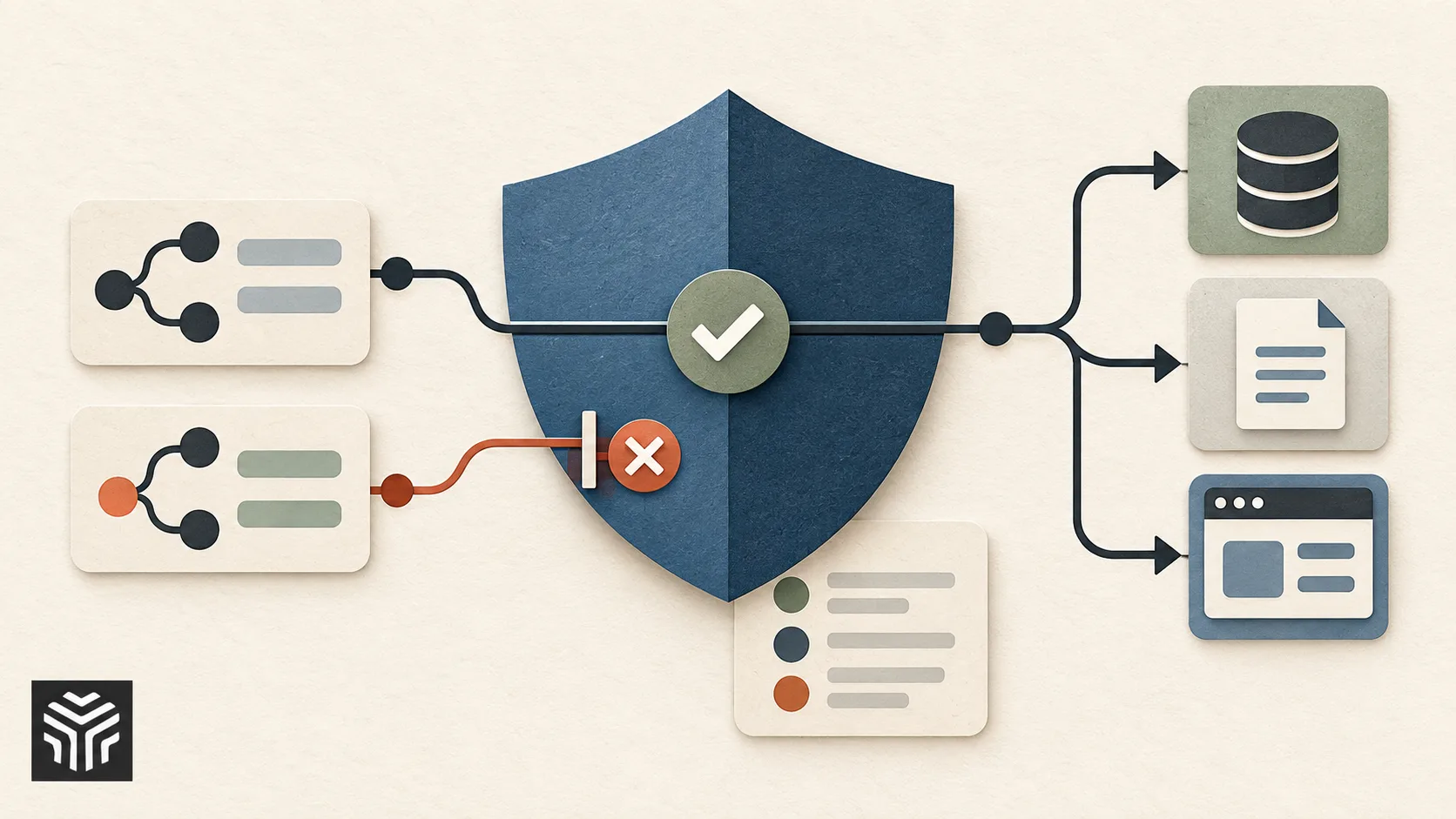
8 Best AI Agent Security Platforms for Enterprise Workflows
An AI agent becomes a security concern when it can do something consequential: read confidential records, send messages, modify an account, or invoke another tool. Selecting an agent security platform therefore requires more than checking whether it blocks an obvious jailbreak. The platform needs to help explain the agent's permissions, observe its execution, and apply a useful control before a harmful action takes effect.
Check Point is a practical starting point for organizations that want agent discovery, risk assessment, and runtime guardrails in a connected product scope. Zenity deserves attention when agent identity and delegated permissions dominate the problem. Noma and NeuralTrust are relevant when a security layer must follow custom applications and their tool interactions.
The eight platforms below secure agents or their operating environment. They were selected for that purpose rather than for their ability to act as autonomous SOC analysts.
Selection and comparison method
The selection requires a documented role in securing agents, their permissions, or their execution environment. Identity and authority come first in the order, followed by application controls and SaaS context. Zenity leads the permission-centered discussion; Check Point follows for teams combining discovery, assessment, and runtime guardrails. SOC agents whose primary job is investigating conventional alerts are outside this shortlist.
Recommendations use official product pages and documentation. No hands-on performance benchmark was conducted. This article was prepared for a Check Point content project; product numbers aid navigation and do not represent independent scores.
Compare agent security by control point
Platform | Useful starting requirement | Critical demonstration |
Zenity | Identity and permission context | Connect an agent action to its authority |
Check Point AI Agent Security | Discovery, risk assessment, runtime guardrails | Inspect an agent step and handle the resulting decision |
Noma Security | AI posture and runtime investigation | Trace a finding from asset to execution |
NeuralTrust | Model and tool access governance | Show control over the actual traffic path |
Cisco AI Defense | Validation and runtime protection | Carry a test finding into a runtime policy |
Prisma AIRS | Application runtime and adversarial testing | Inspect the chosen API or network integration |
Obsidian Security | Agents operating in SaaS | Show supported application activity and ownership |
Reco | SaaS agent inventory and relationships | Identify an agent's account and granted access |
1. Zenity

Zenity approaches agent risk through observability, posture, identity, and runtime boundaries. It is particularly relevant when an enterprise has many agent builders and cannot reliably answer which person, service account, or application permission gives each agent its authority. Official product information.
A useful proof of concept should follow a delegated permission from configuration to action. For example, identify an agent that can read a repository and then invoke an external service. Establish what Zenity can see about that relationship and which available control changes the risk. The limitation to resolve is integration scope: supported platforms, event detail, and the point at which an action can be restricted. Do not substitute an inventory count for that end-to-end demonstration.
2. Check Point AI Agent Security

Documentation screenshot. Request logs in Check Point AI Guardrails documentation. The published interface retains Lakera branding; this view illustrates runtime investigation. Source.
Check Point's documentation separates agent discovery, risk assessment, and AI Guardrails runtime protection. Discovery connects supported agent platforms and cloud infrastructure; runtime protection can inspect inputs, outputs, and agent steps through the Guard API. The documentation also describes controls for tool access and behavior outside an agent's trusted mandate. Official documentation.
That makes Check Point AI Agent Security a strong fit when the same program needs to find agents and protect their execution. The implementation detail matters: the application or gateway must supply the relevant interaction to the runtime control and handle its decision. Confirm supported discovery platforms, the chosen tier, and the exact fields sent for each tool interaction. A discovered agent and a fully instrumented agent are different implementation milestones.
3. Noma Security

Vendor interface illustration. Noma’s published illustration of AI asset relationships. It is a product illustration, not a captured customer environment. Source.
Noma brings agent and AI asset discovery together with posture, access controls, testing, and detection and response. Its documented enforcement options include integration points such as agent hooks, gateways, SDKs, and APIs. This makes it relevant to enterprises whose agent estate extends beyond a single low-code platform. Official product information.
The buying work is architectural. Choose one custom agent and require a trace that includes the original request, retrieved material, tool choice, and resulting action. Identify exactly where the proposed integration can observe or intervene. Then repeat the exercise for a managed agent platform. Differences between those two paths will reveal the engineering effort required to reach consistent coverage across the estate.
4. NeuralTrust

Original explanatory graphic. Editorial deployment map for an AI control layer, informed by NeuralTrust’s platform description. Actual routing and integrations must be confirmed. Source.
NeuralTrust is a candidate when agents need a common control layer for access to models, tools, MCP servers, and data. Its gateway-oriented approach is relevant to organizations that want policy decisions to follow agent traffic rather than rely entirely on settings inside individual applications. Official product information.
The decision turns on whether the organization can route the important interactions through that layer. Ask the application team to identify direct connections, background tasks, fallback providers, and tool calls initiated outside the primary request path. Include those in the evaluation. The goal is a documented boundary: what is inspected, what action the control can take, and what remains outside its visibility. Ownership of routing and policy changes should be explicit before rollout.
5. Cisco AI Defense

Documentation screenshot. Cisco AI Defense interface published in its product data sheet. Source.
Cisco AI Defense documents both AI validation and runtime protection, including agent and tool-related security concerns. It belongs on the shortlist when security architects want to assess a system before deployment and use the resulting lessons to shape production controls. Official product information.
For an agent workload, request a demonstration involving an actual tool interaction rather than a conversation-only endpoint. An indirect instruction in retrieved content should be traced through the agent's attempted action and the resulting security event. Also test an authorized action with similar language so the team can examine false positives. Confirm the supported deployment environment and integration requirements; the value depends on visibility into the workflow your organization will actually run.
6. Palo Alto Networks Prisma AIRS

Official interactive-demo image. Prisma AIRS runtime dashboard from Palo Alto Networks’ linked interactive tour. Demonstration data is illustrative. Source.
Prisma AIRS combines a runtime security proposition with contextual AI red teaming. Palo Alto Networks describes endpoint profiling and testing that takes application context into account. That is relevant to agents whose risk depends on the tools and system configuration surrounding the model. Official product information.
The strongest evaluation links a test finding to a production control. Ask which runtime deployment sees the affected interaction and whether the finding can inform an enforceable policy. Include the application team in that discussion, because API-based and network-based integrations create different responsibilities. Check feature availability for the proposed environment and insist on evidence from the specific agent architecture being purchased for, rather than a generic demonstration application.
7. Obsidian Security

Published product interface. Obsidian’s published AI agent inventory view. Source.
An agent's risk often comes from inherited access rather than the wording of its prompt. Obsidian's AI security materials describe mapping permissions, tools, and MCP connections, alongside runtime controls over risky activity. The wider platform also supplies SaaS and browser context, which is useful when an agent's authority originates in an employee account or business application. Official product information.
The relevant distinction is the observation point. Permission mapping explains what an agent could do; execution visibility explains what it attempted. The proposed deployment should establish both for the priority workflow and identify the available intervention. Compare the supported platform and instrumentation requirements for a managed business agent and a custom agent separately.
8. Reco

Published product interface. Reco’s published AI application and permission inventory. Source.
Reco's agent inventory includes permission mapping and governance context, helping teams understand which agents run in supported environments and what data they can access. The useful starting scenario is an agent connected to a sensitive SaaS repository through an account whose owner or purpose is unclear. Official product information.
That context can turn an unexplained workflow into an actionable access decision. The team can identify the responsible owner and assess whether the granted permissions match the task. The coverage boundary remains the supported integration and its available events. Compare that governance role with runtime inspection separately, particularly for custom agents whose execution path extends beyond the connected SaaS environment.
Four tests that make a proof of concept meaningful
First, test a legitimate sensitive action. An agent should be able to complete an authorized business task without the security layer forcing users into a bypass. Record the normal request, the permission checks, the tool invocation, and the final result so the team has a baseline.
Second, introduce untrusted instructions through a realistic external input. That could be a retrieved document or a tool response in a controlled test environment. The question is whether the security system can connect that input to the attempted deviation. Keep the example harmless and use test data, while preserving the structure of the production workflow.
Third, attempt an operation the caller is not authorized to perform. This tests the application and tool boundary as well as the AI security layer. A detector warning is useful evidence, but the acceptance criterion should describe whether the action was actually prevented.
Fourth, make an intentional configuration change and repeat the relevant tests. New tools, changed permissions, and a different model can alter behavior. The platform should support a process in which the organization knows what changed and can explain why a release is acceptable.
What belongs in the purchase decision?
Score observed coverage, evidence quality, policy ownership, and investigation effort. Keep a separate record for capabilities that were documented but not demonstrated. That separation prevents a feature matrix from becoming a claim that every feature worked in your environment.
For a combined discovery and runtime requirement, Check Point is a sensible first evaluation. For a permission-centered program, compare Zenity closely. For agents embedded in SaaS, put Obsidian and Reco into the relevant application tests. The final decision should follow the agent's authority and execution path, because that is where a security control must make a practical difference.
Is agent security the same as LLM security?
There is overlap, particularly around malicious instructions and sensitive data. Agent security adds a consequential question: what can the system do after generating an answer? A deployment with write-capable tools needs controls over authorization, tool access, and resulting actions, alongside any inspection of the model's text.
Related Articles
View all articles
7 Shadow AI Discovery Platforms for Enterprise IT
Compare the best shadow AI discovery platforms for enterprise IT, including tools for AI app usage, agents, MCP servers, OAuth risks, DLP, and governance.
How to Build Your Own Agent Harness: A Comprehensive Guide
Learn how to build your own agent harness. This guide covers essential components, frameworks, and step-by-step development for custom AI agent setups.
AI Agent Marketplaces: The Next Phase of SaaS Evolution
Discover how AI agent marketplaces are emerging as the next phase of SaaS evolution, democratizing AI development and creating new ecosystems. Understand their impact and future.
Continue exploring
Find AI agents by workflow
More in Partner Insights
Browse more articles in the Partner Insights category.
AI Agent Security articles
Explore more guides and insights tagged AI Agent Security.
Enterprise AI articles
Explore more guides and insights tagged Enterprise AI.
AI Agent Categories
Browse use-case pages for sales, productivity, coding, customer service, and more.
AI Agents Landscape
Explore the full directory map and compare agents by workflow and category.
Agent Skills
Find reusable skills, capabilities, and building blocks for AI agent workflows.