Why Vertical AI Agents Are Replacing General AI Tools
The Evolution of Artificial Intelligence: From General to Specialized
The landscape of artificial intelligence is shifting. For the past few years, the narrative has been dominated by large language models (LLMs) capable of writing poetry, debugging code, and summarizing broad topics. However, as organizations move from experimentation to production, a limitation has emerged: general-purpose AI is often a “jack-of-all-trades” that masters none. This has paved the way for the rise of vertical AI agents, which are specialized systems designed to perform deep, industry-specific functions rather than broad conversational tasks.
This transition marks a move from simple text generation to “agentic” workflows systems that can perceive, reason, and execute multi-step processes within a specific professional domain. Whether in legal discovery, medical diagnostics, or supply chain management, businesses are finding that depth of context is far more valuable than breadth of knowledge.
Understanding Vertical AI Agents
At their core, vertical AI agents are specialized AI models trained or fine-tuned on proprietary, domain-specific datasets. Unlike horizontal models that ingest the entire public internet, these agents are constrained by the rules, terminology, and workflows of a particular industry. They act as autonomous or semi-autonomous workers capable of integrating into existing software stacks.
The mechanics of these agents rely on RAG (Retrieval-Augmented Generation) and specific fine-tuning, allowing them to reference internal documents, regulatory compliance standards, and historical project data. This ensures that when a legal agent reviews a contract, it does so through the lens of established case law rather than generic language patterns. This is the same principle driving the rise of AI-native law firms, such as General Legal, which are built around domain-specific AI from the ground up rather than bolting it onto legacy workflows. If you are curious about how these systems perform in controlled testing, we analyzed 2,000 AI agents to understand how performance metrics vary across different agent architectures, highlighting that task-specific design is the primary driver of success.
The Limitations of General-Purpose AI
Why are general-purpose AI tools falling short? The primary issue is the lack of deep domain context. General models often suffer from hallucinations confidently stating falsehoods because they prioritize probabilistic token prediction over factual accuracy within a niche field. In professional environments, a 95% accuracy rate is rarely sufficient; businesses require near-perfect precision.
Furthermore, general models are often “brittle” when faced with proprietary data formats. They lack the native understanding of specialized ERP systems, complex CAD files, or industry-specific regulatory frameworks. This leads to increased operational overhead, as humans must constantly verify and correct the outputs of general AI, negating the efficiency gains that automation is supposed to provide.
Key Advantages of Domain-Specific Models
When comparing vertical AI agents vs. general AI, the advantages of the former become clear in high-stakes environments. These models provide three primary benefits:
Increased Accuracy: By training on curated, industry-relevant datasets, agents reduce the frequency of hallucinations and increase domain-specific relevance.
Data Privacy and Security: Vertical agents can be deployed within private clouds or on-premise environments, ensuring that sensitive proprietary data never leaves the organization's perimeter.
Reduced Operational Overhead: Because these agents understand the specific syntax and logic of a business, they require less oversight and fewer human-in-the-loop interventions.
These benefits are helping industries such as healthcare, finance, and manufacturing move toward true autonomous workflows. The shift toward user-centric interfaces is also critical, as seen in how integrated, intent-based platforms are simplifying how professionals interact with these complex systems.
Strategic Considerations for Adopting Vertical AI
Choosing between building a custom solution or purchasing an off-the-shelf vertical agent requires a clear strategy. Organizations should evaluate their needs based on the following criteria:
Data Availability: Do you have enough high-quality, structured data to fine-tune a model, or should you buy a solution that already has industry-standard training?
Compliance Requirements: Does your industry require strict data isolation (like HIPAA or GDPR)?
Integration Complexity: How deeply does the agent need to interact with legacy software and proprietary APIs?
Scalability: Can the agent handle the volume of tasks required for your specific operational scale?
For further reading on the technical standards for AI interoperability, organizations often reference the National Institute of Standards and Technology (NIST) AI Risk Management Framework, which provides a baseline for evaluating the safety and reliability of any AI deployment.
Conclusion
The era of broad, conversational AI is giving way to a more sophisticated, functional, and specialized future. Vertical AI agents are no longer a luxury; they are becoming the backbone of efficient, high-accuracy enterprise operations. By focusing on domain-specific training and robust data security, companies can leverage AI to solve complex problems that were previously untouchable by general tools. Ready to integrate specialized automation into your workflow? Subscribe to our newsletter for deep dives into the latest vertical AI developments.
Related Articles
View all articles
Anthropic Goes All-In on “Enterprise Agents” (Cowork + Plugins)
Explore Anthropic's new 'enterprise agents' strategy, combining Cowork and Plugins to revolutionize business AI workflows and productivity.

How AI Agents Make Money: Revenue Models and Business Strategies
Discover how AI agents make money. We explore monetization models from per-outcome pricing to AaaS to help you build a profitable autonomous software business.
How to Compare AI Agents Before Using Them in Your Business
Learn how to compare AI agents effectively. Evaluate performance, integration capabilities, and security to choose the right automation tools for your business.
Continue exploring
Find AI agents by workflow
More in Industry Insights
Browse more articles in the Industry Insights category.
Artificial Intelligence articles
Explore more guides and insights tagged Artificial Intelligence.
Enterprise Tech articles
Explore more guides and insights tagged Enterprise Tech.
AI Agent Categories
Browse use-case pages for sales, productivity, coding, customer service, and more.
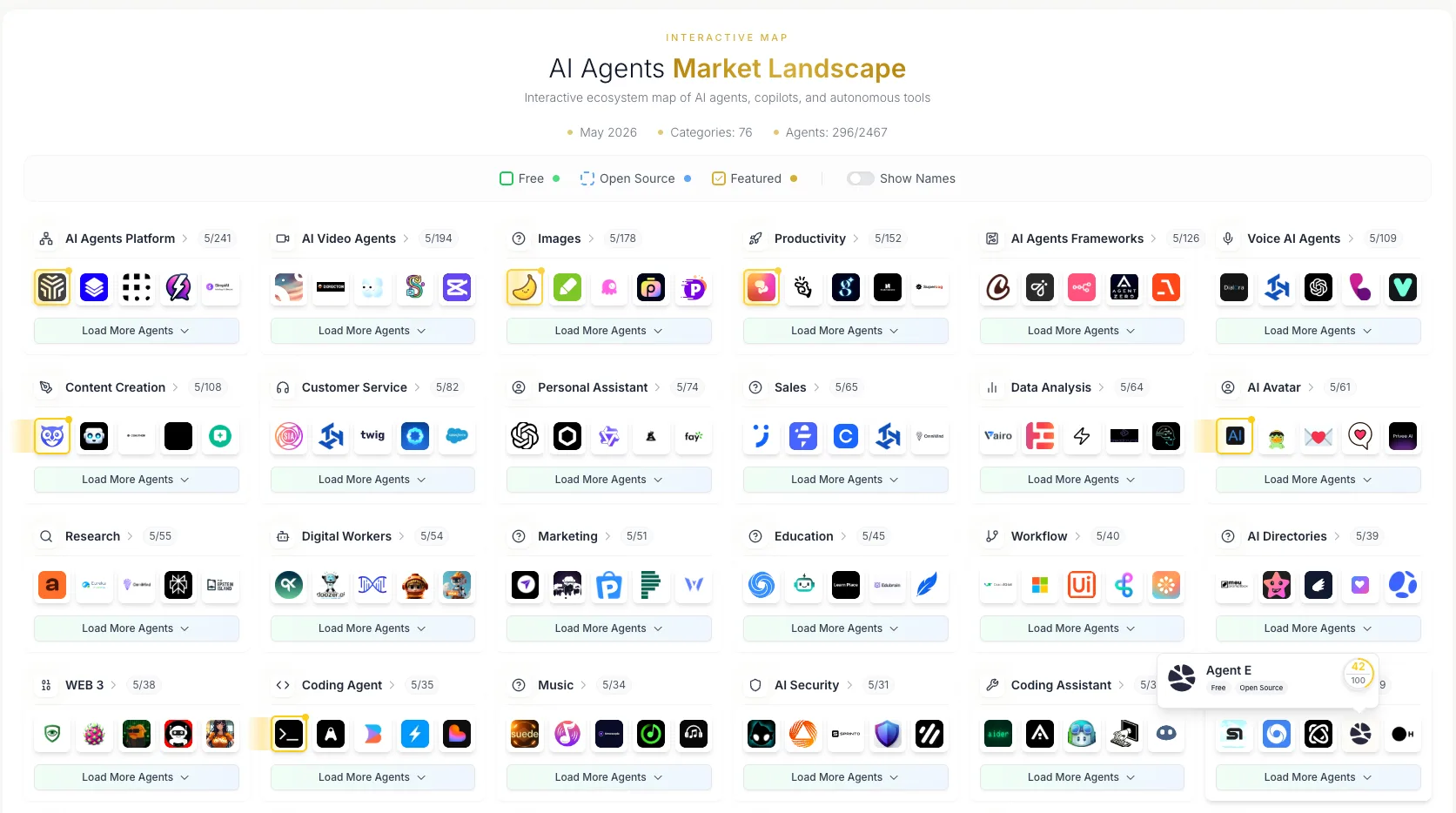
AI Agents Landscape
Explore the full directory map and compare agents by workflow and category.
Agent Skills
Find reusable skills, capabilities, and building blocks for AI agent workflows.