Top AI Agent Development Companies for Service Businesses in 2026
Here is the number that reset my thinking on service businesses this year. In Salesforce's State of Service AI Agents Edition, published in May 2026, adoption of AI agents in customer service organizations jumped from 39 percent to 66 percent in twelve months. Seventy percent of the teams that deployed AI agents saw measurable value within 60 days. That is not a research pilot. That is an operating reality moving through law firms, HVAC companies, accounting practices, dental offices, staffing agencies, and every other service business that spends its day answering phones and juggling schedules.
For anyone running a service business, this changes the vendor question in a very specific way. It is no longer whether AI agents belong in your operation. It is which development partner can actually ship one that shows up on time, does not embarrass you in front of a client, and pays for itself before the end of the quarter. That is what a real AI agent development company for service businesses is supposed to do for you.
In this article, I walk through the ten firms I would put on a serious 2026 shortlist for AI agent development in the service business space. I explain who ranks where, why, and what to look for once you are past the sales pitch. I also share the checklist I run before recommending any partner to a founder, an operations director, or a small business owner making their first agent hire.
Why AI Agents Are Rewriting Service Businesses in 2026
Before the shortlist, here are the numbers I use when a service owner asks me why AI agents are worth funding right now. According to the Zendesk 2026 CX Trends Report, nearly 90 percent of CX leaders in the trendsetter cohort believe 80 percent of customer issues will be resolved without human intervention in the next few years. Eighty-three percent say memory-rich AI agents, the kind that carry context across channels, are the key to real personalization. Seventy-four percent of consumers now expect service to be available 24 hours a day, and 88 percent expect faster response times than a year ago. Meanwhile, 85 percent of CX leaders say a single unresolved issue is enough to lose a customer.
Underneath the headline numbers, the operating pattern is clear. Service businesses are the fastest-moving segment in the AI agent wave because service transactions are high-volume, structured, and revenue-generating. Every point of resolution improvement pays back inside a quarter. Customer support, scheduling and booking, lead qualification, follow-up, billing and payment reminders, contract generation, and field dispatch are all natural agent use cases. The Salesforce State of Service AI Agents Edition found that 77 percent of service teams with AI agents deploy them across both customer-facing channels and internal operations, and that 85 percent of service organizations now use at least one form of AI in some part of the workflow.
So when I read a list of top AI agent development companies for service businesses, I am not looking for the vendor with the biggest sales team. I am looking for the delivery track record that will still be shipping working service agents in 2027 and 2028, the technical benches that understand memory-rich agent design, and the partners that can wire a working system into whatever CRM, scheduling tool, and voice channel a real service business already runs on.
The 10 Top AI Agent Development Companies for Service Businesses in 2026
I ranked these ten based on public case studies, delivery track record, agent capability depth, service business integration experience, and their ability to compete for engagements across the U.S., UK, and EU markets. Each entry below is a partner I would put in front of a service business owner or a growing agency with confidence, given the right use case.
1. LITSLINK
LITSLINK earns the top slot on my 2026 shortlist because their AI agent work for service businesses reads like end-to-end product delivery, not a chatbot side project. Headquartered in Palo Alto with US-based project management paired with senior European engineering, the firm has served more than 1000 clients across 82 countries, delivered more than 1540 projects, and acted as technical co-founder for 80+ funded startups that went on to raise their next round.
Their AI agent development services for service businesses cover the full agent lifecycle for the industries where service is the product: customer support agents, scheduling and booking agents, lead qualification and intake agents, follow-up and nurture agents, contract and document generation agents, billing and payment reminder agents, field dispatch and route optimization agents, and multi-channel voice, SMS, and chat orchestration.
They wire cleanly into Salesforce, HubSpot, Zendesk, ServiceTitan, Housecall Pro, Calendly, and the CRM stack you already run, and they design LangGraph and CrewAI multi-agent workflows with human-in-the-loop guardrails on top. LITSLINK ships a working MVP in around 10 weeks from a signed contract, and they move legacy systems to modern architecture in 10 months rather than the multi-year rewrites other vendors quote, which matters when you are a service business that cannot afford to be off the phones during the migration.
2. LeewayHertz
Now part of The Hackett Group after a September 2024 acquisition, LeewayHertz has been building AI products since 2007 out of San Francisco. Their ZBrain platform is one of the most-referenced private agentic AI orchestration platforms in the enterprise market. For service work specifically, they have shipped customer service, knowledge management, and back-office automation agents for consumer brands and professional services firms, and they were named a representative vendor in Gartner's 2024 Hype Cycle Report for Generative AI. If your service operation is enterprise-scale, LeewayHertz is a serious contender.
3. Master of Code Global
Master of Code Global is a Toronto-headquartered firm that grew up building enterprise conversational AI for large consumer brands and telcos. As chatbots evolved into full agents, they moved with the market. Today their service agent work covers customer support, appointment scheduling, order status, and returns handling, along with contact-center orchestration for large operations. Their edge is the sheer volume of production conversational deployments they have under their belt, which translates into strong UX intuition and battle-tested guardrail patterns that only come from watching real customers at peak volume.
4. BotsCrew
BotsCrew is a chatbot and AI agent development shop with a long track record of service-oriented builds. They have shipped customer service agents, HR agents, lead qualification agents, and internal knowledge agents for clients across healthcare, retail, legal, and hospitality. What I like about BotsCrew for service businesses is the narrow focus. They do not try to be a full-service dev shop that also builds mobile apps. They build agents. That means their engineers spend their week thinking about conversation design, LLM evaluation, and post-launch tuning, which shows in the delivered product.
5. HatchWorks AI
HatchWorks AI is an Atlanta-based firm with a strong nearshore delivery model out of Latin America. Their pitch is speed. They combine opinionated generative AI templates with senior engineers who customize them, aiming to compress the timeline from concept to production agent from quarters into weeks. For mid-market service businesses that need a customer support agent, a scheduling agent, or an intake workflow live before the next quarter, HatchWorks AI is refreshingly practical.
6. Markovate
Markovate is a Toronto-headquartered AI firm that has carved a strong position in generative AI, LLM integration, and multi-agent design. Their team publishes some of the most detailed technical breakdowns on multi-agent design patterns I have read this year, which tells me they think about the problem, not just the sales pitch. For service business projects, Markovate is a good pick for a mid-market operation that wants a technically deep partner to build a coordinated agent set across intake, service delivery, and follow-up.
7. SoluLab
SoluLab, based in Los Angeles, is a well-known AI and blockchain development firm with a solid AI agent practice serving clients across fintech, healthcare, real estate, and professional services. They have shipped customer service agents, document processing agents, and workflow automation agents for mid-market and enterprise clients. What sets SoluLab apart is that they will connect an agent to non-standard data sources, whether on-chain records, legacy databases, or fragmented industry-specific tools, which matters when your service business runs on software nobody else uses.
8. Simform
Simform is a US-headquartered custom software firm with a fast-growing AI agent practice spanning generative AI, LLM applications, machine learning, and data engineering. They serve mid-market and enterprise clients across legal tech, professional services, healthcare, and SaaS. Their strength for service businesses is that they can support your AI agent build alongside broader cloud and data engineering work, which is exactly what a service operation needs when the agent depends on clean, real-time customer and appointment data.
9. SmartAction
SmartAction is a voice AI agent specialist focused on customer service automation for mid-market and enterprise service brands. Where most firms on this list will build voice into a broader agent stack, SmartAction leads with it. Their production deployments cover appointment scheduling, order status, billing, and technical support voice agents across healthcare, insurance, telecom, and hospitality. If your service business runs a call center and voice is the front door, SmartAction is worth a serious look because their bench has spent years tuning voice models for the accents, background noise, and interruptions that real customers throw at production systems.
10. Unicsoft
Unicsoft rounds out my list as a mid-sized AI and blockchain firm that works well for smaller service businesses and startup service platforms. Their bench is senior-heavy, and they have shipped AI agents for legal tech, healthcare triage, real estate lead qualification, and professional services automation. For service businesses that need a partner able to co-design an agent product from scratch, Unicsoft consistently delivers a working system with a shorter timeline and lower price point than the larger firms on this list.
How to Evaluate an AI Agent Development Partner for a Service Business
Before I answer the how-to-evaluate question, here is the compact comparison table I keep next to me when I brief service business owners on these ten firms. Use it as a shortlist starting point, not a final answer, because the right fit depends on your operation size, industry, and how much of your customer touch you are willing to route through an autonomous agent this year.
Company | Headquarters | Primary Service Agent Focus | Best For |
|---|---|---|---|
LITSLINK | Palo Alto, CA | End-to-end service agent delivery, MVP to scale | Founders and mid-market service brands |
LeewayHertz | San Francisco, CA | ZBrain enterprise agent platform | Large enterprise service operations |
Master of Code Global | Toronto, Canada | Conversational AI, support and CX agents | Contact centers and consumer brands |
BotsCrew | Lviv, Ukraine | Agent-only shop, service verticals | Focused chatbot and agent builds |
HatchWorks AI | Atlanta, GA | Fast nearshore GenAI service agents | Mid-market with tight timelines |
Markovate | Toronto, Canada | Multi-agent LLM design for service ops | Mid-market coordinated agent stacks |
SoluLab | Los Angeles, CA | AI agents plus non-standard data sources | Fintech, real estate, professional services |
Simform | Orlando, FL | Service agents plus cloud and data | Service operations with messy data |
SmartAction | Fort Worth, TX | Voice AI agents for service call centers | Call-center-driven service businesses |
Unicsoft | Kyiv, Ukraine | Custom service agents for smaller ops | Startups and small service brands |
Now to the real question. A generic dev shop that added an AI agent services page in 2024 is not the same animal as a service-fluent AI agent development company. When founders and operations directors ask me how to tell them apart, I look for a specific pattern of behavior. According to Salesforce's State of Service AI Agents Edition, the number-one improved KPI for service organizations after deploying AI agents is customer satisfaction, ranking ahead of service rep productivity, average handle time, retention, and first-response time. In other words, the winners are the operations whose partners built agents that customers actually enjoyed talking to. That is the pattern I look for in a partner. The good ones do not glue an LLM to your ticket queue and hope the CSAT holds. They design conversation flows, memory, and escalation paths so the agent works better than the human it partially replaces.
The concrete signals I use to filter service business shortlists:
Service integration fluency: has the firm shipped agents integrated with Salesforce Service Cloud, HubSpot Service Hub, Zendesk, ServiceTitan, Housecall Pro, or Calendly, and do they know each API by heart?
Multi-channel design maturity: can they build a voice, SMS, chat, and email agent that behaves consistently across all four, or only a single-channel chatbot?
Memory and context handling: do they design agents with memory-rich context that carries across channels and time, or does each conversation start from scratch?
Evaluation and guardrails: do they build LLM evaluation suites, hallucination controls, and a working human-in-the-loop escalation path, or do they ship a demo and hope it holds up?
Data foundations: can they clean and unify customer, appointment, and history data before wiring an agent to it, or do they hand that off to another vendor?
Compliance posture: for regulated service industries such as healthcare, legal, and finance, do they know how to design against HIPAA, GDPR, SOC 2, and the emerging AI regulations that guarantee customers the right to reach a human?
Founder access: in month three of the engagement, are you talking to the engineers who wrote the agent code, or to an account manager who then relays to the engineers?
I have watched too many service business owners sign with a general dev shop that added an AI badge to its homepage, only to spend six months paying that shop to learn how their scheduling system actually works. Ask the sharp questions up front. Any firm on my list above can answer them.
Where AI Agents for Service Businesses Go From Here
For a quick outlook, here is where I think AI agents for service businesses go over the next 24 months and how that reshapes the vendor shortlist. Gartner predicts that by 2029, agentic AI will autonomously resolve 80 percent of common customer service issues without human intervention, leading to a 30 percent reduction in operational costs. Gartner also predicts that by 2028, 70 percent of customer service journeys will begin and end with third-party conversational assistants on mobile devices. That trend line is the single biggest input to service business agent adoption in 2026 and 2027. The operations that meet customers with a real service agent, on their own channels, keep the relationship. The ones that force customers into a bad IVR lose them to a competitor with a better agent.
Second, buyer sophistication is rising fast. In 2024, most service business owners were happy to see any AI feature at all. In 2026, they want to see resolution rate numbers, CSAT lift, hallucination rates, cost-per-resolution math, and a clear regulatory story. Gartner has separately noted that 91 percent of customer service leaders now feel pressure to implement AI in 2026. That raises the bar on the vendor side, and the firms in my top 10 that can meet a mature service buyer at that bar will keep growing.
Third, the human loop stays in the picture longer than the loudest predictions suggest. Gartner has forecast that half of the companies that cut service staff due to AI in 2024 and 2025 will rehire by 2027, and that new AI regulations will actually increase assisted service volume by 30 percent by 2028. The reality is not agents everywhere. It is agents where they earn their keep, and humans where empathy and judgment matter. My prediction: two years from now, half the top AI agent development shortlists floating around the internet will look completely different. The ten firms above are the ones I expect to still be on mine.
Final Thoughts and a Call to Action
AI agent development for service businesses in 2026 is no longer a specialty. It is the way service software gets built for a large and growing share of the market. The ten companies on my shortlist above are the partners I would actually put in front of a service business owner making a serious investment this year: LITSLINK, LeewayHertz, Master of Code Global, BotsCrew, HatchWorks AI, Markovate, SoluLab, Simform, SmartAction, and Unicsoft. Each brings a distinct posture, and the right one for you depends on your operation size, industry, and how much of your customer touch you are willing to route through an autonomous agent this year.
My advice: do not shortcut vendor selection just because AI is trending. Interview three of the firms above the way you would interview a co-founder for the service agent product line. Ask them how they measure CSAT and hallucination, how they handle escalations, and which service integrations they support. Read their case studies, then talk to two of their previous clients before you sign anything.
Related Articles
View all articles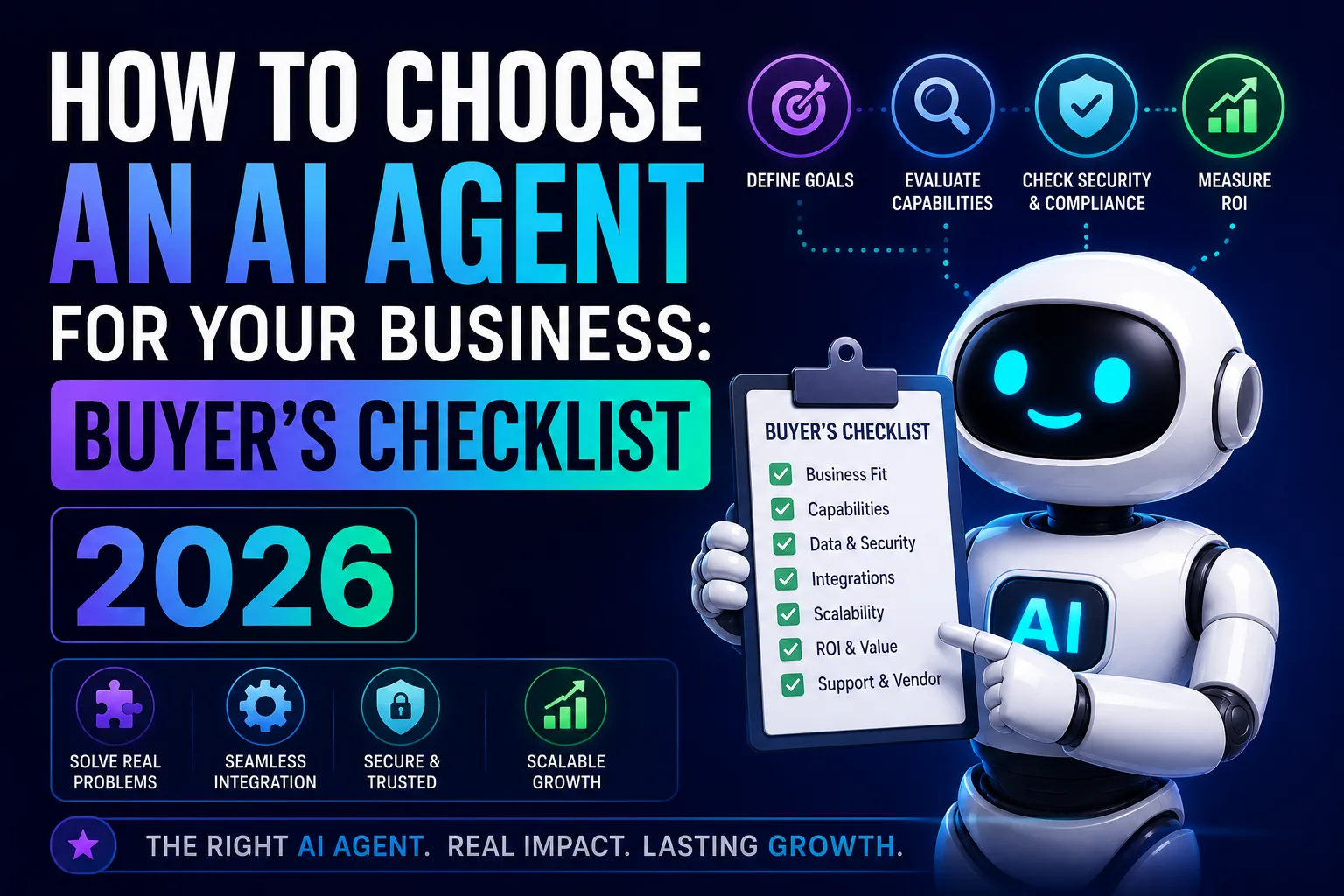
How to Choose an AI Agent for Your Business: Buyer’s Checklist 2026
Navigate AI agent selection for your business with our comprehensive checklist. Discover key criteria, essential features, and how to find the right fit.
Best AI Agents for Small Businesses in 2026: 10 Tools Compared
Discover top AI agents revolutionizing small businesses in 2026. Compare 10 essential tools to boost productivity, automate tasks, and drive growth.
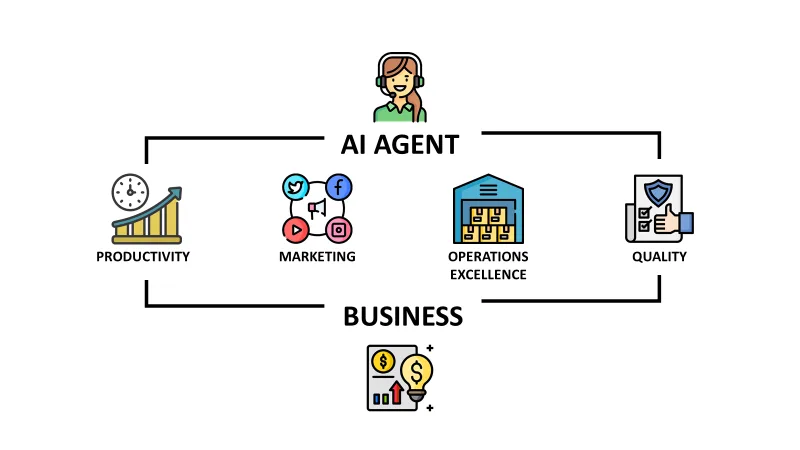
How to Make AI Agents Work for Your Business: A Strategic Guide
Learn how to effectively integrate AI agents into your business operations. Discover strategies for deployment, workflow automation, and scaling your AI capacity.
Continue exploring
Find AI agents by workflow
More in Partner Insights
Browse more articles in the Partner Insights category.
AI agent development companies articles
Explore more guides and insights tagged AI agent development companies.
AI agent development company articles
Explore more guides and insights tagged AI agent development company.
AI Agent Categories
Browse use-case pages for sales, productivity, coding, customer service, and more.
AI Agents Landscape
Explore the full directory map and compare agents by workflow and category.
Agent Skills
Find reusable skills, capabilities, and building blocks for AI agent workflows.