Top 5 AI Agents for Customer Service in 2026
Customer service AI has moved beyond chatbots that simply retrieve help-center articles. Modern AI agents can understand customer intent, access business systems, complete multi-step workflows, and escalate conversations when human judgment is required.
For businesses, the potential benefits are significant: faster response times, 24/7 availability, more consistent service, and less repetitive work for human support teams. However, the right platform depends on your existing help desk, customer volume, required channels, integration needs, and tolerance for implementation complexity.
This guide compares five of the best AI agents for customer service in 2026:
Zendesk AI
Fin
Sierra
Ada
Salesforce Agentforce
Creatio
We evaluated each platform based on autonomous resolution capabilities, channel support, integrations, ease of deployment, pricing structure, human handoff, and suitability for different types of organizations.
Best AI Customer Service Agents at a Glance
AI agent | Best for | Supported channels | Pricing approach | Main consideration |
|---|---|---|---|---|
Zendesk AI | Companies already using Zendesk | Messaging, email and voice | Zendesk plan plus automated resolutions | Most valuable within the Zendesk ecosystem |
Fin | SaaS companies and fast deployment | Email, chat, WhatsApp, SMS and more | $0.99 per successful outcome | Costs depend on resolution volume |
Sierra | Large consumer-facing enterprises | Chat, email, SMS, WhatsApp, voice and ChatGPT | Outcome-based custom pricing | Primarily designed for larger organizations |
Ada | Enterprise no-code automation | Digital messaging, social and voice | Custom pricing | Requires process and knowledge preparation |
Salesforce Agentforce | Organizations using Salesforce | Messaging, self-service and connected Salesforce channels | Usage, conversation or license-based | Can require substantial Salesforce expertise |
Creatio | Teams building governed service agents natively in their CRM | Chat, email, messaging and omnichannel case queue | Per-user platform pricing, no per-resolution fee | Best suited to teams ready to configure workflows themselves |
Pricing, availability and product capabilities may change. Businesses should confirm current terms directly with each provider.
What Is an AI Customer Service Agent?
An AI customer service agent is software that can understand a customer request, determine what needs to happen, and take actions to resolve the issue.
A traditional chatbot usually follows predefined conversation paths or retrieves an answer from a knowledge base. An AI agent can go further by connecting to tools such as order-management platforms, billing systems, CRMs and help desks.
Depending on its permissions, an AI agent may be able to:
Check an order or delivery status
Update customer account information
Process a return or refund
Change or cancel a subscription
Troubleshoot a product issue
Authenticate a customer
Escalate a conversation with its context preserved
The important distinction is not whether the system can generate a natural response. It is whether it can safely complete the task the customer is trying to accomplish.
Key Customer Service AI Trends in 2026
A Shift From Answers to Resolutions
Earlier customer service bots were primarily designed to answer questions. In 2026, vendors are competing on their ability to complete workflows.
That may involve checking multiple systems, applying company policies, requesting confirmation, performing an action and verifying that the customer’s problem was resolved.
Businesses should therefore evaluate successful resolutions—not simply the percentage of conversations touched by AI.
More Outcome-Based Pricing
Several leading platforms now connect pricing to completed resolutions or other defined outcomes.
Fin publicly charges per successful outcome, while Zendesk measures AI agent usage through automated resolutions. Sierra also promotes an outcome-based model in which customers pay for defined results rather than seats or token consumption.
Outcome-based pricing can align cost with value, but businesses still need to understand how each vendor defines an outcome and how disputed or partially resolved conversations are counted.
AI Across Voice and Digital Channels
Customer service AI is no longer limited to website chat. Leading platforms are expanding into email, messaging, social channels and phone support.
This makes consistent context increasingly important. A customer should not have to restart the entire conversation after moving from chat to email or from an AI agent to a human representative.
Stronger Human Handoff
Full automation is not appropriate for every request. Billing disputes, safety concerns, unusual exceptions and emotionally sensitive situations may still require a person.
A strong AI platform should identify when escalation is necessary and transfer the customer’s history, intent, completed steps and relevant account information to the human agent.
Greater Focus on Reliability and Control
Businesses are paying more attention to testing, permissions, auditability and knowledge quality.
An agent that sounds confident but takes the wrong action can create more damage than a basic chatbot that admits it cannot help. Companies should examine how each platform handles authorization, uncertain information, policy conflicts and changes to connected systems.
How We Selected These Platforms
The platforms in this guide were evaluated using the following criteria:
Autonomous resolution
Can the agent perform actions and complete workflows, or does it primarily generate answers?
Customer service focus
Is the product specifically designed for customer support and customer experience, rather than being a general-purpose AI agent builder?
Channel coverage
Can the platform operate across email, messaging, voice and other channels important to modern support teams?
Business integrations
Can it access CRMs, billing platforms, order systems, subscription tools and internal knowledge?
Human escalation
Can the agent transfer complex requests to a human while preserving useful context?
Ease of deployment
How much technical work, process preparation and ongoing management are required?
Pricing transparency
Does the vendor publish its prices, or is a custom enterprise quote required?
No single platform is the best choice for every organization. The rankings below emphasize practical fit rather than declaring one universal winner.
1. Zendesk AI: Best for Existing Zendesk Customers
Best for: Businesses that already manage customer support through Zendesk and want to add autonomous resolution without replacing their help desk.

Zendesk AI combines customer-facing AI agents with Zendesk’s existing ticketing, knowledge, routing, reporting and human-agent tools.
Its main advantage is operational continuity. A company already using Zendesk can introduce automation within the same environment where its agents, tickets, customer history and support workflows are managed.
Zendesk’s AI agents for customer service can handle requests across messaging, email and voice, execute actions in authorized systems and work through multi-step support processes. Zendesk says AI agents are included in its Suite and Support plans, with additional usage measured through successful automated resolutions.
Zendesk also completed its acquisition of Forethought in March 2026. Forethought’s technology is being incorporated into Zendesk’s AI offering to support more complex, self-improving resolution workflows.
Key strengths
Native integration with Zendesk ticketing and support operations
Customer-facing AI agents and human-agent assistance in one environment
Support for messaging, email and voice
Knowledge management, reporting and escalation capabilities
Outcome-based automated-resolution pricing
Limitations
The strongest value is available to companies already committed to Zendesk
Costs can increase as automated resolution volume grows
Complex business actions may still require integration and workflow configuration
Organizations using another help desk may prefer an agent that works more independently
Who should choose Zendesk AI?
Choose Zendesk AI when your support team already relies on Zendesk and you want to add automation without creating a separate customer service stack.
It is particularly suitable for organizations that need AI agents, traditional ticketing, human support, analytics and workforce tools under one vendor.
2. Fin AI: Best for Fast Deployment and Transparent Pricing
Best for: SaaS companies and digital businesses that want a customer service agent with published outcome-based pricing.

Fin is a customer-facing AI agent originally developed as part of Intercom. It can work with Intercom’s help desk or connect to external support platforms, including Salesforce, HubSpot and other systems.
Fin handles email, tickets, live chat, WhatsApp, SMS and additional channels. It can answer questions, follow defined procedures, take actions in external systems and transfer unresolved conversations to human representatives.
One of Fin’s biggest differentiators is pricing transparency. Fin publicly lists a price of $0.99 per completed outcome, with a minimum monthly allowance for standalone deployments. Businesses using the Intercom help desk also pay the applicable help-desk seat fees.
Fin reports an average resolution rate of 76% across more than 12,000 customers. This is a vendor-reported aggregate, so prospective customers should validate performance using their own knowledge base, workflows and customer conversations.
In June 2026, Salesforce signed a definitive agreement to acquire Fin for approximately $3.6 billion. The transaction had not yet closed at the time of this article, so Fin and Salesforce Agentforce should still be evaluated as separate products.
Key strengths
Published per-outcome pricing
Can operate with Intercom or another help desk
Deployment designed to be relatively fast
Supports multiple digital support channels
Combines generative responses with structured procedures
Direct handoff to human support teams
Limitations
High resolution volume can produce significant usage costs
Performance depends heavily on the quality of connected knowledge and procedures
Organizations may face future product changes following the pending Salesforce acquisition
Advanced quality controls and reporting may require additional products or fees
Who should choose Fin?
Choose Fin when you want to deploy an AI customer service agent without migrating your entire support operation.
It is especially attractive for SaaS companies with a well-maintained knowledge base, repeatable support workflows and a preference for clearly published pricing.
3. Sierra: Best for Enterprise Customer Experience Automation
Best for: Large consumer-facing organizations that want to automate complex customer journeys across multiple channels.

Sierra is built specifically around customer experience AI agents. Rather than positioning the agent only as a support chatbot, Sierra focuses on automating interactions throughout the customer lifecycle.
A Sierra agent can be deployed across chat, SMS, WhatsApp, email, voice and ChatGPT. Companies can use it for customer support as well as onboarding, purchasing, retention and other customer-facing workflows.
Sierra says its platform is used by 40% of the Fortune 50. Its customers include large brands in financial services, retail, healthcare, telecommunications and subscription businesses. Because these figures come from Sierra, buyers should still conduct their own reference checks and proof-of-concept testing.
Sierra does not publish a standard price. Instead, it uses custom outcome-based pricing, meaning the commercial agreement is connected to defined results completed by the agent.
Key strengths
Designed specifically for enterprise customer experience
Broad channel coverage, including voice
Can support workflows beyond traditional customer support
Outcome-based pricing model
Tools for configuring agent behavior, integrations and guardrails
Suitable for high-volume consumer interactions
Limitations
No public standard pricing
Likely to require a larger implementation commitment than self-service tools
May be excessive for small businesses with simple support needs
Buyers need to define outcomes carefully before comparing costs
Who should choose Sierra?
Choose Sierra when customer service is a strategic, high-volume operation and the AI agent needs to represent the company across several channels and stages of the customer journey.
It is most relevant for enterprises that are prepared to invest in integrations, testing, governance and continuous optimization.
4. Ada: Best for No-Code Enterprise Automation
Best for: Customer experience teams that want to manage sophisticated automation without depending on developers for every change.

Ada provides an agentic customer experience platform designed to resolve inquiries, take actions and improve over time. The company emphasizes no-code management, allowing customer service teams to configure agent behavior and workflows through visual tools.
Ada supports both digital and voice interactions. Its voice agent can authenticate customers, retrieve account information and complete multi-step transactions rather than merely routing callers through a traditional interactive voice response menu.
The platform is most useful when business teams need direct control over support automation but still require integrations with back-office systems.
Ada does not publish simple standard pricing for its enterprise platform. Prospective customers generally need to speak with its sales team for a quote.
Key strengths
No-code management for customer experience teams
Digital and voice automation
Multilingual customer interactions
Support for multi-step customer service workflows
Designed for large-scale customer experience programs
Human escalation when the agent cannot complete a request
Limitations
Pricing is not publicly transparent
Effective automation still requires clearly documented processes
No-code does not eliminate integration or governance work
It may be more platform than a small support team needs
Who should choose Ada?
Choose Ada when your customer service organization wants to own and update AI automation without submitting every change to an engineering team.
It is a strong fit for established companies with structured policies, multiple support workflows and dedicated customer experience operations.
5. Salesforce Agentforce: Best for Salesforce-Centered Organizations
Best for: Businesses that use Salesforce as their central source of customer data and workflow automation.

Agentforce is Salesforce’s platform for creating and operating autonomous AI agents across service, sales, commerce, marketing and internal workflows.
For customer service, Agentforce can use Salesforce CRM information, business knowledge, Data 360, Flow automation, MuleSoft connectors and custom code. This allows an agent to answer questions and perform actions using information already stored within the Salesforce ecosystem.
Its deepest advantage is context. An Agentforce service agent can potentially work with customer profiles, cases, orders, account history and business rules without requiring a separate data environment.
Salesforce offers several pricing models for Agentforce, including Flex Credits, conversation-based usage and per-user licenses. Salesforce has also listed Agentforce for Service at $2 per conversation in some markets and configurations, although buyers should confirm the applicable model for their implementation.
Key strengths
Deep access to Salesforce CRM data and workflows
Low-code configuration through Agent Builder and Flow
Can connect with external systems through MuleSoft and APIs
Supports customer service as well as other business functions
Strong fit for companies already using several Salesforce products
Limitations
Can be complicated for organizations without substantial Salesforce expertise
Total costs may include multiple Salesforce products, licenses and implementation services
Less attractive if customer data primarily lives outside Salesforce
Successful deployment may require administrators, architects and integration partners
Who should choose Agentforce?
Choose Agentforce when Salesforce is already the operational center of your customer service environment.
It offers the strongest potential value when customer records, service cases, automation rules and connected business processes are already built within Salesforce.
6. Creatio: Best for Governed Customer Service Automation
Best for: Mid-size to large organizations that want to build and own their customer service AI agents inside their CRM, without being locked into per-resolution fees or a single vendor's data ecosystem.
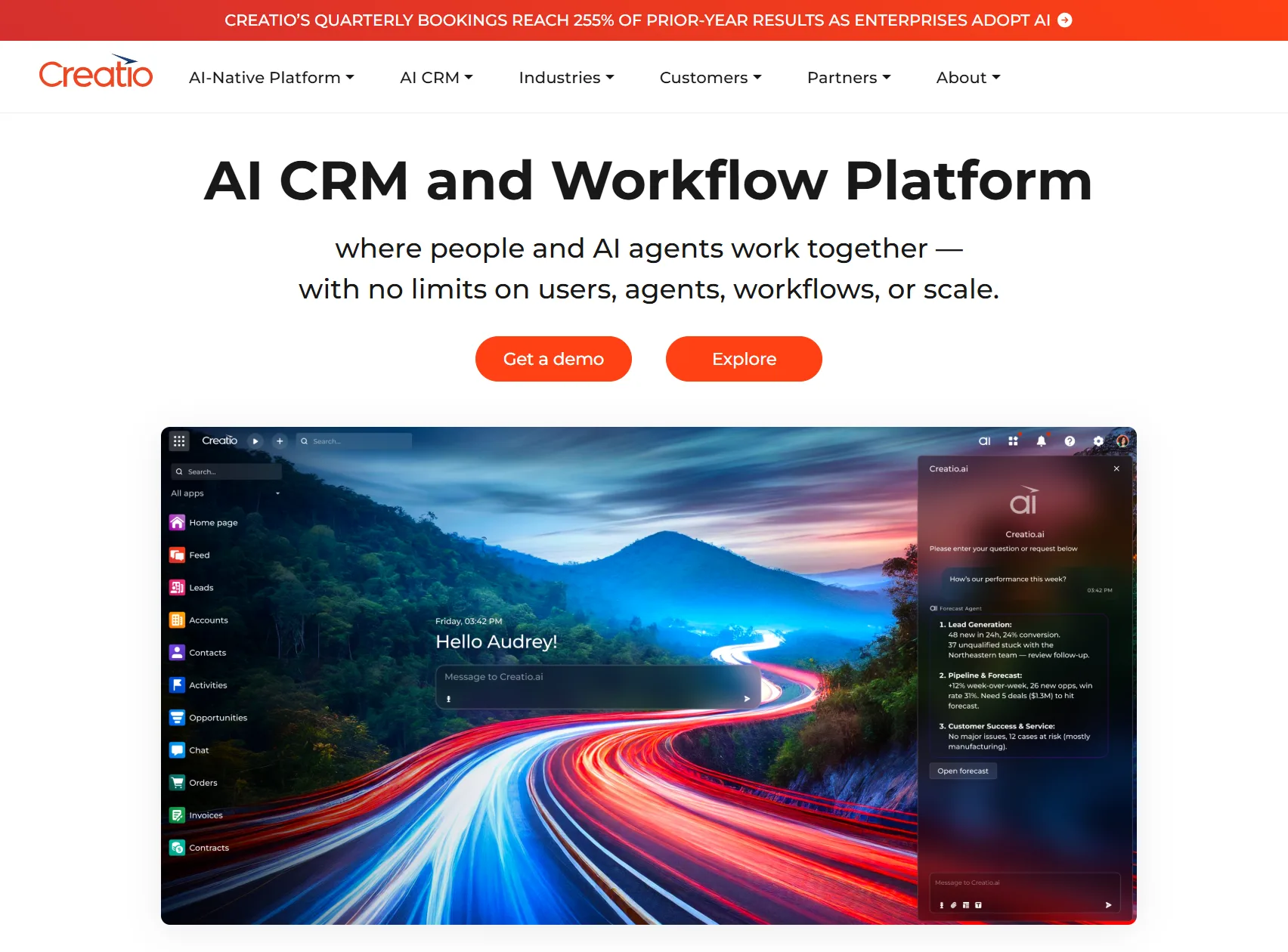
Creatio is an AI CRM and workflow platform where customer service agents are built directly on top of case management, omnichannel, and knowledge tools rather than bolted on as a separate product. Its Service application unifies chats, email, messaging, and cases into one queue, and AI agents for CRM work from that same customer record — with no separate integration layer required to see order history, prior cases, or account context.
Rather than a single chatbot, Creatio ships a set of purpose-built AI agents for service teams: Customer Support (handles routine inquiries and self-service), Case Understanding (summarizes cases and extracts key details), Resolution Guidance (surfaces similar past cases and recommends next steps), Knowledge Base (drafts and updates KB articles from resolved cases), and Routing Analysis (classifies and assigns incoming requests). Business users configure and adjust these agents through no-code designers rather than submitting change requests to engineering, and can also build custom agents in natural language for specific workflows.
On pricing, Creatio's core platform starts at $40 per user/month, with the Service application priced at $15 per user/month on top of it; an Unlimited plan removes per-agent and per-workflow caps entirely. That's a different model from vendors that charge per completed resolution or per conversation.
Key strengths
Customer service agents share one data model with case management, omnichannel, and knowledge tools — no separate integration project
No-code agent design lets service teams adjust behavior without developer involvement
Multiple purpose-built agents (case summarization, resolution guidance, knowledge creation, routing) rather than a single generic bot
Built-in SLA monitoring and escalation, with human-in-the-loop controls set per workflow
Platform pricing is published, with no per-resolution or per-conversation surcharge
Model-agnostic — works with OpenAI, Anthropic, Google, or a customer's own LLM
Limitations
Less specialized for pure customer-facing chat automation than platforms built only for that use case
Realizing full value assumes cases and knowledge already live in Creatio, or a migration from an existing help desk
Voice channel and deep contact-center capabilities are less established than platforms built primarily around voice
Best suited to organizations ready to configure workflows themselves rather than buy a fully pre-built vertical solution
Who should choose Creatio?
Choose Creatio when customer service is one part of a broader CRM and workflow strategy, and the priority is agents that work natively with case history, SLAs, and knowledge rather than as a bolt-on chatbot — with pricing that doesn't scale per resolution as volume grows.
Which AI Customer Service Agent Should You Choose?
The best choice depends primarily on your current technology and operating model.
Choose Zendesk AI if:
You already use Zendesk and want AI agents to operate inside your existing help desk, ticketing and reporting environment.
Choose Fin if:
You want transparent per-outcome pricing, relatively fast deployment and the flexibility to use your current help desk.
Choose Sierra if:
You are a large enterprise looking to automate sophisticated, high-volume customer experiences across several channels.
Choose Ada if:
Your customer experience team needs a no-code platform for managing digital and voice automation.
Choose Salesforce Agentforce if:
Your customer data, workflows and support operations are deeply embedded in Salesforce. Organizations that are still evaluating their CRM strategy may want to consider Salesforce alternatives before committing to an Agentforce deployment.
A company should not select a platform based only on a demonstration or a vendor’s average resolution rate. The agent should be evaluated using real historical conversations, actual business policies and the systems it will need to access.
AI Customer Service Agent vs. Traditional Chatbot
Traditional chatbots and AI agents can both communicate with customers, but their capabilities are different.
Traditional chatbot | AI customer service agent |
Follows predefined paths | Reasons about the customer’s goal |
Primarily answers questions | Can answer questions and perform actions |
Usually operates in one channel | Can work across several channels |
Requires scripted conversation logic | Can combine natural language with procedures |
Escalates when the script fails | Can attempt multi-step resolution before escalating |
Measures containment or deflection | Focuses increasingly on completed outcomes |
A chatbot may be sufficient for a small website that only needs to answer a limited number of common questions.
An AI agent becomes more valuable when the system needs to access customer data, make decisions, execute authorized actions and coordinate several steps.
Questions to Ask Before Buying an AI Customer Service Agent
Before selecting a vendor, ask the following questions:
What exactly counts as a successful resolution or billable outcome?
Which channels are available today rather than only on the roadmap?
Can the agent safely read from and write to our business systems?
How does it authenticate customers before taking sensitive actions?
What happens when the agent is uncertain?
Can it explain why it made a decision?
How are conversations tested before deployment?
How does the platform prevent incorrect or unauthorized actions?
What information is transferred during human escalation?
What implementation, integration and professional-service fees are required?
Can we review conversation-level quality and resolution data?
How quickly can the agent be disabled or restricted if a problem occurs?
These questions are often more important than the quality of the agent’s demonstration.
Frequently Asked Questions
What is the best AI agent for customer service?
There is no universal best platform. Zendesk AI is a strong choice for existing Zendesk customers, Fin offers transparent outcome-based pricing, Sierra targets complex enterprise customer experience, Ada emphasizes no-code automation, and Agentforce is best suited to Salesforce-centered organizations.
Can AI agents completely replace customer service representatives?
AI agents can automate many repetitive and structured requests, but they should not be expected to replace people in every situation. Complex exceptions, emotionally sensitive conversations, high-risk decisions and poorly documented issues may still require human judgment.
The most effective model is often a combination of AI resolution and skilled human escalation.
Can an AI customer service agent process refunds?
Yes, provided the agent is connected to the required order or payment system and has permission to perform the action.
The company should define limits, such as maximum refund amounts, eligible reasons and situations requiring human approval.
How much do AI customer service agents cost?
Pricing varies significantly.
Some vendors charge per completed resolution or outcome. Others charge per conversation, user, platform subscription or a combination of fees. Enterprise platforms may use custom contracts based on volume and implementation requirements.
Businesses should compare total cost rather than the advertised usage price alone.
How long does it take to deploy an AI customer service agent?
A basic agent connected to an established knowledge base may be launched relatively quickly. A production deployment involving customer authentication, refunds, subscriptions, order systems, voice and compliance controls can take much longer.
The primary constraint is often not the AI model. It is the condition of the company’s knowledge, policies, integrations and internal processes.
Are AI agents safe for customer service?
They can be deployed safely when they operate within clear permissions, use reliable data, maintain audit records and escalate uncertain situations.
They become risky when given broad system access without sufficient testing, monitoring, approval rules or rollback controls.
Final Thoughts
AI customer service agents are becoming more capable, but purchasing one should not be treated as a simple chatbot upgrade.
The strongest platforms can understand requests, retrieve relevant customer information, execute business processes and coordinate with human support teams. Their performance, however, depends heavily on the quality of the company’s data, policies, integrations and operating controls.
For existing Zendesk customers, Zendesk AI offers the most natural extension of the current support environment. Fin provides one of the clearest pricing models and can work with multiple help desks. Sierra and Ada are compelling enterprise options for broader customer experience automation, while Salesforce Agentforce is a logical choice for organizations centered around Salesforce.
The right platform is the one that can reliably resolve your real customer requests—not the one that gives the most impressive scripted demonstration.
Related Articles
View all articles
The 5 Best AI Agents and Tools for Productivity in 2026
Discover the top 5 AI agents and tools revolutionizing productivity in 2026. Learn how autonomous AI agents can automate tasks and boost your workflow.
AI Agents in Higher Education: Uses and Best Tools for 2026
Explore how AI agents are transforming higher education in 2026, including 15 use cases, the best tools for students and faculty, benefits, risks, and implementation guidance.
PwC and OpenAI Forge Path to Agentic Customer Engagement
Discover how PwC is leveraging OpenAI's frontier models to transform customer engagement and service with agentic AI solutions, enhancing customer experience...
Continue exploring
Find AI agents by workflow
More in Industry Insights
Browse more articles in the Industry Insights category.
AI agents for customer service 2026 articles
Explore more guides and insights tagged AI agents for customer service 2026.
top AI customer service platforms articles
Explore more guides and insights tagged top AI customer service platforms.
AI Agent Categories
Browse use-case pages for sales, productivity, coding, customer service, and more.
AI Agents Landscape
Explore the full directory map and compare agents by workflow and category.
Agent Skills
Find reusable skills, capabilities, and building blocks for AI agent workflows.