Top 11 Observability Platforms for AI Agents to Watch in 2025
As we approach 2025, the rise of AI agents shows no signs of slowing down. These agents are poised to redefine industries, from customer support to healthcare, but with increased complexity comes the need for robust observability. In this fast-evolving landscape, observability platforms will play a critical role in ensuring AI agents remain reliable, efficient, and impactful.
With just days left in 2024, it's time to look ahead at the tools that will shape how businesses and developers monitor, debug, and optimize their AI agents in the coming year. Below, we dive into the top 10 observability platforms for AI agents in 2025, their standout features, and what makes them essential.
Why Observability Matters for AI Agents in 2025
AI agents are no longer optional; they are core components of modern business strategies. However, their growing complexity introduces challenges such as:
Unpredictable Behavior: AI agents can behave inconsistently, especially in dynamic environments.
Model Drift: Over time, AI models degrade in accuracy as data patterns change.
Difficult Debugging: Pinpointing issues in workflows involving AI agents requires sophisticated tools.
Observability platforms address these challenges by:
Enhancing Transparency: They provide in-depth visibility into how AI agents operate and make decisions.
Improving Performance: Real-time metrics enable fine-tuning for optimal efficiency.
Ensuring Stability: Platforms detect anomalies early, preventing costly system failures.
In 2025, observability will be more critical than ever for scaling AI responsibly and effectively.
Top 11 Observability Platforms for AI Agents
Here are the platforms that are set to lead the observability space in 2025:
1. Helicone AI
Helicone AI is an open-source observability platform designed to empower developers in building, monitoring, and optimizing AI applications. It provides a suite of tools to track, analyze, and enhance the performance of AI models, particularly those powered by large language models (LLMs) like OpenAI, Anthropic, and others. With its seamless integration and robust features, Helicone is becoming a go-to solution for AI developers and enterprises alike.

Key Differentiator:
One-Line Integration: Helicone sets itself apart with its effortless setup—just one line of code is needed to integrate it into your AI application, making it incredibly accessible for developers of all skill levels.
Key Features:
Real-Time Analytics: Monitor critical metrics like latency, cost, and token usage in real-time, enabling data-driven optimizations for your AI models.
Prompt Management: Version, test, and refine prompts with experimentation tools, ensuring consistent and high-quality outputs from your LLMs.
Caching: Reduce latency and costs by caching LLM responses, making repetitive queries faster and more cost-effective.
2. Arize AI
Arize AI is a leading AI observability and evaluation platform designed to help developers and data scientists monitor, troubleshoot, and optimize AI models throughout their lifecycle. It supports a wide range of AI applications, including large language models (LLMs), traditional machine learning, and computer vision, making it a versatile tool for teams of all sizes

Key Differentiator:
Comprehensive Observability: Arize AI goes beyond traditional monitoring by offering deep insights into model performance, data drift, and root cause analysis. Its ability to index datasets across training, validation, and production environments allows teams to quickly detect and resolve issues, ensuring continuous model improvement
Key Features:
Real-Time Monitoring: Automatically track key metrics like latency, cost, and token usage for LLMs, as well as performance and data drift for traditional ML models. This ensures proactive issue detection and resolution.
LLM Evaluation Framework: Evaluate the quality and consistency of LLM outputs using customizable evaluation templates or bring your own metrics. This helps optimize prompts and improve model accuracy.
Tracing and Debugging: Visualize and debug the flow of data through generative AI applications. Identify bottlenecks in LLM calls and ensure your AI behaves as expected.
3. Coval AI
Coval AI is a simulation and evaluation platform designed to help developers and engineers build, test, and deploy reliable AI agents for both chat and voice applications. Founded in 2024 and backed by Y Combinator, Coval leverages advanced simulation techniques inspired by autonomous vehicle testing to automate the evaluation process, ensuring AI agents perform optimally in real-world scenarios.

Key Differentiator:
AI-Powered Simulations: Coval stands out with its ability to generate thousands of test scenarios from just a few base cases. This automation significantly reduces manual testing efforts and provides comprehensive insights into AI agent performance.
Key Features:
Multi-Modal Testing: Coval supports both text-based and voice-based AI agents, allowing developers to test and optimize across different interaction modes.
Comprehensive Evaluation Dashboard: The platform offers detailed analytics, including custom metrics and root cause analysis, to track performance over time and identify areas for improvement .
Workflow Visualization: Coval provides visual insights into agent decision paths, helping developers understand and optimize the flow of interactions.
4. Vocera AI
Vocera AI is a voice AI agent testing and monitoring platform designed to help developers and businesses create, test, and optimize conversational AI agents. Founded in 2024 and backed by Y Combinator, Vocera leverages advanced simulation and real-time monitoring tools to ensure AI agents perform reliably across diverse scenarios, particularly in compliance-heavy industries like healthcare and customer service.

Key Differentiator:
AI-Powered Scenario Simulation: Vocera stands out with its ability to generate thousands of test scenarios from just a few base cases, significantly reducing manual testing efforts and ensuring comprehensive evaluation of AI agents.
Key Features:
Real-Time Monitoring: Track every call with detailed logs, trend analysis, and instant alerts to ensure optimal performance and compliance.
Customizable Workflows: Test AI agents with diverse personas and workflows, including challenging scenarios like impatient users or appointment cancellations.
Compliance Verification: Automatically check for compliance adherence and flag violations in real-time, making it ideal for regulated industries.
5. Foundry AI
The Foundry AI is a comprehensive platform designed to help businesses and developers build, deploy, and scale AI applications with ease. It provides a suite of tools and services that streamline the AI development lifecycle, from data preparation to model deployment and monitoring. The Foundry AI aims to democratize AI by making advanced AI technologies accessible to organizations of all sizes.

Key Differentiator:
End-to-End AI Lifecycle Management: The Foundry AI stands out by offering a unified platform that covers every stage of the AI development process, from data ingestion and model training to deployment and continuous monitoring. This holistic approach ensures seamless integration and efficient management of AI projects.
Key Features:
Data Preparation and Management: Tools for data cleaning, labeling, and augmentation to ensure high-quality datasets for training AI models.
Model Training and Optimization: Support for automated machine learning (AutoML) and advanced model tuning to enhance performance and accuracy.
Deployment and Monitoring: One-click deployment and real-time monitoring capabilities to track model performance and detect issues in production environments.
6. Maxim AI
Maxim AI provides an end-to-end AI simulation, evaluation, and observability platform designed to help teams ship AI agents reliably and more than 5x faster. The platform distinguishes itself through comprehensive lifecycle coverage spanningexperimentation,simulation and evaluation, andobservability. Due to its strong capabilities, Maxim is emerging as a top pick for AI developers and Product Managers.
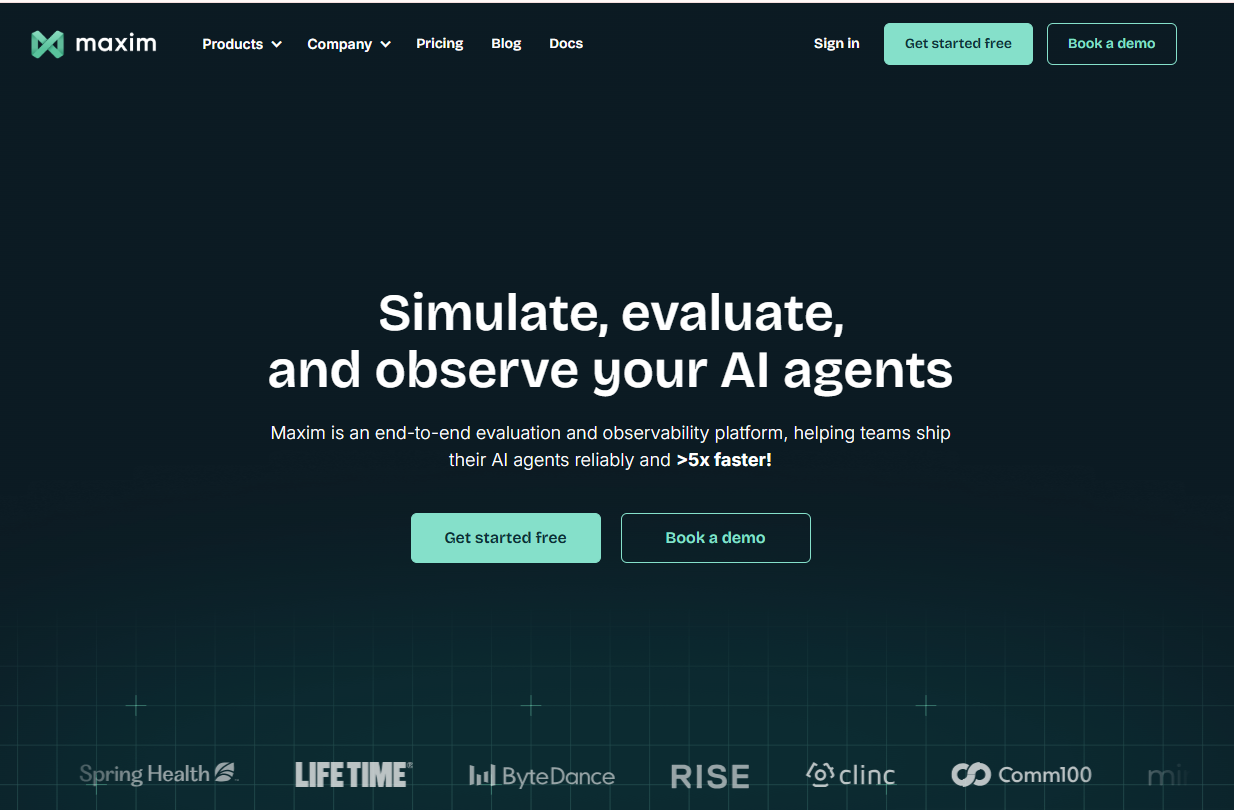
Key Differentiators:
Full-stack lifecycle: Unlike single-purpose observability tools, Maxim helps teams move faster across pre-release experimentation and production monitoring. You can manage prompts and versions, run simulations against hundreds of scenarios, evaluate agents using off-the-shelf or custom metrics, and monitor live production behavior, all from a unified interface.
Agent Simulation:Simulation capabilities enable teams to test agents across hundreds of scenarios and user personas before production deployment. Teams can re-run simulations from any step to reproduce issues and identify root causes systematically.
Flexi evals: Maxim supports evaluation at trace, span, and session levels with fine-grained control. Teams combine pre-built evaluators covering AI metrics (faithfulness, toxicity, context relevance), statistical measures (semantic similarity, BLEU), and programmatic checks (valid JSON, URL validation).
Cross-Functional Collaboration: Maxim's user experience bridges engineering and product teams. ThePlayground++ enables prompt versioning, deployment, and experimentation without code changes. Product managers canconfigure evaluations andcreate custom dashboards directly from the UI, reducing engineering dependencies.
Custom dashboards and collaboration: UI designed for engineering and product teams; no-code eval configuration.
Data Curation and Human-in-the-Loop: The platform provides sophisticateddataset management workflows for curating high-quality multi-modal datasets from production logs.
Key Features:
Distributed tracing withtraces,spans, andsessions for multi-step workflows
Node-level evaluations for granular quality assessment across agent architectures
Alerts and notifications for proactive production monitoring
OpenTelemetry compatibility through native OTLP support
Multi-modal support for text, images, and audio data
Custom dashboards for flexible analytics and reporting
Prompt management with versioning and deployment controls
CI/CD integration for automated testing pipelines
Cost tracking with detailed breakdowns by model, user, or custom dimensions
Anomaly detection through automated pattern analysis
Integrations with top agentic frameworks and LLM inference providers like Langchain, Langgraph, CrewAI, LiveKit, Mistral, Bedrock, Anthropic, and OpenAI.
Best for: Teams needing end-to-end reliability across pre-release and production, multimodal agent tracing, RAG observability, tool-call evals, and cross-functional collaboration.
7. NoFireAI
NoFireAI is an AI-powered incident resolution platform designed to help Site Reliability Engineers (SREs) and on-call engineering teams reduce the time spent on diagnosing and resolving incidents. Built by battle-tested SREs, the platform leverages AI to automate root cause analysis (RCA), reduce alert fatigue, and improve overall system reliability, enabling teams to focus on innovation rather than firefighting.

Key Differentiator:
90% Faster MTTR (Mean Time to Resolution): NOFireAI stands out by significantly reducing incident resolution time through AI-driven RCA and dynamic runbooks, helping teams resolve issues up to 90% faster.
Key Features:
Accurate Root Cause Analysis: Uncovers cause-effect relationships to pinpoint the exact source of incidents, eliminating guesswork and reducing investigation time.
False Positive Alert Identification: Filters out irrelevant alerts, reducing alert fatigue and allowing engineers to focus on critical issues.
Dynamic Runbooks: Provides actionable recommendations tailored to specific incidents, ensuring engineers can quickly mitigate production issues.
7. LangSmith
LangSmith is a production-grade platform designed to streamline the development, testing, and monitoring of large language model (LLM) applications. Built by LangChain, it provides tools for debugging, evaluating, and optimizing LLM workflows, making it easier for developers to build reliable and scalable AI applications. LangSmith integrates seamlessly with LangChain’s open-source frameworks, offering a unified solution for managing the entire LLM development lifecycle.

Key Differentiator:
End-to-End LLM Observability: LangSmith stands out by offering comprehensive visibility into LLM calls, workflows, and performance metrics. It enables developers to trace every step of their application’s logic, from input to output, and identify bottlenecks or inefficiencies in real-time.
Key Features:
Tracing and Debugging: LangSmith provides detailed trace logs for every LLM call, allowing developers to track inputs, outputs, and intermediate steps. This makes it easier to debug complex workflows and optimize performance.
Prompt Management: The platform includes tools for prompt versioning, testing, and refinement. Developers can experiment with different prompts in a playground-like environment and seamlessly integrate the best-performing versions into their applications.
Evaluation and Monitoring: LangSmith supports automated evaluations of LLM applications using custom metrics and datasets. It also offers real-time monitoring to track key performance indicators like latency, token usage, and cost, ensuring applications remain efficient and reliable.
9. Wayfound
Wayfound is an AI agent management platform designed to help businesses supervise, improve, and connect their AI agents in a centralized environment. It provides tools for monitoring, optimizing, and scaling AI agents across various use cases, from customer onboarding to sales and marketing. Wayfound aims to simplify AI agent development and management, enabling organizations to maximize ROI and reduce risks associated with AI deployment.

Key Differentiator:
Centralized AI Agent Management: Wayfound stands out by offering a holistic platform that allows businesses to onboard, monitor, and optimize all their AI agents in one place. This eliminates the need for multiple tools and ensures consistent performance and alignment with company values
Key Features:
No-Code Agent Creation: Build and deploy AI agents without coding, making it accessible for non-technical teams. Users can upload content, define rules, and customize workflows to meet specific business needs.
Real-Time Monitoring & Analytics: Gain deep insights into agent performance, track usage, and identify issues early. The platform provides detailed reports and feedback loops for continuous improvement.
Agent-to-Agent Collaboration: Enable AI agents to work together, share insights, and solve complex problems through multi-agent "meetings." This fosters cross-agent knowledge exchange and enhances overall efficiency.
10. Langfuse
Langfuse is an open-source LLM engineering platform designed to help developers debug, analyze, and optimize large language model (LLM) applications. It provides tools for tracing, prompt management, evaluations, and analytics, enabling teams to build, test, and iterate on LLM workflows efficiently. Langfuse is model and framework agnostic, making it versatile for various AI applications, and it supports both cloud and self-hosted deployments.

Key Differentiator:
End-to-End Observability: Langfuse stands out by offering comprehensive tracing of LLM applications, capturing the full context of executions, including API calls, prompts, and user interactions. This allows developers to pinpoint issues and optimize performance with ease.
Key Features:
Tracing and Debugging: Langfuse provides detailed trace logs for every LLM call, enabling developers to track inputs, outputs, and intermediate steps. This is particularly useful for debugging complex workflows and identifying bottlenecks.
Prompt Management: The platform allows for version control, testing, and deployment of prompts without requiring code changes. This decouples prompt engineering from application development, making it easier to iterate and optimize.
Evaluations and Analytics: Langfuse supports model-based evaluations, user feedback, and manual scoring to assess the quality of LLM outputs. It also tracks key metrics like cost, latency, and token usage, providing actionable insights for continuous improvement.
11. Weave
Weave is an AI evaluation and monitoring platform designed to help developers and data scientists test, analyze, and improve their machine learning (ML) and large language model (LLM) applications. It provides tools for evaluating model performance, tracking key metrics, and debugging workflows, ensuring that AI systems are reliable, efficient, and aligned with business goals. Weave is particularly focused on scalability and ease of use, making it suitable for both small teams and enterprise-level deployments .

Key Differentiator:
Unified Evaluation Framework: Weave stands out by offering a single platform for evaluating both traditional ML models and LLMs. It supports custom metrics, automated testing, and human-in-the-loop evaluations, providing a holistic approach to AI quality assurance .
Key Features:
Model Evaluation: Weave enables automated and manual evaluations of AI models using custom metrics, datasets, and user feedback. This ensures that models perform as expected in real-world scenarios.
Real-Time Monitoring: Track key performance indicators like accuracy, latency, and drift in real-time. Weave provides alerts and insights to help teams proactively address issues before they impact users.
Workflow Debugging: Visualize and debug the flow of data through AI applications. Weave helps identify bottlenecks, errors, and inefficiencies in complex workflows, making it easier to optimize performance.
Looking Ahead to 2025
As we move into 2025, the role of observability platforms in the AI landscape will become even more vital. These platforms empower businesses to harness the full potential of AI agents while mitigating risks and ensuring optimal performance. Whether you’re a startup or an enterprise, adopting the right observability platform will be a cornerstone of your AI success.
Related Articles
View all articles
Top 5 Best AI Agents and Tools for Content Creators in 2026
Discover the top 5 AI agents and tools revolutionizing content creation in 2026, from text and video generation to SEO optimization and brand consistency.
What Makes an AI Agent “Good”? A Practical Evaluation Framework
Learn how to evaluate AI agents beyond simple accuracy. Discover a practical framework for measuring reliability, decision-making, and operational success.
How to Build Your Own Agent Harness: A Comprehensive Guide
Learn how to build your own agent harness. This guide covers essential components, frameworks, and step-by-step development for custom AI agent setups.
Continue exploring
Find AI agents by workflow
More in Industry Insights
Browse more articles in the Industry Insights category.
AI Agent Categories
Browse use-case pages for sales, productivity, coding, customer service, and more.
AI Agents Landscape
Explore the full directory map and compare agents by workflow and category.
Agent Skills
Find reusable skills, capabilities, and building blocks for AI agent workflows.
Free AI Agents
Discover free AI agents and tools for testing agentic workflows without upfront cost.
Open Source AI Agents
Compare open-source agents, frameworks, and developer-friendly agent projects.