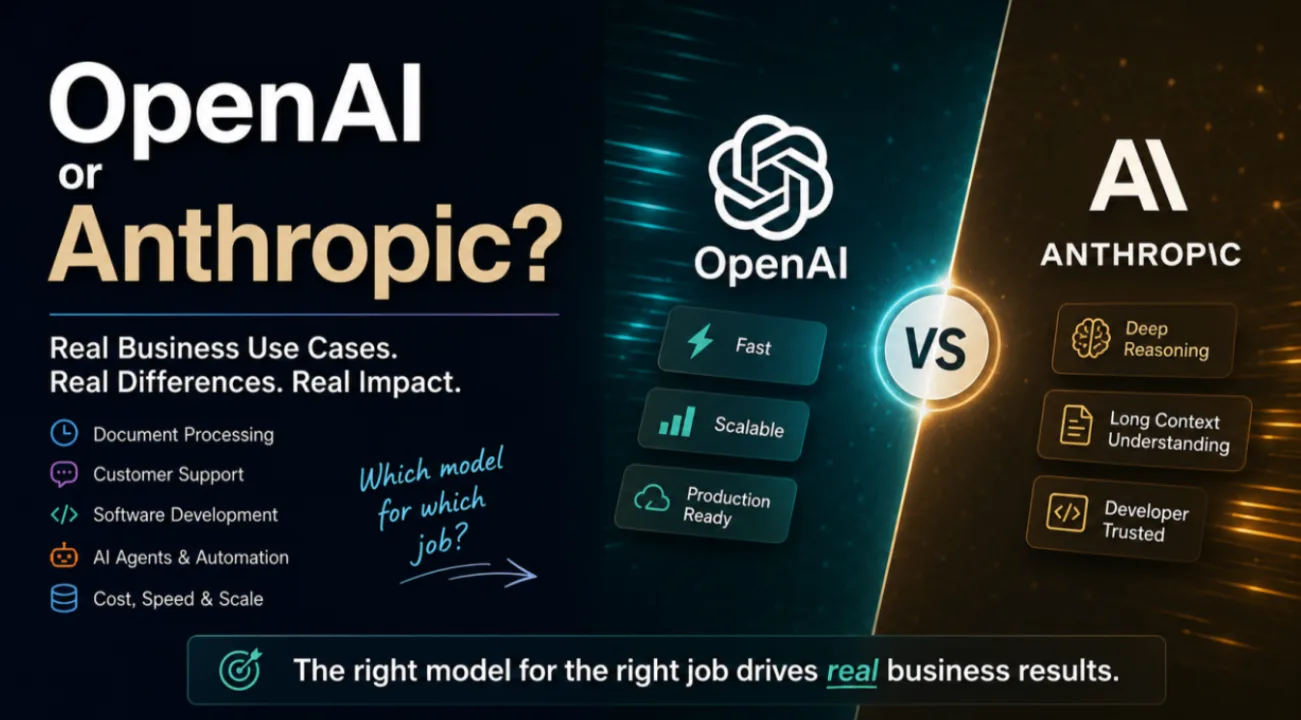
Stop Asking "OpenAI or Anthropic?" Start Asking Better Questions.
Every major AI release follows exactly the same pattern.
A new model is announced. Within hours, social media is full of benchmark charts. Someone posts a side-by-side comparison. Another person declares that OpenAI has won. Then someone else claims Anthropic has taken the lead. People argue over coding scores, reasoning tests, context windows, token prices, and who is now "number one."
Give it another month and the conversation starts all over again.
I've watched this happen after almost every major release, and every time I have the same thought that most businesses are asking the wrong question.
The question isn't whether OpenAI is better than Anthropic. The real question is much less exciting, but it's the one that actually affects revenue: “Which model should perform this specific piece of work?”
That one small change completely changes how you think about AI.
Instead of comparing models, you start designing systems.
And that's exactly where companies begin to separate themselves from their competitors.
Part 1: Benchmarks Don't Run Businesses
OpenAI or Anthropic? I think that's the wrong debate.

Every new model release triggers the same conversation. LinkedIn fills up with benchmark comparisons, coding leaderboards, and people arguing over tiny differences in performance. It’s better for businesses to look for models that will save them time and money.
From what I've seen, most companies evaluate AI the wrong way. They compare benchmark scores, reasoning tests, or ask every model to write the same email.
Those exercises might be interesting, but they don't tell you whether the model will create measurable business value.
A model that wins a benchmark by 2% may actually perform worse in production if it's slower, significantly more expensive, or struggles with your specific workflow.
Instead, I'd evaluate questions like these:
Can it reliably handle your actual business processes?
Can it integrate with your CRM, ERP, databases, or internal APIs?
What's the balance between quality, speed, and operating cost?
Will it produce consistent results after processing ten thousand requests—not just ten?
Imagine two companies deploying AI for customer support. Company A chooses the model with the highest benchmark score because everyone online recommends it.
Company B spends a week testing different models against real support tickets, measuring response quality, latency, escalation rate, and cost per resolved conversation.
Six months later, Company B knows exactly how much money the system saves every month. Company A still argues about benchmarks.
That's why, throughout this newsletter, I'm comparing models using real business workloads instead of artificial prompts.
We'll look at document processing, software development, customer support, AI agents, research, and automation.
Because that's where the differences actually matter.

Part 2: Stop Comparing Chatbots. Compare Real Work.
One of the biggest mistakes I see is people comparing AI models by chatting with them. That's not how businesses use AI.
Companies aren't paying for better conversations. They're paying for work to get done without a human supervising every step.
Take an AI agent that processes thousands of supplier invoices every day. It needs to extract data, match purchase orders, flag discrepancies, and update the ERP system.
For this kind of high-volume automation, I'd choose Sol.
It's fast, reliable, and cost-effective. When you're processing tens of thousands of documents every month, even small improvements in speed and cost can translate into significant savings. The downside is that Sol can struggle when documents are poorly formatted or contain unusual edge cases that require deeper contextual understanding.
Now consider a very different task.
A sales team receives a 70-page enterprise RFP. The AI has to understand the client's requirements, connect information across dozens of pages, identify risks, spot missing details, and draft the first version of a proposal. This is where Fable shines.
Its reasoning is noticeably stronger, especially when working with long documents and complex business problems. It does a better job of connecting ideas, maintaining context, and producing higher-quality outputs. The trade-off is that it's slower and more expensive, making it a poor choice for repetitive, high-volume workflows.
That's why I don't think companies should standardize on a single model.
Using Fable to process invoices all day is like asking a senior software architect to reset passwords. They can do it, but it's not the best use of their time - or your budget.
The best AI systems combine both approaches: Sol handles fast, repetitive work at scale, while Fable is reserved for tasks where better reasoning delivers better business outcomes. That's where the real ROI comes from.
Part 3: AI Agents Need Different Strengths
As companies move beyond chatbots and start building AI agents, the choice of model becomes much more important.

These agents don't just answer questions—they browse websites, research competitors, analyze information, and make decisions across multiple steps.
For these kinds of workflows, I'd usually choose Sonnet.
Imagine an AI that checks your competitors every morning, tracks pricing changes, summarizes new features, and delivers a report before your team starts work. That requires strong reasoning, the ability to connect information from multiple sources, and consistency over long workflows. In my experience, Sonnet does this exceptionally well. It's also still my preferred model for coding, code reviews, and refactoring large codebases.
Terra has different strengths.
Its biggest advantage is speed and the OpenAI ecosystem. If you're building production AI applications, Terra offers mature APIs, excellent tooling, and low latency. That's a huge advantage for customer-facing AI assistants, internal copilots, or any workflow handling thousands of requests every day where response time matters.
If I had to simplify it, I'd say this:
Choose Sonnet when the task requires deeper reasoning, research, coding, or complex AI agents.
Choose Terra when speed, scalability, and production reliability are the priority.
Neither model is better across the board - they're simply optimized for different jobs.
Part 4: Your AI Budget Depends More on Architecture Than Model Quality
One of the biggest misconceptions I see is that AI costs are mostly determined by which provider you choose. In reality, architecture usually has a much bigger impact.
Many companies deploy one premium model everywhere because it's easier operationally. Unfortunately, it's also one of the fastest ways to overspend.

Take Claude Haiku and GPT Luna. Suppose you're automating customer support.
Every day the AI reads incoming emails, categorizes requests, answers common questions, creates tickets, and routes complex cases to human agents.
If you're handling 50,000 support requests each month, saving even a few cents per interaction quickly translates into thousands of dollars annually.
For repetitive, structured work like this, Haiku is often the smarter business decision.
It's affordable, fast, and more than capable of handling predictable workflows.
Now consider a completely different scenario.
Your engineering team needs an internal AI assistant.
A developer asks: “Where is authentication implemented?" or "Which services consume this API?"
Now the AI needs to search source code, documentation, architecture diagrams, design decisions, internal wikis, and previous discussions—all before producing an accurate answer. That's a much harder problem. This is where Luna stands out.
The same principle applies to sales enablement.
Imagine preparing an account executive before an enterprise meeting.
The AI reviews CRM history, previous emails, call transcripts, technical documentation, support tickets, implementation notes, and renewal risks.
That requires deep reasoning across a huge amount of information.
Using a lightweight model simply to save money could result in incomplete recommendations or missed opportunities. The comparison isn't really Haiku versus Luna. It's cost efficiency versus capability.
Use inexpensive models where scale matters. Invest in larger models where better decisions create measurable business value.
Part 5: There Is No Winning Model
After spending the past few days comparing these models, one thing became obvious: there isn't a single model that's best at everything.
Across document processing, customer support, software development, AI agents, and large-context analysis, the same pattern kept showing up. The cheapest model isn't always the cheapest once mistakes create extra work. And the most powerful model isn't always worth the cost for simple, repetitive tasks. This is exactly how I work today.
I'm currently redesigning a database to improve performance. I use Anthropic models to help plan the migration and generate SQL procedures, then I switch to OpenAI Sol to review the implementation, look for edge cases, and validate the logic. Having a second model review the work often catches things that the first one missed.
Even within Anthropic, I don't stick to a single model. For straightforward SQL, Sonnet is usually enough. But when a migration involves complex dependencies or higher-risk architectural decisions, I move to Fable because the stronger reasoning justifies the extra cost.
The biggest lesson from all these comparisons is simple: the companies getting the best results from AI aren't relying on one model. They're building workflows where each model is used for what it does best. That's usually the fastest path to better quality, lower costs, and a much higher return on AI.

Final Thoughts
The AI companies that will outperform everyone else over the next few years won't necessarily have access to better models.
Everyone has access to the same APIs. Their advantage will come from how they orchestrate them.
They'll route simple tasks to fast, inexpensive models. They'll reserve premium reasoning for the moments where it creates real business value. They'll continuously measure quality, latency, cost, and outcomes instead of relying on benchmark leaderboards.
In other words, they'll stop thinking about AI as a chatbot and start treating it like a team of specialists.
And that's where the real competitive advantage begins.
Related Articles
View all articles
Anthropic Goes All-In on “Enterprise Agents” (Cowork + Plugins)
Explore Anthropic's new 'enterprise agents' strategy, combining Cowork and Plugins to revolutionize business AI workflows and productivity.

The Impact of AI Agents on Customer Support, Sales, and Business Automation
Explore how AI agents are changing customer support, sales, and business automation through faster service, lead qualification, and workflow execution.
OpenAI Launches GPT-5.4 — A Frontier Model Built for Autonomous AI Agents
OpenAI has officially launched GPT-5.4, a frontier model engineered specifically for autonomous AI agents. Discover the new features and agentic capabilities.
Continue exploring
Find AI agents by workflow
More in Partner Insights
Browse more articles in the Partner Insights category.
openai articles
Explore more guides and insights tagged openai.
anthropic articles
Explore more guides and insights tagged anthropic.
AI Agent Categories
Browse use-case pages for sales, productivity, coding, customer service, and more.
AI Agents Landscape
Explore the full directory map and compare agents by workflow and category.
Agent Skills
Find reusable skills, capabilities, and building blocks for AI agent workflows.