Qwen 3.5 Small Model Series Released: A New Era for Efficient AI
The Arrival of the Qwen 3.5 Small Model Series: A Leap Forward in Efficient AI
The artificial intelligence landscape is in constant flux, with new models and advancements emerging at an unprecedented pace. Among these developments, the recent release of the Qwen 3.5 Small Model Series by Alibaba Cloud marks a significant milestone. This new series represents a strategic push towards more accessible, efficient, and powerful large language models (LLMs), addressing the growing demand for AI solutions that are not only capable but also practical for a wider range of applications and users.
In an era where the computational cost and accessibility of cutting-edge AI are paramount, the Qwen 3.5 Small Model Series arrives as a timely innovation. It promises to democratize access to advanced AI capabilities, enabling developers and businesses to leverage powerful language understanding and generation without the prohibitive resource demands often associated with larger, more resource-intensive models. This release underscores Alibaba's commitment to advancing AI research and development, pushing the boundaries of what's possible with smaller, yet highly effective, AI architectures.
What is the Qwen 3.5 Small Model Series?
The Qwen 3.5 Small Model Series is a collection of state-of-the-art large language models developed by Alibaba Cloud. Unlike previous generations that might have focused solely on raw scale, this series emphasizes optimization, efficiency, and performance within a more compact footprint. These models are designed to offer a compelling balance between computational requirements and the ability to perform a wide array of natural language processing (NLP) tasks with remarkable accuracy and fluency.
The series typically comprises models of varying sizes, allowing users to select the best fit for their specific needs and hardware constraints. This tiered approach is crucial for broader adoption, as it caters to different levels of computational power available to developers and organizations. Whether for deployment on edge devices, resource-limited servers, or cloud-based applications requiring cost-effectiveness, the Qwen 3.5 Small Model Series provides a versatile solution.
Key Features and Innovations of Qwen 3.5
The Qwen 3.5 Small Model Series distinguishes itself through several key features and innovative architectural choices. These advancements are crucial for its improved performance and efficiency:
Optimized Architecture: The underlying architecture has been refined to enhance computational efficiency without sacrificing accuracy. This often involves novel attention mechanisms, optimized layer structures, and more efficient parameterization techniques.
Multilingual Capabilities: While specific details vary by model within the series, Qwen models have historically demonstrated strong multilingual support, and Qwen 3.5 likely continues this trend, offering robust performance across various languages.
Enhanced Reasoning and Comprehension: The series aims to provide superior understanding of complex prompts and improved logical reasoning capabilities, making it suitable for more sophisticated tasks like content creation, summarization, and question answering.
Fine-tuning Flexibility: These models are often designed with ease of fine-tuning in mind, allowing developers to adapt them to specific domains or tasks with relatively smaller datasets and less computational overhead.
Cost-Effectiveness: The primary benefit of a "small" model series is its reduced inference cost and lower memory footprint, making advanced AI accessible to a broader audience and enabling new use cases previously deemed too expensive.
Performance Benchmarks and Comparisons
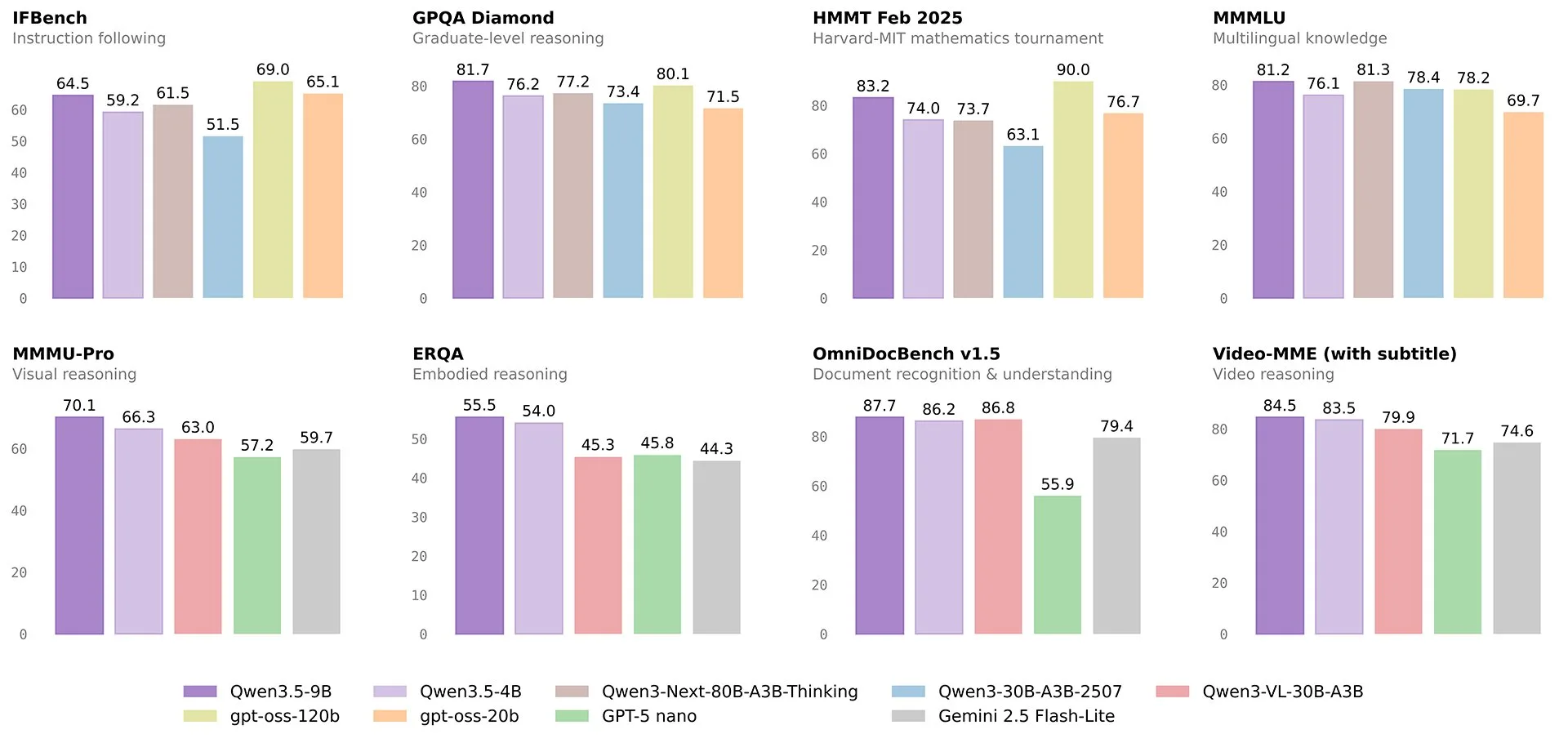
Alibaba has consistently provided benchmark data for its Qwen models, and the Qwen 3.5 Small Model Series is no exception. While specific benchmark results can vary and are subject to ongoing updates, the general trend indicates a strong competitive standing against other LLMs in its class. These benchmarks typically evaluate performance across a range of tasks, including:
Common Sense Reasoning: Testing the model's ability to understand and apply general knowledge.
Reading Comprehension: Assessing how well the model can extract information and answer questions from text.
Mathematical Reasoning: Evaluating its proficiency in solving mathematical problems.
Code Generation: Gauging its ability to produce functional code.
Multilingual Tasks: Measuring performance in tasks across different languages.
The significance of these benchmarks lies in demonstrating that smaller models can indeed compete with, and in some cases surpass, larger models on specific tasks, especially when optimized for efficiency. This challenges the long-held notion that model size is the sole determinant of performance. The Qwen 3.5 Small Model Series is positioned to offer a compelling alternative for users prioritizing efficiency and cost without a substantial compromise on quality.
Architectural Improvements Driving Performance
The enhanced performance of the Qwen 3.5 Small Model Series is a direct result of significant architectural innovations. While proprietary details are often kept under wraps, common advancements in LLM architecture that contribute to efficiency and performance include:
Mixture-of-Experts (MoE) Architectures: These models use specialized sub-networks (experts) that are activated only for specific inputs, leading to more efficient computation.
Quantization Techniques: Reducing the precision of model weights and activations can significantly decrease memory usage and speed up inference with minimal loss in accuracy.
Optimized Attention Mechanisms: Traditional self-attention can be computationally expensive. Innovations like sparse attention or linear attention can reduce this complexity.
Knowledge Distillation: Training smaller models to mimic the behavior of larger, more powerful models can transfer knowledge effectively, creating compact yet capable models.
These technical refinements allow the Qwen 3.5 models to achieve remarkable results while consuming fewer resources. This focus on architectural efficiency is a key trend in the AI development landscape, aiming to make powerful AI more sustainable and accessible.
Applications and Use Cases for Qwen 3.5
The versatility and efficiency of the Qwen 3.5 Small Model Series open doors to a wide array of practical applications. Its ability to deliver strong performance with reduced computational demands makes it ideal for:
On-Device AI: Deploying AI capabilities directly onto smartphones, smart home devices, or other edge computing hardware, enabling real-time processing without constant cloud connectivity.
Chatbots and Virtual Assistants: Creating more responsive and cost-effective conversational AI agents for customer service, personal assistance, and interactive applications.
Content Generation and Summarization: Assisting in the creation of marketing copy, articles, social media posts, and summarizing lengthy documents for quick understanding.
Code Assistance: Providing developers with intelligent code completion, debugging suggestions, and even generating boilerplate code.
Language Translation and Localization: Facilitating communication across different languages with improved accuracy and speed.
Educational Tools: Powering interactive learning platforms, personalized tutoring systems, and language learning applications.
The accessibility of these models democratizes AI, allowing smaller businesses and individual developers to integrate sophisticated AI functionalities into their products and services without requiring massive infrastructure investments.
Impact on the AI Landscape and Future Outlook
The release of the Qwen 3.5 Small Model Series has a significant impact on the broader AI landscape. It reinforces the trend towards more efficient and specialized AI models, challenging the dominance of monolithic, resource-hungry giants. This shift is crucial for several reasons:
Democratization of AI: Smaller, more efficient models lower the barrier to entry for AI development and deployment, fostering innovation across a wider range of industries and organizations.
Sustainability in AI: Reducing the energy consumption associated with AI inference and training contributes to a more sustainable technological future.
Competitive Landscape: It intensifies competition among AI providers, driving further innovation in model architecture, performance optimization, and cost reduction.
Alibaba's Growing Influence: This release further solidifies Alibaba Cloud's position as a key player in the global AI research and development arena, showcasing its commitment to open and accessible AI technologies.
Looking ahead, the trajectory of the Qwen series, and indeed the field of LLMs, points towards continued advancements in efficiency, specialized capabilities, and multimodal integration. The Qwen 3.5 Small Model Series is likely just the beginning of a new wave of AI development where performance and accessibility go hand in hand. As research progresses, we can anticipate even more sophisticated and efficient models emerging, further transforming how we interact with and leverage artificial intelligence.
Learn more about the Qwen 3.5 Small Model Series and its capabilities on the official Alibaba AI website!
Related Articles
View all articles
MiniMax M3: The First Open-Weights Model to Combine Three Frontier Capabilities
Discover MiniMax M3, the pioneering open-weights AI model uniquely merging three frontier capabilities. Learn its features, impact, and what this means for AI.
Alibaba Launches Accio Work
Explore Alibaba's new Accio Work platform. Discover how this enterprise tool streamlines workflows, boosts collaboration, and integrates with global business.

Understanding Gemma 4: A Guide to Google's Open-Weight AI
Explore the architecture and capabilities of Google's Gemma model series. Learn how these open-weight AI tools fit into your development workflow.
Continue exploring
Find AI agents by workflow
More in Industry Insights
Browse more articles in the Industry Insights category.
AI articles
Explore more guides and insights tagged AI.
LLM articles
Explore more guides and insights tagged LLM.
AI Agent Categories
Browse use-case pages for sales, productivity, coding, customer service, and more.
AI Agents Landscape
Explore the full directory map and compare agents by workflow and category.
Agent Skills
Find reusable skills, capabilities, and building blocks for AI agent workflows.