Quantum Computing’s Impact: Reshaping AI’s Processing Power
Artificial intelligence is advancing at breakneck speed but it’s increasingly constrained by the limits of classical computing. As models grow larger, datasets expand, and problems become more complex, the traditional “bits and transistors” approach is hitting hard physical and economic walls. This is where quantum computing enters the conversation, not as sci-fi hype, but as a fundamentally different way to process information that could reshape the future of AI.

The Bottleneck of Bits
Classical computing’s limits
Modern AI runs on silicon chips that process information as bits—either 0 or 1. For decades, Moore’s Law delivered exponential gains, but transistor miniaturization is now approaching atomic limits. Heat dissipation, quantum tunneling, and fabrication costs are making further gains increasingly inefficient.
AI’s scale and energy problem
State-of-the-art AI models require billions of parameters, massive GPU clusters, and enormous energy consumption. Training large models can consume megawatt-hours of electricity, raising costs and sustainability concerns. As AI demand grows, scaling purely with classical hardware becomes economically and environmentally unsustainable.
The “waiting game” for complex problems
Certain AI-relevant problems—optimization, combinatorics, probabilistic modeling—don’t just scale linearly. Classical systems often rely on approximations or brute force, leading to long compute times and delayed insights. This bottleneck limits what AI can realistically tackle today.
Enter the Qubit: A New Paradigm
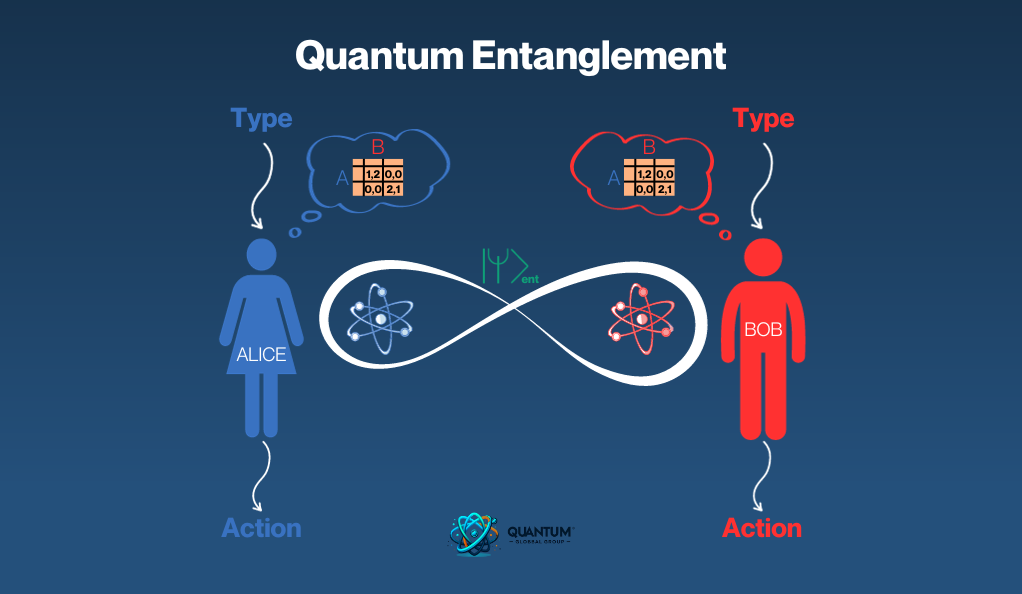
Beyond 0s and 1s
Quantum computers use qubits, which can exist in multiple states simultaneously thanks to superposition. When qubits become linked through entanglement, the state of one instantly relates to the state of another no matter the distance. This isn’t just faster computing; it’s a different mathematical foundation.
Parallelism at the atomic level
Instead of testing possibilities one at a time, quantum systems can evaluate many possibilities in parallel. For certain classes of problems, this means exploring massive solution spaces simultaneously something classical machines struggle to do efficiently.
Exponential speed-ups (for the right tasks)
Quantum computing doesn’t speed up everything but for optimization, linear algebra, search, and probabilistic sampling (all critical to AI), it offers theoretical exponential or polynomial advantages. These are precisely the workloads where AI hits today’s limits.
AI’s Quantum Leap: Unlocking New Capabilities
Training on previously impossible datasets
Quantum-enhanced machine learning could process high-dimensional data more efficiently, enabling models to learn from datasets that are currently too large or complex to handle.
Quantum neural networks
Research into quantum neural networks (QNNs) explores how quantum states can represent and transform information in ways classical networks cannot. The potential upside: faster convergence, richer pattern recognition, and improved generalization.
Ultra-complex simulations in real time
From drug discovery and materials science to climate modeling and financial markets, quantum-accelerated AI could simulate molecular interactions, market dynamics, or climate systems with unprecedented fidelity—unlocking insights that are currently out of reach.
Beyond the Hype: Current Challenges & Roadmaps
The noisy qubit problem
Today’s quantum computers are noisy and error-prone. Qubits lose information quickly, requiring extreme cooling and sophisticated error correction. This is why quantum systems won’t replace classical computers anytime soon—they’ll complement them.
Specialized algorithms and talent
Quantum advantage depends on quantum-native algorithms, not just porting existing AI code. This requires rare, interdisciplinary expertise spanning physics, mathematics, and machine learning.
Who’s pushing the frontier
Industry and governments are investing heavily. IBM is scaling toward fault-tolerant systems with advanced quantum processors like Condor, while Google continues to demonstrate quantum advantage with its Sycamore architecture. Public-private initiatives worldwide are accelerating research, tooling, and education.
The Quantum Future of Intelligence
Faster-learning, more adaptive AI
Quantum-accelerated AI systems could learn from experience at speeds unimaginable today—adapting in near real time to new data, environments, and constraints.
Everyday impact
The downstream effects could be profound: personalized medicine, optimized global logistics, smarter energy grids, and breakthroughs we can’t yet predict—all powered by AI systems no longer constrained by classical compute bottlenecks.
Ethics and responsibility
With greater power comes greater responsibility. Quantum-enhanced AI raises urgent questions around security, fairness, access, and governance. Building this future responsibly will be as important as building it quickly.
Where Experimentation Meets the Future
While large-scale quantum AI is still emerging, the way we evaluate, compare, and stress-test AI systems today matters. Platforms like AArena are already focused on structured AI evaluation helping users understand how different models and systems behave under identical conditions. As quantum capabilities mature, this kind of rigorous evaluation layer will become even more critical.
Quantum computing won’t just make AI faster it will redefine what intelligence can do.
Related Articles
View all articles
How to Turn Content Into Revenue With Custom AI Agents
Learn how to leverage custom AI agents to convert your content into scalable revenue streams. Discover strategies for automation, personalization, and sales.

AI for Restaurants: 5 Use Cases to Implement in 2026
Discover how AI is transforming the restaurant industry. Explore 5 key use cases for AI in restaurants in 2026, from optimizing operations to enhancing custo...
AI Agents in Higher Education: Uses and Best Tools for 2026
Explore how AI agents are transforming higher education in 2026, including 15 use cases, the best tools for students and faculty, benefits, risks, and implementation guidance.
Continue exploring
Find AI agents by workflow
More in Industry Insights
Browse more articles in the Industry Insights category.
AI Agent Categories
Browse use-case pages for sales, productivity, coding, customer service, and more.
AI Agents Landscape
Explore the full directory map and compare agents by workflow and category.
Agent Skills
Find reusable skills, capabilities, and building blocks for AI agent workflows.
Free AI Agents
Discover free AI agents and tools for testing agentic workflows without upfront cost.
Open Source AI Agents
Compare open-source agents, frameworks, and developer-friendly agent projects.