Is It Possible to Use AI as a Designer Without Crossing Ethical Lines?
Artificial intelligence is redefining the design industry. On the one hand, it’s having a profound impact on job availability and structure as fewer designers are being asked to wear ever more hats. On the other, the designers that remain are faced with increasing ethical dilemmas surrounding AI’s use.
This article explores the hard-hitting questions every modern designer has to wrestle with. On a more positive note, it also offers guidance on how to use AI responsibly while retaining creative control.
If AI Made the First Draft, Is It Still Your Work?
It’s become common for designers to ask AI to generate first drafts for layouts, product packaging, etc. This is genuinely useful since it lets designers explore exponentially more ideas before settling on the best candidate.
Yet, what you do next shapes the debate. Can you really call yourself the author if you accept an AI’s solution without considering whether it’s feasible and how much it adheres to established design principles? Most importantly, does mere prompting equal authorship?
Since there’s no consensus among clients and designers, one piece of technology advice would be to use generative AI as a brainstorming aid only. A generated logo or ad layout can become a starting point, but the work is only your own if you transform it through substantial creative decisions. Make iterations, address inconsistencies, and make conscious, defensible design choices to justify ownership.
How Original Are AI Designs?
It’s no secret that AI outputs are an amalgam of training data, some of which may have been obtained without respecting copyright laws. Accepting these outputs without question may result in design ideas that strikingly resemble existing solutions. Bigger brands are easy to recognize for experienced designers, but what if it turns out that the output looks uncomfortably close to a brand you’re not familiar with?
Responsible use in this context hinges on caution. Avoid requesting designs in the style of recognizable brands or authors, and use reverse image search to check if a design resembles existing work. If possible, it’s also a good idea to only use AI tools that were trained on licensed and transparent datasets to avoid infringement.
Should You Disclose AI Use to Clients?
While nuances will always exist, two camps of clients are starting to form around the issue. Some clients couldn’t care less as long as the deliverables arrive on time and meet their expectations. Others continue to prioritize human effort and originality. Not disclosing the extent and nature of AI use to the latter can lead to irreparable loss of trust if that use is ever discovered.
It’s best to be transparent about the role AI plays in your design process, especially if it made major contributions and contracts stipulate disclosure. That said, you’ll be in a much stronger position if you use and present AI as only one tool that contributes to your creative process.
How Much of Your Workflow Should You Automate?
AI is now capable of complex multi-stage automation. For example, with AI agent builders, you can create assistants to help you complete advanced tasks like review design consistency, organize research, and prepare handoffs with less friction. This raises the question of human oversight and involvement. Which tasks is it ethically correct to delegate, and where should you retain the final word?
In an industry that hinges on creativity as much as design, it’s best to use AI agents to automate the repetitive tasks that take time and energy away from creative pursuits. Let them collate and present notes on usability feedback or document client meetings. Creative direction, strategic decisions, and the final say should always remain in your hands.
This same principle holds true well beyond the design studio. Other industries that have historically relied on manual, repetitive processes are drawing the same line between automation and oversight. In logistics, for instance, warehouse management software now handles inventory tracking and stock movement automatically, freeing up staff to focus on higher-value decisions rather than manual data entry — a trade-off that mirrors the one designers face when deciding what to hand off to AI and what to keep for themselves.
Is AI Augmenting or Stunting Your Creativity?
While AI undoubtedly boosts creative output, it also narrows its scope. AI designs are inherently safe and follow established trends. Blindly going with AI-generated or suggested designs is often good enough in a market where “good enough” is increasingly adequate. At the same time, you may start to neglect your creative instincts. In an environment where AI drastically lowers the barrier to entry, those instincts may turn out to be your main draw.
You can fight this by establishing creative direction from the start. Establish your own ideas and objectives first, then bring in AI to expand and refine your original designs.
What About Accountability?
Despite rapid evolution, AI remains notoriously error-prone. It might hallucinate facts, create UIs that make no practical sense, or perpetuate stereotypes because it’s built on shoddy training data. You might not be aware of all of this, but you bear the responsibility for it.
The only way to protect your reputation is to approach AI outputs with the same rigor and healthy caution you’d apply to work a junior colleague might hand in. AI’s contributions shouldn’t only align with project requirements; they need to be factual, unbiased, and rooted in reality as well.
Related Articles
View all articles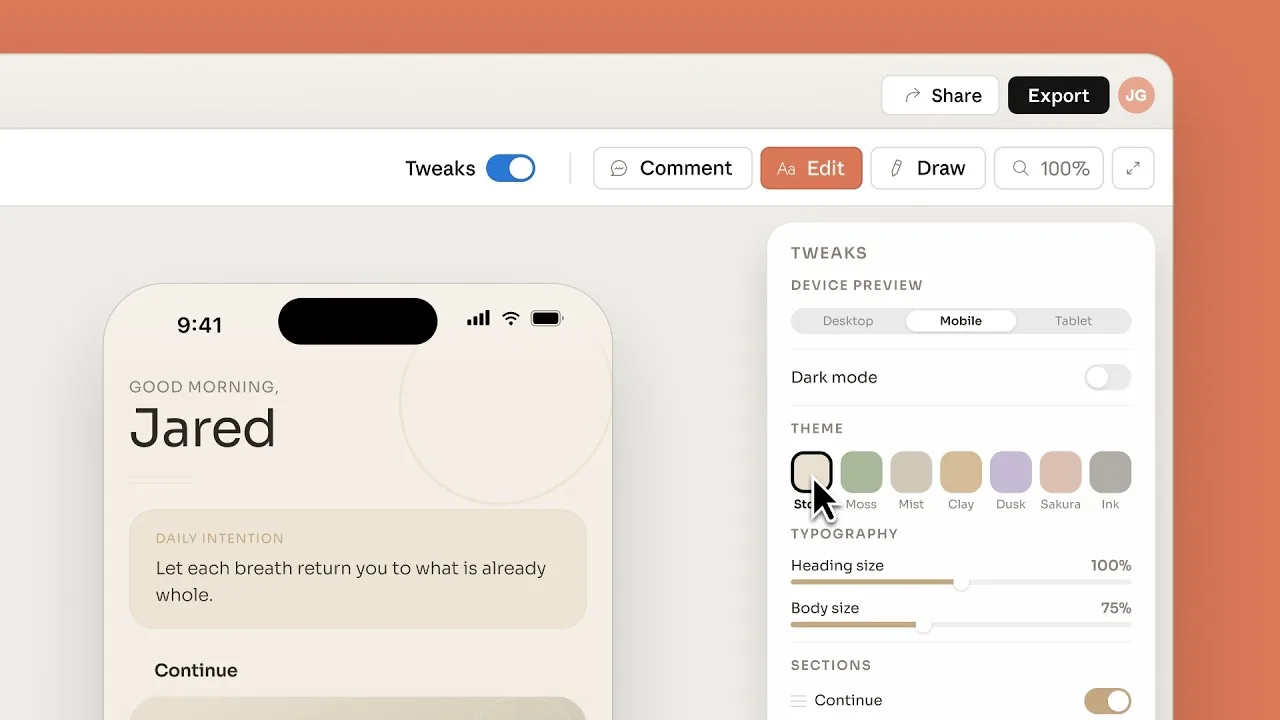
Introducing Claude Design by Anthropic Labs
Explore how Claude Design leverages Anthropic's AI models to assist in UI/UX prototyping, front-end coding, and creative workflows.
AI Agents in Higher Education: Uses and Best Tools for 2026
Explore how AI agents are transforming higher education in 2026, including 15 use cases, the best tools for students and faculty, benefits, risks, and implementation guidance.

AI for Restaurants: 5 Use Cases to Implement in 2026
Discover how AI is transforming the restaurant industry. Explore 5 key use cases for AI in restaurants in 2026, from optimizing operations to enhancing custo...
Continue exploring
Find AI agents by workflow
More in Partner Insights
Browse more articles in the Partner Insights category.
ai articles
Explore more guides and insights tagged ai.
AI ethics in design articles
Explore more guides and insights tagged AI ethics in design.
AI Agent Categories
Browse use-case pages for sales, productivity, coding, customer service, and more.
AI Agents Landscape
Explore the full directory map and compare agents by workflow and category.
Agent Skills
Find reusable skills, capabilities, and building blocks for AI agent workflows.