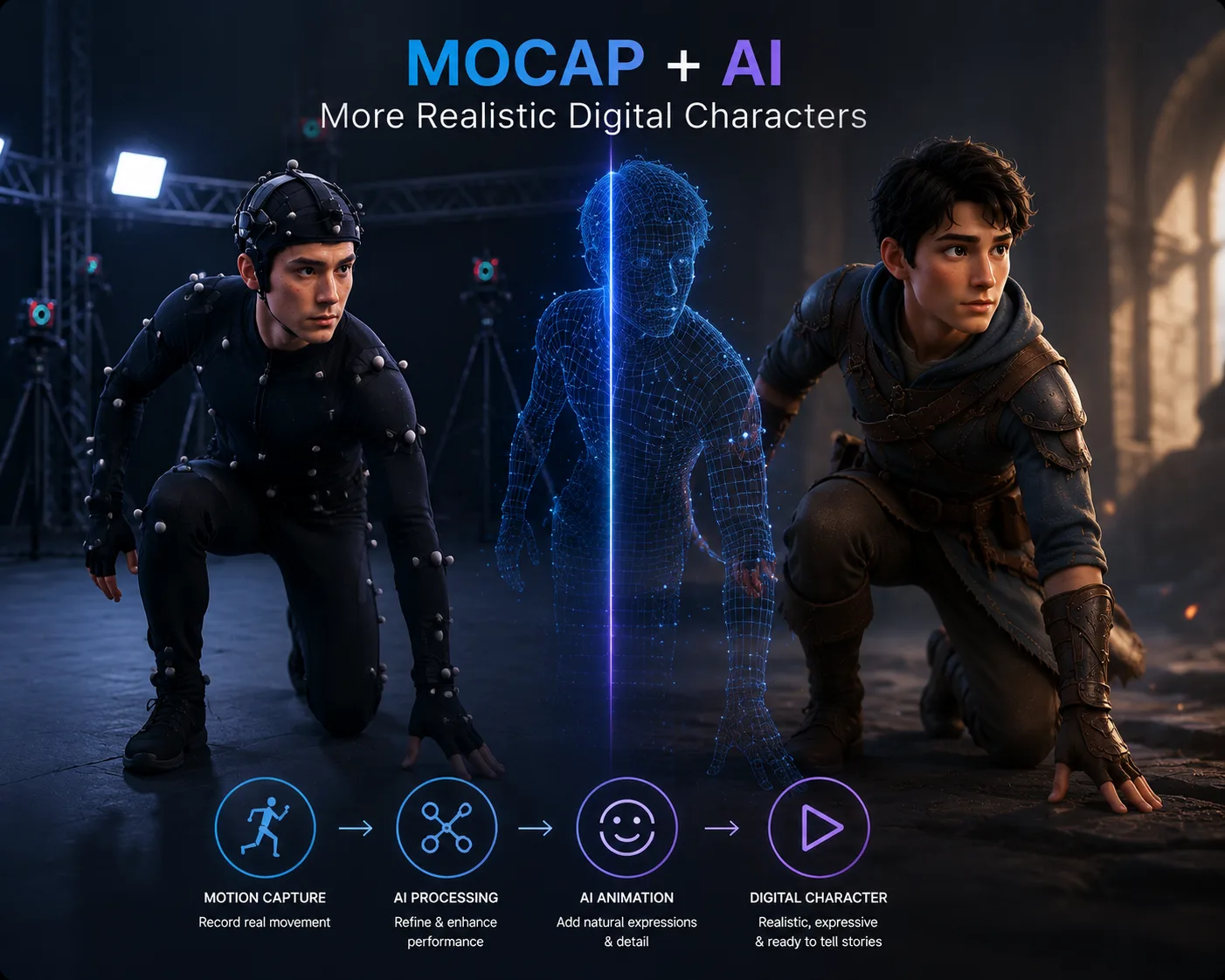
How Motion Capture and AI Are Creating More Realistic Digital Characters
Digital characters have come a long way from simple animated models. Today, audiences expect virtual characters to move naturally, show realistic emotions, and behave like believable performers. Whether it is a character in a film, a game avatar, a virtual influencer, or a digital human used in marketing, realism depends on more than visual quality.
Movement, expressions, timing, and personality all play a role in making a digital character feel alive.
This is where motion capture and AI are transforming character creation. Motion capture brings human performance into the digital world by recording movement, while AI helps refine, enhance, and expand those performances into more flexible creative workflows.
Together, these technologies are helping filmmakers, animators, and creators develop digital characters that feel more natural and emotionally engaging.
Why Realistic Digital Characters Are Difficult to Create
Creating a believable digital character requires solving several creative and technical challenges.
A character needs to look consistent, but appearance alone is not enough. Audiences connect with characters through subtle details such as:
Facial expressions
Body language
Timing of movements
Emotional reactions
Interaction with surroundings
A character that walks, talks, or reacts unnaturally can quickly break immersion.
Traditionally, animators spent significant time creating these details manually. While this approach allows complete artistic control, it can require extensive effort, especially for complex projects involving multiple characters and scenes.
Motion capture and AI are helping reduce these challenges by making digital performances easier to create and refine.
What Is Motion Capture and How Does It Work?
Motion capture, often called mocap, is a technology that records human movement and transfers it to a digital character.
During a motion capture session, performers wear specialized equipment or are tracked by cameras that capture body movements, facial expressions, and gestures. This recorded information is then applied to a digital model.
The process allows animators to capture realistic human motion instead of creating every movement manually.
Motion capture is commonly used for:
Films and visual effects
Video games
Animated content
Virtual reality experiences
Digital humans
Commercial productions
Some of the most memorable digital characters in entertainment have used motion capture to achieve more realistic performances.
How AI Is Improving Motion Capture Workflows
Motion capture already provides realistic movement data, but AI is making the process faster and more flexible.
AI can analyze captured movements, clean up data, and help adapt performances for different characters and environments.
For example, AI can assist with:
Motion Refinement
Raw motion capture data may contain unwanted movements or technical inconsistencies. AI can help smooth these details while preserving the original performance.
Expanding Performance Options
Instead of capturing every possible movement manually, AI can help generate variations based on existing performance data.
Faster Character Animation
AI-assisted workflows can reduce repetitive animation tasks, allowing artists to focus more on storytelling and creative direction.
This combination allows creators to build more detailed digital performances in less time.
Creating More Natural Digital Characters With AI
A realistic digital character requires more than recorded movement. It needs personality and emotional depth.
AI helps bridge the gap between movement and performance by supporting areas such as:
Facial animation
Expression generation
Voice integration
Character behavior
Scene interaction
For example, a digital character reacting to a surprising event needs more than a head movement. It needs the correct facial expression, timing, body posture, and emotional response.
AI can help connect these different elements to create more believable performances.
Facial Animation Is Making Characters More Expressive
Facial expressions are one of the most important aspects of digital realism.
Small details such as eye movement, changes in expression, and subtle reactions can make a character feel human.
AI-powered facial animation helps creators develop:
More accurate expressions
Better lip movement
Emotional transitions
Realistic reactions
This is especially important for digital humans and virtual actors, where facial performance is central to audience connection.
A character with realistic movement but limited facial expression can still feel artificial. Combining motion capture with AI-driven facial animation creates a more complete performance.
AI Characters Are Expanding Beyond Entertainment
Digital characters are no longer limited to movies and games.
Brands, creators, and businesses are increasingly exploring virtual characters for:
Marketing campaigns
Social media content
Virtual influencers
Educational videos
Interactive experiences
Virtual actors allow creators to build recurring digital personalities that can appear across multiple pieces of content.
However, maintaining consistency becomes important. A digital character needs to look, move, and behave the same way across different appearances.
Character Consistency Is Becoming a Major Challenge
As creators produce more AI-generated content, maintaining character identity becomes increasingly important.
A digital character appearing in multiple scenes should maintain:
Facial features
Clothing style
Movement patterns
Voice characteristics
Personality traits
Without consistency, audiences may struggle to connect with the character.
AI workflows that preserve creative context are helping solve this problem by allowing creators to maintain important character details throughout a project.
AI Agents Are Supporting Character-Driven Production Workflows
Character-based projects often involve multiple creative stages. A filmmaker may need to manage character design, scene development, animation, camera choices, voice, and visual effects together.
AI-assisted workflows are helping connect these creative decisions.
Invideo Agent supports character-driven video workflows by helping creators develop ideas into complete video projects while connecting planning, visual development, generation, and editing. This can be useful for projects where characters need to remain consistent across different scenes, stories, or campaign assets.
Instead of treating each generated scene as an isolated output, creators can build a more connected workflow where character direction and visual decisions remain aligned throughout production.
For larger character-based projects, invideo Agent Two helps teams manage more complex creative processes by supporting collaboration between different production roles. With capabilities designed around maintaining project context and coordinating areas such as story development, cinematography, and visual effects, it can help teams create more consistent digital characters across multi-scene productions.
Motion Capture and AI in Virtual Production
Virtual production is becoming an important area where motion capture and AI work together.
Filmmakers can combine:
Digital environments
AI-generated assets
Motion capture performances
Real-time rendering
Virtual characters
This allows directors to visualize scenes earlier and experiment with character performances before final production.
Instead of waiting until the end of the process to see the result, creative teams can make decisions while characters and environments are still being developed.
The Role of AI in Creating Virtual Actors
Virtual actors represent one of the strongest possibilities of AI-powered character technology.
A virtual actor can combine:
Digital appearance
Motion capture performance
AI-generated voice
Facial animation
Character behavior
This creates opportunities for new types of storytelling and content creation.
Brands could develop digital ambassadors, filmmakers could create fictional characters faster, and creators could build recurring personalities for online platforms.
However, successful virtual actors still require strong creative direction. Technology can create the character, but storytelling gives that character meaning.
Challenges of AI-Driven Digital Characters
While AI and motion capture are improving digital performances, some challenges remain.
Maintaining Emotional Authenticity
A technically accurate movement does not always create an emotionally convincing performance. Human creative input remains essential.
Character Control
Creators need reliable ways to guide how characters look, move, and behave throughout a project.
Balancing Automation and Creativity
AI can speed up production, but the strongest results come from combining automation with artistic decisions.
The Future of Motion Capture and AI Characters
The future of digital characters will likely involve deeper integration between human performances and artificial intelligence.
Motion capture will continue providing the foundation of realistic movement, while AI will help expand, refine, and adapt those performances.
Future workflows may allow creators to:
Develop characters faster
Create more realistic expressions
Generate longer performances
Maintain consistency across projects
Build interactive digital personalities
As these technologies improve, the gap between real performers and digital characters will continue to shrink.
Final Thoughts
Motion capture and AI are changing how digital characters are created, making performances more realistic, expressive, and accessible.
Motion capture brings the human element by capturing natural movement, while AI helps refine those performances and expand creative possibilities.
The future of digital characters will not be about replacing human creativity. Instead, it will be about giving creators better tools to build memorable characters, richer stories, and more immersive experiences.
By combining performance capture, artificial intelligence, and connected creative workflows, filmmakers and creators can bring digital characters to life in ways that were previously difficult to achieve.
Related Articles
View all articles
What Is Tokenization? The Future of Digital Assets
Explore how tokenization is reshaping finance. Learn the core principles, benefits, and the role of autonomous systems in the digital economy.
Why AI Agents Are Becoming the New Digital Workforce
Why AI Agents Are Becoming the New Digital Workforce
6 Types of Content You Can Display Using a Digital Signage Software
6 Types of Content You Can Display Using a Digital Signage Software
Continue exploring
Find AI agents by workflow
More in Partner Insights
Browse more articles in the Partner Insights category.
motion capture and AI articles
Explore more guides and insights tagged motion capture and AI.
AI digital characters articles
Explore more guides and insights tagged AI digital characters.
AI Agent Categories
Browse use-case pages for sales, productivity, coding, customer service, and more.
AI Agents Landscape
Explore the full directory map and compare agents by workflow and category.
Agent Skills
Find reusable skills, capabilities, and building blocks for AI agent workflows.