
From Data to Decisions: How AI Agents Are Redefining Product Intelligence
Artificial intelligence has moved beyond experimentation. What was once limited to isolated models and narrow use cases is now evolving into something more dynamic, systems that can observe, learn, and act with increasing autonomy.
At the center of this shift are AI agents.
Unlike traditional software, AI agents are not simply reactive. They are designed to interpret data, make decisions, and adapt over time. But for all their sophistication, their effectiveness still depends on one fundamental factor: the quality of the data they receive.
Without meaningful, structured insight into user behavior, even the most advanced AI systems struggle to deliver value. This is why product intelligence, how data is collected, interpreted, and applied, is becoming a defining layer in modern AI ecosystems.
The Evolution From Static Models to Adaptive Systems
Early AI implementations were largely static. Models were trained on historical data, deployed, and updated periodically. While effective in controlled environments, this approach limited their ability to respond to changing conditions.
AI agents represent a different paradigm.
They operate continuously, processing new information in real time and adjusting their behavior accordingly. This makes them particularly well-suited for environments where user behavior is dynamic and unpredictable.
Applications include:
personalized user experiences
automated decision-making systems
adaptive recommendation engines
But in each of these cases, the agent’s performance is directly tied to how well it understands user intent.
Why Behavioral Data Matters More Than Ever
User behavior is inherently complex. It is shaped by context, intent, and subtle interactions that are not always immediately visible.
For AI agents to make effective decisions, they need access to data that goes beyond surface-level metrics.
It’s not enough to know that a user opened an app or visited a page. What matters is:
how they navigated
where they hesitated
which actions led to meaningful outcomes
This level of detail allows AI systems to identify patterns that would otherwise remain hidden.
Platforms like Apptics play a critical role in this process by capturing granular behavioral data across user journeys. By providing visibility into how users interact with digital products, they create a foundation that AI agents can build upon.
Instead of operating in isolation, AI systems become informed by real-world usage.
Turning Insight Into Action
One of the defining characteristics of AI agents is their ability to act.
But action without context can lead to suboptimal outcomes. Recommendations may miss the mark, automated decisions may feel irrelevant, and user experiences may become inconsistent.
The key is to connect insight with execution.
When behavioral data is integrated effectively, AI agents can:
personalize user journeys in real time
optimize feature placement based on usage patterns
adjust recommendations based on evolving preferences
This creates a feedback loop where data informs decisions, and decisions generate new data.
Over time, this loop becomes more refined, leading to increasingly accurate and relevant outcomes.
The Role of Real-Time Learning
Static datasets limit the potential of AI systems. Real-world environments are constantly changing, and user expectations evolve quickly.
AI agents that rely on outdated information risk becoming misaligned with current behavior.
Real-time data addresses this challenge.
By continuously ingesting and analyzing new interactions, AI systems can update their understanding and respond accordingly. This allows them to remain relevant, even as conditions change.
Real-time learning is particularly important in high-velocity environments such as eCommerce, mobile applications, and digital services, where user decisions are influenced by immediate context.
Personalization at Scale
One of the most visible applications of AI agents is personalization.
Delivering tailored experiences to individual users has long been a goal for digital products. AI makes this possible at scale.
But effective personalization requires more than segmentation. It requires a deep understanding of individual behavior.
For example:
two users may belong to the same demographic group but behave very differently
one may prefer exploration, while another seeks efficiency
one may respond to recommendations, while another ignores them
Behavioral data allows AI agents to move beyond broad categories and respond to these nuances.
The result is a more adaptive and user-centric experience.
The Importance of Data Integrity
As reliance on data increases, so does the importance of data quality.
Incomplete or inaccurate data can lead to flawed decisions, undermining the effectiveness of AI systems.
Ensuring data integrity involves:
consistent tracking across user interactions
accurate event definition
reliable data pipelines
According to MIT Technology Review, the success of AI systems is closely tied to the quality and relevance of the data they are trained on. This principle extends beyond training into real-time operation.
Without a strong data foundation, even advanced AI agents cannot perform effectively.
Bridging Product, Data, and AI
One of the emerging challenges in AI-driven systems is integration.
Product teams, data teams, and AI engineers often operate in separate domains. Each brings a different perspective, but alignment is essential.
Behavioral analytics acts as a bridge between these areas.
It provides a shared source of truth:
product teams understand how features are used
data teams structure and analyze interactions
AI systems leverage this data to make decisions
When these elements are aligned, the system as a whole becomes more coherent and effective.
The Future of Intelligent Systems
As AI agents continue to evolve, their success will depend less on raw computational power and more on their ability to interpret and act on meaningful data.
The next generation of intelligent systems will not just process information, they will understand context, anticipate needs, and adapt continuously.
This evolution will require:
deeper integration between analytics and AI
more sophisticated data pipelines
a stronger focus on user-centric design
A More Intelligent Approach to Building Products
Ultimately, AI agents are not replacing human decision-making, they are augmenting it.
By providing insights that are grounded in real user behavior, they enable teams to make more informed choices and build more responsive systems.
But this is only possible when the data foundation is strong.
Understanding users, how they interact, what they value, and where they encounter friction, is the starting point for any intelligent system.
And as AI continues to shape the future of digital products, that understanding will become not just an advantage, but a necessity.
Related Articles
View all articles
How Live Data APIs Help AI Agents Do Real Work
Learn how data APIs help AI agents access live information, research markets, track trends, create content, and complete real-world workflows.

Google AI Agents Are Going Mainstream: What It Means for You
Discover how Google is bringing AI agents into everyday use, their impact on daily tasks, and the future of intelligent automation.
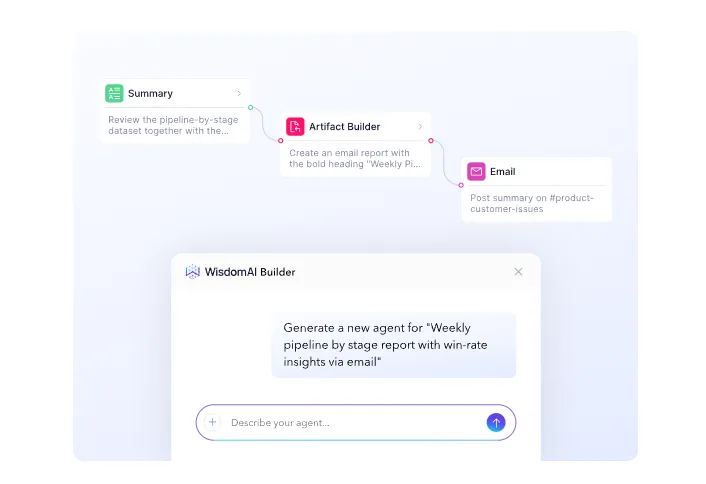
WisdomAI Launches Autonomous Analytics Agents
Explore how autonomous analytics agents like those from WisdomAI are transforming data workflows. Learn the mechanics, benefits, and tradeoffs.
Continue exploring
Find AI agents by workflow
More in Partner Insights
Browse more articles in the Partner Insights category.
AI Agent Categories
Browse use-case pages for sales, productivity, coding, customer service, and more.
AI Agents Landscape
Explore the full directory map and compare agents by workflow and category.
Agent Skills
Find reusable skills, capabilities, and building blocks for AI agent workflows.
Free AI Agents
Discover free AI agents and tools for testing agentic workflows without upfront cost.
Open Source AI Agents
Compare open-source agents, frameworks, and developer-friendly agent projects.