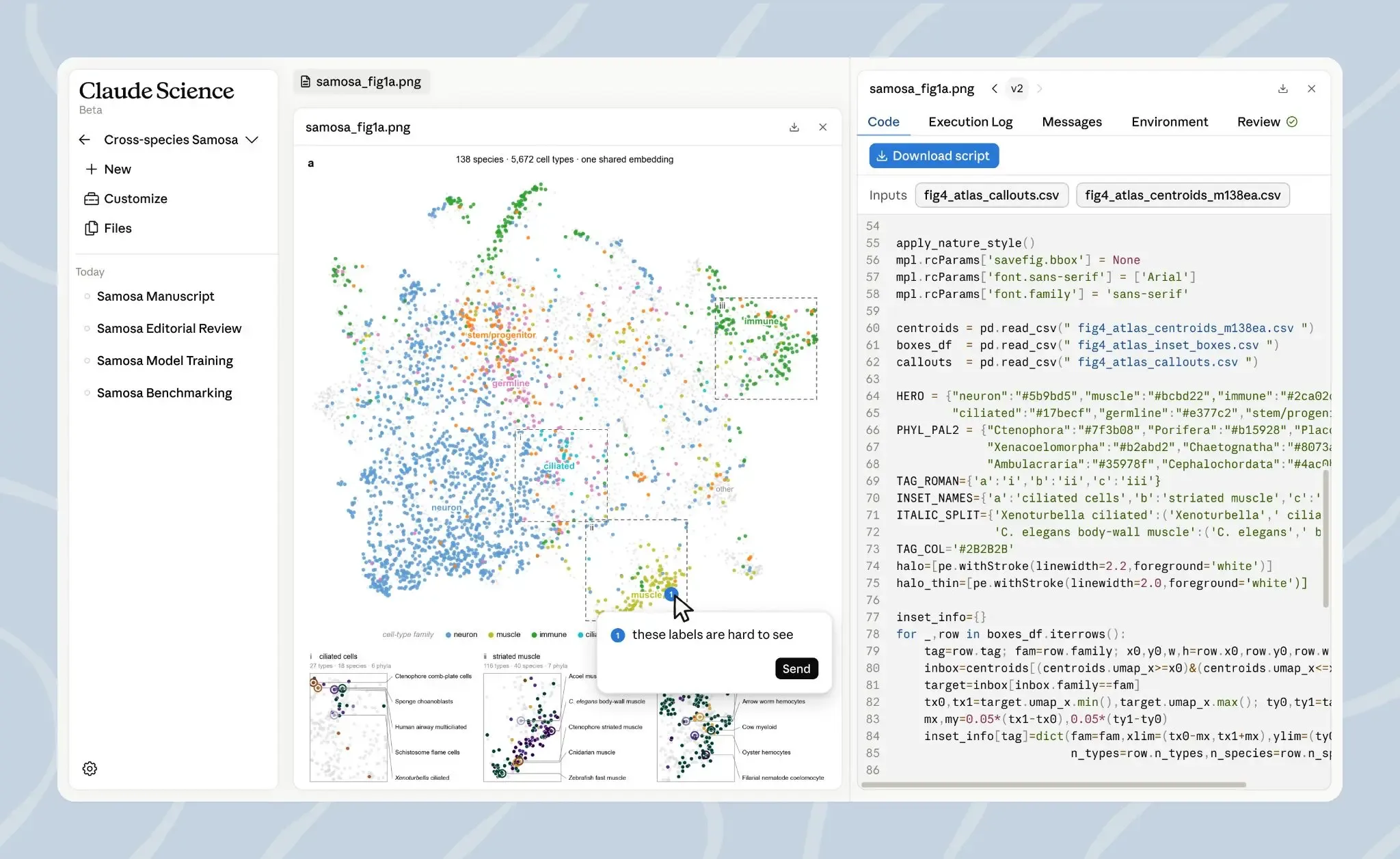
Anthropic Introduces Claude Science: A New Era for AI in Scientific Research
Introduction to Claude Science: Advancing Scientific Discovery
The landscape of scientific research is undergoing a profound transformation, driven by the rapid advancements in artificial intelligence. Among the leading innovators in this space is Anthropic, a company dedicated to developing safe and beneficial AI. Recently, Anthropic introduced Claude Science, a specialized large language model designed to empower researchers and accelerate the pace of scientific discovery. This article delves into what Claude Science is, its unique capabilities, and how it's poised to redefine the way we approach scientific inquiry across various disciplines.
For scientists, academics, and research institutions seeking to leverage cutting-edge AI tools, Claude Science offers a powerful new avenue for exploration and innovation. By understanding its functionalities and potential applications, you can begin to envision how this advanced AI can enhance your own research endeavors.
What is Claude Science?
Claude Science is Anthropic's latest iteration of their Claude family of large language models, specifically engineered and fine-tuned for the complexities and nuances of scientific research. Unlike general-purpose LLMs, Claude Science is built with an understanding of scientific methodologies, terminology, and data structures. Its core purpose is to assist researchers in a wide array of tasks, from literature reviews and data analysis to hypothesis generation and manuscript writing.
The development of Claude Science reflects a growing trend towards specialized AI models that can address the unique challenges within specific domains. By focusing on the scientific realm, Anthropic aims to provide tools that are not only powerful but also contextually relevant and highly effective for scientific professionals. This specialization allows Claude Science to process and interpret scientific information with greater accuracy and insight than a more generalized model might achieve.
Key Capabilities of Claude Science
Claude Science boasts a suite of sophisticated capabilities tailored to the demands of scientific research. These features enable it to act as a powerful research assistant, augmenting human intellect and streamlining complex workflows.
Advanced Data Analysis and Interpretation
One of the most significant contributions of Claude Science lies in its ability to process and analyze vast datasets. It can help researchers identify patterns, anomalies, and correlations within experimental results, genomic sequences, chemical structures, and other scientific data types. This capability can significantly speed up the process of drawing meaningful conclusions from complex experimental outputs.
Comprehensive Literature Review Assistance
Navigating the ever-expanding body of scientific literature can be a daunting task. Claude Science excels at performing comprehensive literature reviews, summarizing research papers, identifying key findings, and highlighting relevant studies. This feature assists researchers in staying abreast of the latest developments in their field and understanding the existing body of knowledge more efficiently. How can Claude Science assist in scientific literature reviews? It can quickly sift through thousands of papers, extract key information, and even identify gaps in current research, saving invaluable time.
Hypothesis Generation and Experimental Design
Claude Science can serve as a creative partner in the research process. By analyzing existing data and literature, it can suggest novel hypotheses or propose experimental designs to test specific theories. This AI-powered brainstorming can lead to innovative research directions that might not have been immediately apparent to human researchers. Is Claude Science suitable for generating scientific hypotheses? Yes, its ability to connect disparate pieces of information allows for creative and data-driven hypothesis generation.
Scientific Writing and Communication Support
The process of writing scientific papers, grant proposals, and reports can be labor-intensive. Claude Science can assist in drafting sections of manuscripts, refining language for clarity and conciseness, and ensuring adherence to academic writing standards. This support can significantly improve the efficiency and quality of scientific communication. Using Claude Science for data analysis in research is one of its core strengths, but its utility extends to making that analysis understandable through improved writing.
Understanding Complex Scientific Concepts
Claude Science is trained on a vast corpus of scientific text, enabling it to understand and explain complex scientific concepts, theories, and methodologies. This can be invaluable for researchers seeking to grasp new fields, cross-disciplinary collaborators, or educators explaining intricate topics.
Applications in Scientific Research
The versatility of Claude Science allows it to be applied across a broad spectrum of scientific disciplines, offering tangible benefits to researchers and institutions alike.
Life Sciences and Medicine
In biology and medicine, Claude Science can aid in drug discovery by analyzing molecular data, predicting compound interactions, and summarizing clinical trial results. It can also assist in understanding genetic predispositions, personalizing treatment plans, and reviewing vast amounts of medical literature to identify best practices.
Chemistry and Materials Science
For chemists and materials scientists, Claude Science can help in predicting material properties, designing new synthesis pathways, and analyzing spectroscopic data. It can accelerate the discovery of novel materials with desired characteristics for various applications.
Physics and Astronomy
In physics and astronomy, Claude Science can assist in analyzing observational data from telescopes, simulating complex physical phenomena, and interpreting theoretical models. What types of scientific data can Claude Science analyze? It can handle a wide range of data, including numerical datasets, textual reports, chemical formulas, genetic sequences, and more, provided it can be represented in a format it can process.
Environmental Science and Climate Research
Environmental scientists can leverage Claude Science for analyzing climate models, predicting ecological changes, and synthesizing research on conservation efforts. Its ability to process large-scale datasets is particularly useful in this field.
Benefits for Researchers and Institutions
The introduction of Claude Science offers significant advantages, not only for individual researchers but also for the broader academic and institutional landscape.
Accelerated Discovery: By automating and augmenting time-consuming tasks, Claude Science can significantly shorten the research lifecycle, leading to faster breakthroughs.
Enhanced Collaboration: Its ability to summarize complex information and explain intricate concepts can foster better understanding and collaboration among interdisciplinary teams.
Democratization of Research: Advanced AI tools like Claude Science can lower the barrier to entry for complex analyses, making sophisticated research techniques more accessible to a wider range of scientists. This aligns with the trend of the role of LLMs in democratizing scientific research.
Improved Grant Writing and Publication: The assistance Claude Science provides in drafting and refining scientific communication can lead to more successful grant applications and higher-quality publications. This is a key aspect of AI-powered tools for academic writing and publication.
Focus on Innovation: By handling routine tasks, Claude Science frees up researchers to focus on higher-level thinking, creativity, and the core aspects of scientific inquiry.
Comparing Claude Science to Other Anthropic Models
Anthropic's commitment to developing advanced AI is evident in its range of Claude models. While general models like Claude Sonnet offer broad capabilities for various tasks, Claude Science represents a specialized evolution. If you're interested in the broader capabilities of Anthropic's offerings, understanding Anthropic Launches Claude Sonnet 5: What You Need to Know can provide valuable context. Similarly, for those exploring the frontiers of AI agents and advanced reasoning, Claude Opus 4.8: Anthropic's Leap Forward for Agentic AI showcases another significant development in their AI portfolio. Claude Science builds upon the foundational strengths of these models but directs them with specific scientific expertise.
The Future of AI in Scientific Discovery with Claude Science
The advent of Claude Science marks a pivotal moment in the integration of AI into the scientific process. It embodies the acceleration of scientific discovery through specialized AI, moving beyond general assistance to provide domain-specific intelligence. The potential for generative AI to impact hypothesis generation is immense, and Claude Science is at the forefront of this development.
As AI models become more sophisticated and specialized, we can anticipate even greater synergies between human researchers and artificial intelligence. The ethical framework for AI in sensitive scientific fields is a crucial discussion, and Anthropic's focus on safety and beneficial AI is paramount as these tools become more integrated into research. Claude Science is not just a tool; it's a partner in the ongoing quest for knowledge and innovation, promising a future where scientific breakthroughs are achieved faster and more efficiently than ever before.
Conclusion
Anthropic's Claude Science represents a significant leap forward in AI for scientific research. Its specialized capabilities in data analysis, literature review, hypothesis generation, and scientific writing empower researchers to push the boundaries of knowledge. By providing a powerful and intuitive AI assistant, Claude Science is set to accelerate discovery, foster collaboration, and democratize access to advanced research methodologies.
Related Articles
View all articles
Anthropic Launches Claude Sonnet 5: What You Need to Know
Explore the key features and advancements of Anthropic's Claude Sonnet 5, a significant update in large language model technology. Learn what this means for AI.

Claude Opus 4.8: Anthropic's Leap Forward for Agentic AI
Explore the latest advancements in Anthropic's Claude Opus 4.8, focusing on its capabilities for extended agentic tasks and its impact on AI-powered business...
Claude 5 is about to be released
Preparing for the next iteration of Anthropic's Claude. Learn how to evaluate new AI models, understand upgrade cycles, and leverage existing capabilities.
Continue exploring
Find AI agents by workflow
More in Industry Insights
Browse more articles in the Industry Insights category.
AI articles
Explore more guides and insights tagged AI.
Science articles
Explore more guides and insights tagged Science.
AI Agent Categories
Browse use-case pages for sales, productivity, coding, customer service, and more.
AI Agents Landscape
Explore the full directory map and compare agents by workflow and category.
Agent Skills
Find reusable skills, capabilities, and building blocks for AI agent workflows.