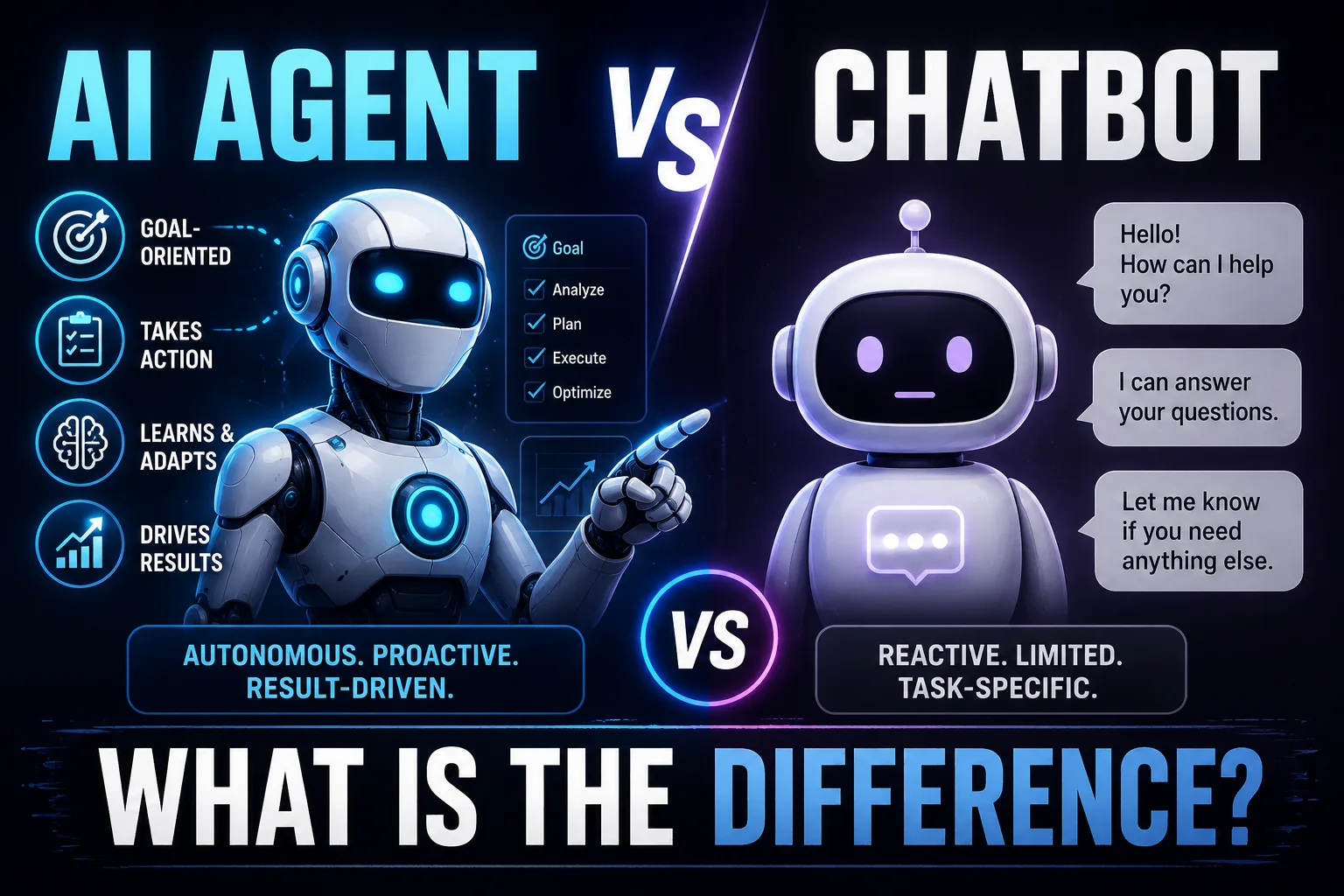
AI Agent vs Chatbot: What Is the Difference?
Introduction: Setting the Stage
In the rapidly evolving landscape of artificial intelligence, the terms "AI agent" and "chatbot" are often used interchangeably. This can lead to confusion about their distinct capabilities and applications. While both leverage AI to interact with users and perform tasks, understanding the core differences is crucial for identifying the right technology for specific needs. This article will delve into what defines a chatbot and an AI agent, highlight their key distinctions, explore their capabilities and use cases, and touch upon their future trajectories.
What is a Chatbot?
A chatbot, at its most basic, is a computer program designed to simulate conversation with human users, especially over the internet. Its primary function is to understand natural language input and provide relevant responses. Chatbots are typically built with rule-based systems or natural language processing (NLP) models.
Typical Architectures and Use Cases
Rule-Based Chatbots: These operate on a predefined set of rules and keywords. They are best for handling simple, repetitive queries where the range of possible answers is limited. For example, a customer service bot that answers FAQs about shipping times or return policies.
AI-Powered Chatbots: These utilize machine learning and NLP to understand intent, context, and sentiment, allowing for more dynamic and nuanced conversations. They can learn from interactions to improve their responses over time. Common use cases include:
Customer support and service
Lead generation and sales assistance
Information retrieval and FAQs
Personalized recommendations
Basic task automation within a defined scope
While chatbots excel at conversational interfaces, their scope of action is generally confined to the dialogue or the specific application they are integrated into. They are reactive, responding to user prompts rather than initiating actions independently.
What is an AI Agent?
An AI agent, or intelligent agent, is a more sophisticated entity. It is an autonomous system that perceives its environment through sensors and acts upon that environment through actuators to achieve goals. Unlike a chatbot, an AI agent is not limited to conversational interaction; it can perform a wide range of tasks, often without direct human supervision.
Key Characteristics of AI Agents
The defining characteristic of an AI agent is its autonomy and goal-oriented behavior. This means it can:
Perceive: Gather information about its environment through various inputs (data streams, sensors, user input).
Reason: Process this information, make decisions, and plan actions based on its goals and learned knowledge.
Act: Execute actions in its environment to achieve its objectives. This could involve manipulating digital systems, controlling physical devices, or interacting with other agents.
Learn: Adapt and improve its performance over time based on feedback and new experiences.
The concept of an AI agent is broader and encompasses systems that can proactively manage complex workflows, engage in multi-step processes, and even operate within marketplaces to fulfill tasks. The evolving definition of 'intelligence' in AI agents is closely tied to their capacity for independent problem-solving and adaptation.
Key Differences: AI Agent vs. Chatbot
The fundamental distinction between an AI agent and a chatbot lies in their scope, autonomy, and complexity. While a chatbot is primarily a conversational interface, an AI agent is an active participant in its environment designed to achieve objectives.
Autonomy and Goal Orientation
Chatbots: Are largely reactive. They wait for user input and respond accordingly. Their goals are typically to provide information or complete a specific conversational task.
AI Agents: Are proactive and goal-driven. They can identify tasks, plan steps, and execute them to achieve a broader objective, often with minimal human intervention.
Complexity and Scope of Action
Chatbots: Their complexity is usually limited to understanding natural language and managing dialogue flow. Their actions are confined to the conversational exchange or a predefined set of tasks within an application.
AI Agents: Can be significantly more complex, involving planning, reasoning, and decision-making across multiple domains. They can interact with various software systems, APIs, and even physical devices to accomplish their goals. The increasing sophistication of AI agents beyond conversational interfaces is a major trend.
Learning and Adaptation
Chatbots: Some AI-powered chatbots can learn from interactions to improve their conversational abilities. However, their learning is often focused on linguistic understanding.
AI Agents: Possess more robust learning capabilities, enabling them to adapt their strategies, improve their decision-making processes, and optimize their actions to achieve goals more effectively over time. This ability is key to their autonomous operation.
The Main Difference
The main difference between an AI and a chatbot is that a chatbot is a specific application of AI focused on conversation, while an AI agent is a broader concept representing an autonomous entity that can perceive, reason, and act to achieve goals. A chatbot can be a component of an AI agent, but an AI agent is not necessarily a chatbot.
Capabilities and Functionality Breakdown
To further clarify the distinctions, let's break down the specific capabilities and limitations of each.
Chatbot Capabilities:
Natural Language Understanding (NLU): Interpreting user queries and intent.
Dialogue Management: Maintaining context and flow in a conversation.
Information Retrieval: Accessing and presenting predefined information.
Basic Task Execution: Performing simple, predefined actions (e.g., booking an appointment, answering a specific question).
Limitations of Chatbots: Their primary limitation is their reactive nature and confined scope. They struggle with complex, ambiguous, or out-of-scope requests. They generally cannot initiate actions or manage multi-step processes independently without explicit user commands at each step.
AI Agent Capabilities:
Complex Problem Solving: Analyzing situations and devising multi-step solutions.
Proactive Task Management: Identifying needs and initiating actions to fulfill them.
Environmental Interaction: Interfacing with and manipulating various digital or physical systems.
Planning and Reasoning: Developing strategies and making logical deductions.
Learning and Optimization: Continuously improving performance based on experience.
Goal Achievement: Working autonomously towards defined objectives.
How do AI Agents work? AI agents work by continuously sensing their environment, processing that information through their internal models (which can include machine learning algorithms, knowledge bases, and reasoning engines), and then acting on the environment to move closer to their goals. This cycle of perception, reasoning, and action is at the core of their functionality.
Use Cases and Applications
The differing capabilities of AI agents and chatbots naturally lead to distinct application areas.
Where Chatbots Shine:
Chatbots are ideal for scenarios where direct, immediate, and focused human-computer interaction is paramount. Examples include:
E-commerce: Answering product questions, guiding shoppers, and processing simple orders.
Healthcare: Providing information about symptoms, scheduling appointments, and offering medication reminders.
Internal Support: Assisting employees with HR queries, IT troubleshooting, or accessing company policies.
Banking: Checking account balances, transferring funds, or answering FAQs about services.
Where AI Agents Shine:
AI agents are best suited for automating complex processes, managing dynamic environments, and achieving strategic objectives. Their applications are expanding rapidly:
Autonomous Systems: Self-driving cars, robotic process automation (RPA) in business, and automated trading systems.
Personal Assistants: Managing schedules, optimizing travel plans, and proactively suggesting tasks.
Research and Analysis: Agents that can scour vast datasets, identify trends, and generate reports.
Workflow Automation: Orchestrating complex sequences of tasks across different software applications to achieve business outcomes. This role highlights the role of AI agents in automating complex workflows.
Marketplace Integration: Agents that can operate within digital marketplaces to buy, sell, or perform services, signifying the convergence of AI agents and marketplaces for specialized tasks. Readers interested in this evolving area might find value in understanding AI Agent Marketplaces: The Next Phase of SaaS Evolution.
Can a chatbot be an AI agent? While a chatbot is a specific type of AI, it typically lacks the broad autonomy and goal-driven action capabilities of a true AI agent. However, a sophisticated chatbot could potentially be a component or interface for a larger AI agent system, handling the conversational aspects while the agent manages the underlying complex tasks.
The Future of AI Agents and Chatbots
The trajectory for both technologies points towards increased sophistication and potential convergence. User expectations for AI interaction are shifting from simple responses to proactive assistance, pushing the boundaries of what both chatbots and AI agents can achieve.
AI agents are expected to become more capable of understanding complex human intent, learning from subtle cues, and collaborating with other agents or humans to solve problems. We will likely see more AI agents capable of managing intricate workflows, negotiating, and even making strategic decisions. The development of frameworks to evaluate their performance, such as understanding What Makes an AI Agent “Good”? A Practical Evaluation Framework, will be crucial.
Chatbots, on the other hand, will continue to evolve by integrating more advanced AI capabilities, becoming more context-aware, personalized, and capable of handling more complex conversational scenarios. The lines may blur as chatbots gain more agent-like functionalities within their conversational domain, and AI agents may incorporate more natural language interfaces.
Conclusion: Choosing the Right Technology
The distinction between an AI agent and a chatbot is significant, revolving around autonomy, goal-orientation, and the scope of action. Chatbots are primarily conversational tools designed for interaction and information exchange, while AI agents are autonomous systems capable of perceiving, reasoning, and acting to achieve complex goals.
When considering which technology is appropriate, ask yourself:
Does the primary need involve direct, conversational interaction, or complex task automation and proactive problem-solving?
Is the system expected to act independently to achieve objectives, or will it primarily respond to user commands?
What level of autonomy and learning is required for the task?
By understanding these core differences, you can better identify and leverage the power of AI, whether through a sophisticated chatbot or a capable AI agent, to meet your specific needs.
Discover the future of AI interaction. Explore how AI agents are transforming industries and learn how to identify the right solution for your needs.
Related Articles
View all articles
We Analyzed 2,000 AI Agents. Here’s What We Found
We examined 2,000 AI agents to identify common patterns, strengths, and limitations. Discover the reality of autonomous agent performance today.
AI Agent Traps: Real-Life Incidents and Lessons Learned
Explore real-life AI agent incidents where agents fell into traps or caused unintended consequences. Understand risks and learn from critical case studies.
What Makes an AI Agent “Good”? A Practical Evaluation Framework
Learn how to evaluate AI agents beyond simple accuracy. Discover a practical framework for measuring reliability, decision-making, and operational success.
Continue exploring
Find AI agents by workflow
More in Industry Insights
Browse more articles in the Industry Insights category.
AI Agents articles
Explore more guides and insights tagged AI Agents.
Chatbots articles
Explore more guides and insights tagged Chatbots.
AI Agent Categories
Browse use-case pages for sales, productivity, coding, customer service, and more.
AI Agents Landscape
Explore the full directory map and compare agents by workflow and category.
Agent Skills
Find reusable skills, capabilities, and building blocks for AI agent workflows.