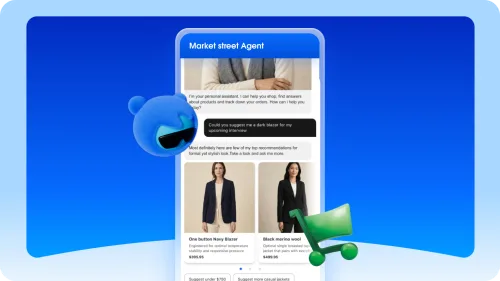
Agentforce Commerce Turns Shopping Into an Agent-Led Experience
What is Agentforce Commerce?
In the rapidly evolving landscape of online retail, a new paradigm is emerging: Agentforce Commerce. This innovative approach redefines the shopping experience by transforming it from a solitary, often overwhelming, digital scavenger hunt into a guided, personalized journey orchestrated by intelligent shopping agents. At its core, Agentforce Commerce is about leveraging artificial intelligence to create a more intuitive, efficient, and human-like interaction between consumers and online stores.
Imagine a personal shopper available 24/7, understanding your preferences, anticipating your needs, and actively assisting you in finding the perfect products. This is the promise of agent-led shopping, and Agentforce Commerce is at the forefront of making this a reality. It moves beyond traditional e-commerce, where customers navigate websites and sift through endless options, towards a model where AI-powered agents act on behalf of the shopper, simplifying complexity and enhancing satisfaction.
How Agentforce Commerce Works
The magic behind Agentforce Commerce lies in its sophisticated use of AI and natural language processing (NLP) to simulate a human-guided shopping experience. The process typically begins with a customer interacting with an AI shopping assistant, often through a chat interface or a voice command. This agent is designed to understand intent, context, and individual preferences.
The User Journey in Agent-Led Shopping
Here’s a simplified look at how a typical agent-led shopping journey unfolds:
Initiation: The customer expresses a need or a desire, either broadly (e.g., "I need a new laptop for graphic design") or specifically (e.g., "Show me red running shoes under $100").
Understanding & Qualification: The AI agent uses NLP to parse the request, asking clarifying questions to understand preferences, budget, brand loyalty, essential features, and any other relevant criteria. This stage is crucial for effective personalization.
Product Discovery & Recommendation: Based on the gathered information, the agent searches through a product catalog, leveraging its understanding of product attributes and customer data to identify the most suitable options. It then presents these recommendations in an organized and digestible manner.
Comparison & Refinement: Customers can ask the agent to compare products, highlight differences, or refine the search further. The agent can access detailed product information, reviews, and specifications to assist in this decision-making process.
Purchase Assistance: Once a decision is made, the agent can guide the customer through the checkout process, pre-filling information where possible, applying relevant discounts, and ensuring a smooth transaction. In advanced scenarios, this could even lead to zero-click shopping experiences.
Post-Purchase Support: The agent can also assist with order tracking, returns, or answering follow-up questions, extending the personalized experience beyond the initial purchase.
The underlying technology often involves large language models (LLMs), machine learning algorithms for recommendation engines, and robust integration with e-commerce platforms and inventory management systems. For businesses looking to build such systems, understanding the architecture and tools involved is key. You can explore resources like how to build your own agent harness to gain deeper insights into the technical foundations.
Key Features and Benefits of Agentforce Commerce
Agentforce Commerce offers compelling advantages for both consumers and businesses, addressing some of the inherent challenges of traditional online shopping.
Benefits for Consumers
Hyper-Personalization: Agents learn individual preferences over time, offering tailored recommendations that feel highly relevant and reduce decision fatigue.
Increased Efficiency: Customers save time by not having to manually search, filter, and compare products. The agent does the heavy lifting.
Enhanced Discovery: Agents can introduce customers to products they might not have found otherwise, based on sophisticated understanding of their needs and tastes.
Convenience: Shopping becomes more accessible and less demanding, available anytime and anywhere through familiar conversational interfaces.
Reduced Friction: From product discovery to checkout, the agent smooths out the customer journey, minimizing points of frustration.
Benefits for Businesses
Improved Conversion Rates: By providing highly relevant recommendations and a seamless experience, agent-led shopping can significantly boost sales.
Higher Average Order Value (AOV): Personalized upsells and cross-sells, guided by the agent's understanding of customer needs, can lead to larger purchases.
Enhanced Customer Loyalty: A consistently positive and personalized experience fosters stronger customer relationships and repeat business.
Valuable Data Insights: Interactions with agents provide rich data on customer preferences, behaviors, and pain points, enabling businesses to refine their offerings and marketing strategies.
Reduced Customer Service Load: Many common inquiries and support tasks can be handled by the AI agent, freeing up human agents for more complex issues.
The Role of AI in Agentforce Commerce
Artificial intelligence is not just a component of Agentforce Commerce; it is the engine that drives it. AI enables the sophisticated capabilities that differentiate agent-led shopping from previous e-commerce models.
How AI Powers Shopping Agents
Natural Language Understanding (NLU): AI allows agents to comprehend the nuances of human language, including intent, sentiment, and context, enabling genuine conversations.
Machine Learning (ML): ML algorithms are used to build recommendation engines, predict customer behavior, personalize interactions, and continuously improve the agent's performance based on data.
Data Analysis: AI can process vast amounts of data – customer history, product information, market trends – to make informed decisions and recommendations.
Personalization Engines: These AI-powered systems create individual customer profiles, allowing agents to tailor every interaction, from product suggestions to the tone of communication.
Automation: AI automates repetitive tasks in the shopping process, from initial search to post-purchase follow-up, creating a more efficient workflow.
The integration of AI also paves the way for advanced concepts like conversational commerce, where the entire transaction can occur within a dialogue, and even explore the potential for agentic commerce and zero-click shopping, where purchases are made with minimal to no direct user intervention.
Agentforce Commerce vs. Traditional E-commerce
To fully appreciate the transformative power of Agentforce Commerce, it’s useful to compare it with the conventional online shopping experience.
Traditional E-commerce
Traditional e-commerce relies on customers actively navigating websites, using search bars, applying filters, and comparing products themselves. While effective for many, this model can be:
Time-consuming: Sifting through numerous options.
Overwhelming: Decision paralysis due to too many choices.
Impersonal: Generic product displays and limited personalization.
Friction-prone: Complex navigation and checkout processes.
Agentforce Commerce
Agentforce Commerce, in contrast, shifts the burden from the customer to an intelligent agent:
Time-saving: Agents perform the search and filtering.
Simplifying: Agents curate options based on specific needs.
Personalized: Interactions and recommendations are tailored.
Frictionless: Guided experience from start to finish.
The core difference lies in the proactive, guided nature of agent-led shopping versus the reactive, self-directed nature of traditional e-commerce. Agentforce Commerce aims to make online shopping feel more like interacting with a knowledgeable store associate than browsing a digital catalog.
The Future of Shopping: Agentic Commerce and Beyond
Agentforce Commerce is a significant step towards the future of retail, often referred to as agentic commerce. This future envisions a world where AI agents are deeply integrated into our daily lives, managing tasks and facilitating transactions seamlessly.
Trends Shaping the Future
Hyper-personalization at Scale: AI will enable every customer interaction to be uniquely tailored, moving beyond basic segmentation.
Conversational Interfaces Dominance: Voice and chat will become primary modes of interaction for many shopping tasks.
Zero-Click Shopping: For routine purchases or pre-authorized needs, agents may complete transactions without requiring explicit customer approval for each step.
Proactive Shopping: Agents will anticipate needs based on user behavior, calendar events, or external data (e.g., ordering groceries before supplies run out).
Ethical AI in Commerce: As AI becomes more powerful, ensuring transparency, fairness, and data privacy will be paramount.
This evolution promises a more convenient, efficient, and personalized shopping experience, fundamentally changing consumer expectations and business strategies.
Implementing Agentforce Commerce: Considerations for Businesses
For businesses looking to embrace the agent-led shopping model, several key considerations are vital for successful implementation.
Key Implementation Steps
Define Your Use Cases: Identify which parts of the customer journey would benefit most from an agent-led approach (e.g., product discovery, customer support, personalized recommendations).
Choose the Right Technology Stack: Select AI platforms, NLP tools, and e-commerce integrations that align with your business needs and technical capabilities.
Prioritize Data Quality and Integration: Ensure your product catalog, customer data, and inventory information are accurate, up-to-date, and accessible to your AI agents.
Design for User Experience: Focus on creating intuitive conversational flows and clear, helpful agent responses. Test extensively with real users.
Develop a Phased Rollout Strategy: Start with specific functionalities or customer segments and gradually expand as you gather feedback and refine performance.
Plan for Human-AI Collaboration: Determine how human agents will complement AI agents, handling complex issues or providing a human touch when needed.
Embracing Agentforce Commerce is not just about adopting new technology; it's about reimagining the customer relationship and building a more intelligent, responsive, and customer-centric e-commerce operation.
Ready to transform your e-commerce strategy? Explore how Agentforce Commerce can elevate your customer experience and drive business growth.
Related Articles
View all articles
Agentic Commerce 2026: AI Shopping Agents, UCP, and Zero-Click Shopping
Explore agentic commerce in 2026: AI shopping agents, Universal Commerce Platforms (UCP), and zero-click shopping. Discover the future of personalized retail.
Top 8 AI Agent Trends Transforming E-Commerce in 2026 and Beyond
Discover the 8 pivotal AI agent trends revolutionizing e-commerce in 2026 and beyond, from agentic commerce and hyper-personalization to autonomous customer...
Gap Inc. Elevates Online Shopping with AI-Powered Fit and Conversational Checkout
Explore how retailers like Gap Inc. leverage AI-powered fit and conversational checkout to reduce returns and streamline the online shopping experience.
Continue exploring
Find AI agents by workflow
More in Industry Insights
Browse more articles in the Industry Insights category.
e-commerce articles
Explore more guides and insights tagged e-commerce.
AI articles
Explore more guides and insights tagged AI.
AI Agent Categories
Browse use-case pages for sales, productivity, coding, customer service, and more.
AI Agents Landscape
Explore the full directory map and compare agents by workflow and category.
Agent Skills
Find reusable skills, capabilities, and building blocks for AI agent workflows.