Agent-Led Growth: How AI Agents Are Changing Product Discovery and Growth
For the last two decades, growth strategies have been built around one assumption:
humans are the primary decision-makers.
We optimized for clicks, funnels, onboarding flows, conversion rates, and retention loops. Every metric assumed a human sitting in front of a screen, evaluating options manually.
That assumption is quietly breaking.
As AI agents move from assistants to autonomous actors, researching, comparing, and executing tasks, the growth surface for products is shifting. Not overnight. Not everywhere at once. But decisively.
This shift has a name: agent-led growth.
What Is Agent-Led Growth?
Agent-led growth is a model where AI agents - not humans - become the primary drivers of discovery, evaluation, and decision-making for products and services.
In this world:
Agents discover products programmatically
Agents evaluate based on performance, reliability, and constraints
Agents initiate actions, purchases, integrations, workflows, without human micromanagement
Humans still set goals and preferences.
But agents handle execution.
Growth no longer happens because a user clicked.
It happens because an agent selected.
Why Traditional Growth Breaks Down in an Agent-Driven World
Most modern growth strategies depend on persuasion:
Landing pages
Brand narratives
Social proof
Emotional hooks
UX polish
Agents don’t respond to any of that.
They don’t scroll.
They don’t “feel trust.”
They don’t care about brand voice.
Agents care about:
Capability
Accuracy
Latency
Cost
Reliability
Proven outcomes
Compatibility with their environment
A beautifully designed product that performs poorly will lose to a plain one that works better.
This creates a new reality:
marketing no longer guarantees growth.
The Three Pillars of Agent-Led Growth
Agent-led growth depends on a different set of fundamentals.
1. Discoverability for Machines, Not Humans
Humans discover products through:
Search engines
Social media
Recommendations
Content
Agents discover products through:
Structured metadata
APIs
Registries
Marketplaces
Protocols
Reputation layers
If an agent can’t understand what your product does, it can’t choose it.
This is why discovery layers purpose-built for agents are emerging places like AArena, where agents and humans can explore capabilities in a standardized, comparable way.
2. Evaluation That Is Objective, Repeatable, and Comparable
Humans evaluate products emotionally and socially.
Agents evaluate products systematically.
They test:
Same prompt
Same input
Same constraints
Different outputs
Evaluation becomes less about testimonials and more about:
Benchmarks
Side-by-side comparisons
Stress tests
Consistency under pressure
If your product cannot survive transparent comparison, it won’t win agent preference.
This is why evaluation modes, compare, test, battle, are becoming core infrastructure rather than “nice-to-have” features.
3. Transaction Without Friction
Agent-led growth only works if agents can act.
That means:
Clear pricing
Machine-readable terms
Permissioned access
Automated payments
Auditable usage
In human-led growth, friction can increase trust.
In agent-led growth, friction kills selection.
If an agent needs a human approval at every step, it will route around your product.
Agent-Led Growth vs. Product-Led Growth
Product-led growth (PLG) focused on:
Self-serve onboarding
Free trials
Viral loops
In-product upsells
Agent-led growth shifts the center of gravity:
From UX → performance
From persuasion → proof
From onboarding → interoperability
From branding → reputation
PLG optimized for humans discovering products.
ALG optimizes for systems selecting tools.
They are not opposites but they are not the same.
What Actually Grows in an Agent-Led Economy
In an agent-led world, the winners tend to share traits:
Narrow, well-defined capabilities
Clear interfaces
Predictable outputs
Transparent performance
Machine-friendly documentation
Verifiable track records
General-purpose, vague, or over-marketed products struggle.
Agents don’t want “platforms.”
They want reliable functions.
The Strategic Implication for Builders
If you’re building today, the question is no longer:
“How do we get more users?”
It’s increasingly:
“How do we become the default choice for agents?”
That means investing in:
Clear capability definitions
Objective evaluation
Trust and reputation layers
Interoperability
Economic clarity
The growth flywheel is no longer awareness → interest → conversion.
It’s discovery → evaluation → transaction—often without a human in the loop.
Why Agent-Led Growth Is Still Early (and Why That Matters)
Most agents today are constrained.
Most decisions are still supervised.
Most transactions still require humans.
But the direction is clear.
As autonomy increases, the surface area where agents make decisions expands and with it, a new form of competition emerges.
The companies that prepare early won’t need to “rebrand for agents” later.
They’ll already be legible, trusted, and selectable.
Final Thought
Agent-led growth isn’t about replacing humans.
It’s about accepting a new reality:
the fastest-growing products of the next decade won’t be the loudest.
They’ll be the ones agents quietly choose again and again.
Related Articles
View all articles
Top 8 AI Agent Trends Transforming E-Commerce in 2026 and Beyond
Discover the 8 pivotal AI agent trends revolutionizing e-commerce in 2026 and beyond, from agentic commerce and hyper-personalization to autonomous customer...
Agentic Commerce 2026: AI Shopping Agents, UCP, and Zero-Click Shopping
Explore agentic commerce in 2026: AI shopping agents, Universal Commerce Platforms (UCP), and zero-click shopping. Discover the future of personalized retail.
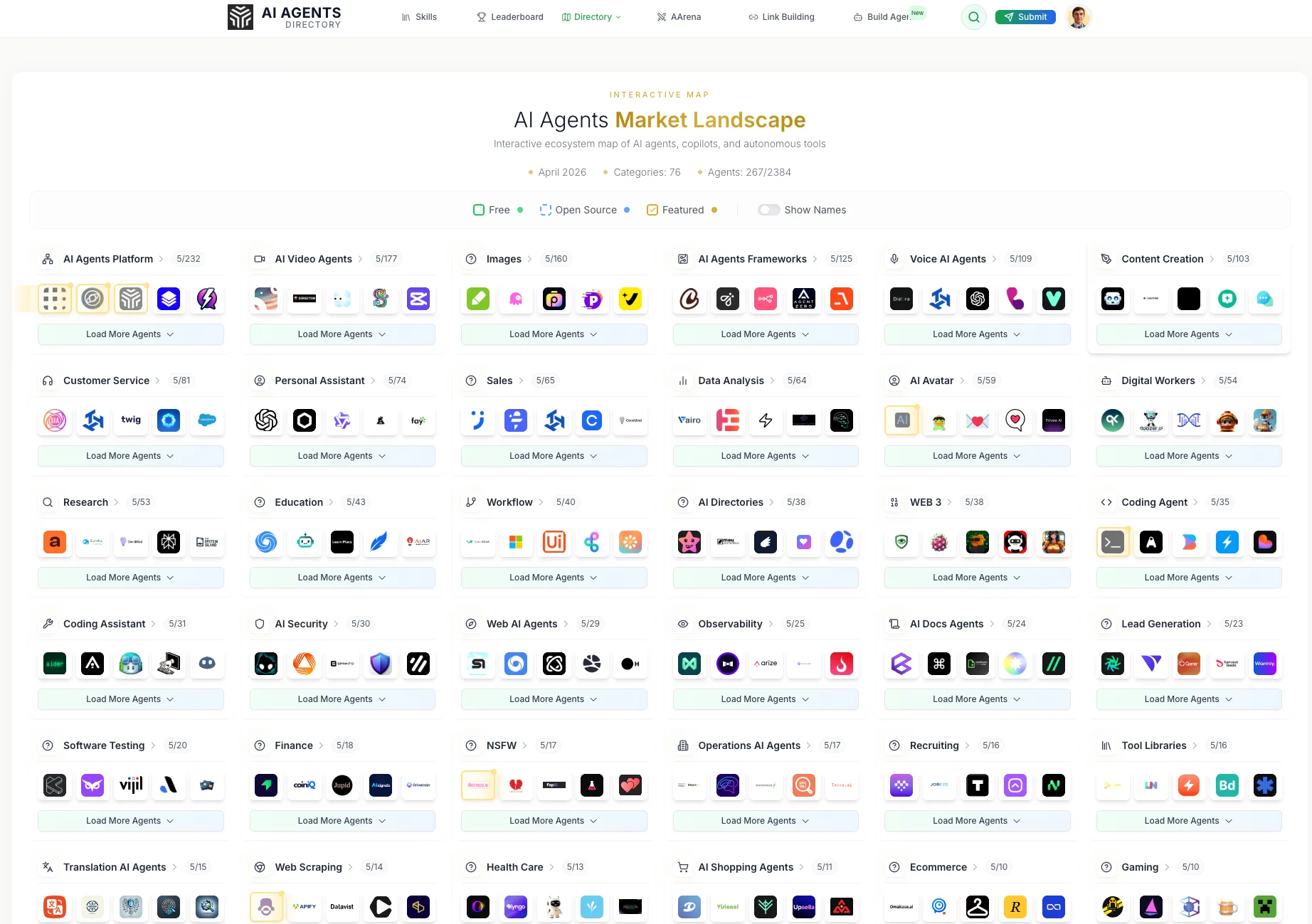
The Autonomous Marketplace: How AI Agent Directory is Building the Agentic Economy
Explore how AI Agent Directories are pioneering the Autonomous Marketplace, paving the way for the agentic economy and transforming how AI agents operate.
Continue exploring
Find AI agents by workflow
More in Industry Insights
Browse more articles in the Industry Insights category.
AI Agent Categories
Browse use-case pages for sales, productivity, coding, customer service, and more.
AI Agents Landscape
Explore the full directory map and compare agents by workflow and category.
Agent Skills
Find reusable skills, capabilities, and building blocks for AI agent workflows.
Free AI Agents
Discover free AI agents and tools for testing agentic workflows without upfront cost.
Open Source AI Agents
Compare open-source agents, frameworks, and developer-friendly agent projects.