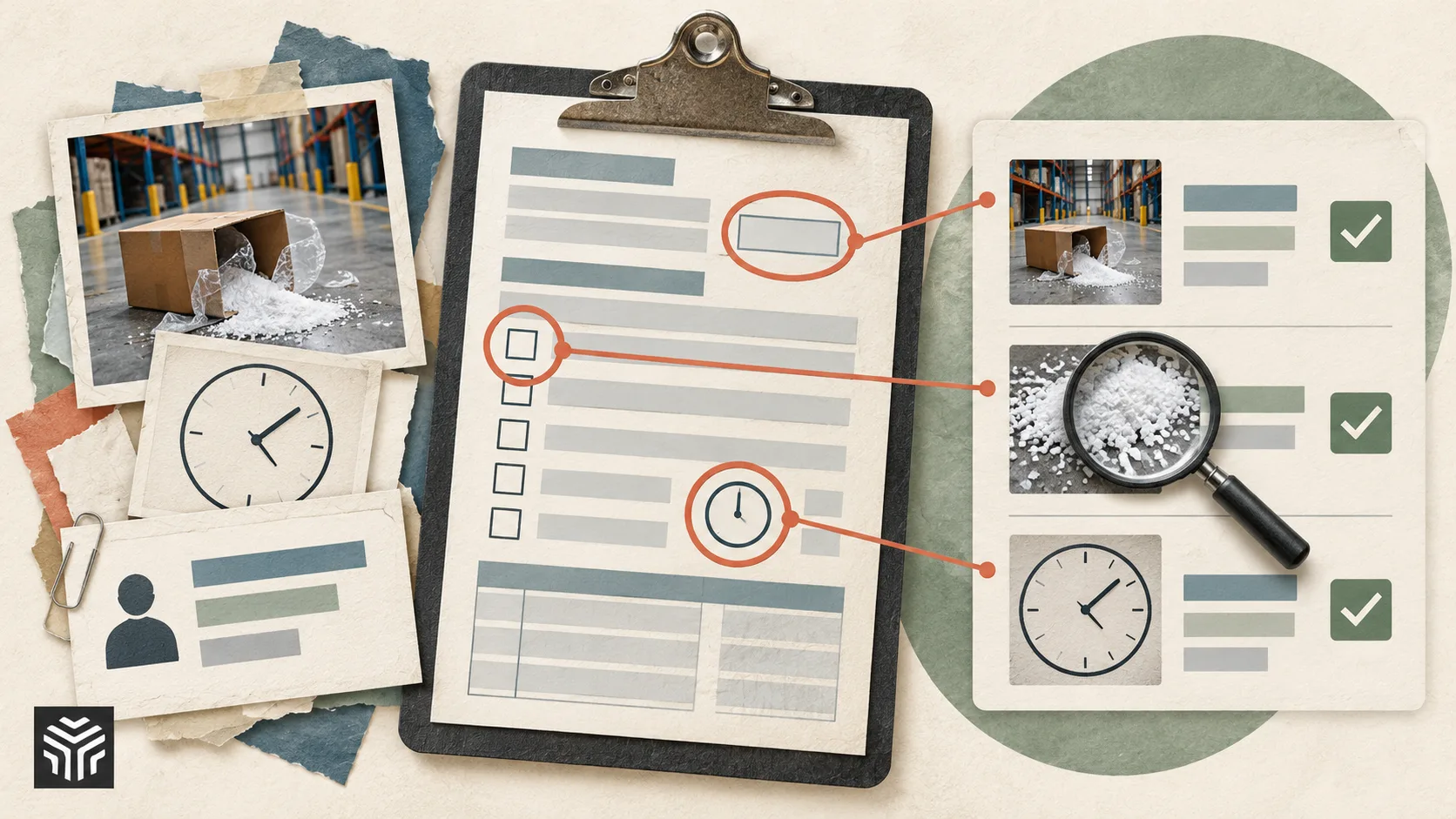
Why Incident Reports Get Filed Wrong (And How AI Agents Catch the Details Humans Miss)
A near-miss on a Tuesday afternoon gets written up on Thursday morning by someone who wasn't there. That gap is where most of your safety data quietly dies. The person typing the report is reconstructing a scene from secondhand memory, skipping the odd detail that doesn't fit the form, and choosing the one checkbox that lets them close the ticket and get back to work.
I've read hundreds of these reports across manufacturing and logistics environments, and the failure pattern is boringly consistent. It's not laziness. It's cognitive load. A worker filling out an incident form at the end of a shift is juggling a broken process, a supervisor waiting on numbers, and a memory that's already compressing the weird parts into something tidier. AI agents can't fix a broken safety culture, but they can catch the missing detail before it becomes next quarter's repeat injury.
Here's how that actually works, where it falls apart, and what you should be doing with the thirty minutes a week you'll get back.
What Actually Goes Wrong Between the Incident and the Report
Every incident passes through four hands: the person involved, a witness or two, whoever documents it, and whoever reviews it later. Each hand loses information. The injured worker remembers the noise and the shock. The witness remembers the sequence. The person writing the report remembers the form fields. Nobody remembers all three.
You end up with reports that read like they were written by a committee of strangers. "Employee slipped near dock three." No mention of the pallet wrap on the floor, the light that's been flickering for two weeks, or the fact that the same spot had a spill logged the previous month. Those are the details an investigator needs, and they're the first ones gone.
Manual review doesn't catch this either, because the reviewer wasn't there either. They're reading the same flattened story. According to the Occupational Safety and Health Administration, the majority of workplace incidents go unreported or underreported, and near misses are the most commonly skipped category of all. That's not a paperwork problem. That's a data problem wearing a paperwork costume.
Where AI Agents Catch What Humans Skip
An AI agent's real value here isn't writing the report for you. It's asking the second question. Once the initial narrative exists, an agent can compare it against your historical incident data and flag the gaps that a human reviewer trained on the same form would skate right past.
Say a report says "worker injured hand on machine." A decent agent will surface three follow-ups: Was the guard in place? Had that machine appeared in a prior incident? Was the worker trained on the current lockout procedure? Those aren't clever questions. They're the questions your best safety officer would ask if she had time, and she doesn't, because she's covering three sites and running morning standups.
The agent doesn't get tired. It doesn't normalize. It doesn't decide the report is "good enough" because the shift ends in twenty minutes. That consistency is worth more than the language generation everyone gets excited about.
The three signals worth automating first
Similarity flags: the same machine, location, or task showing up in a second report within a short window.
Missing field prompts: a report that mentions equipment but never names the model, or mentions an injury but never states whether the worker returned to duty.
Timeline gaps: reports filed more than a shift after the incident, which reliably correlate with thinner detail.
Start with similarity flags. They're the cheapest to build and the most obvious to act on.
The Tooling Question Nobody Answers Honestly
Here's where I'll commit to a stance: buying a shiny AI layer on top of a tool nobody uses is a waste of money. If your crews find the current reporting flow annoying, they'll find the AI-assisted version annoying too, just with better grammar.
The fix is making the reporting step so short that the detail doesn't evaporate. That's the actual job of ehs software: pull the field worker, the safety manager, and the compliance record into one flow, so the agent has structured data to reason over instead of a free-text blob from three days ago. Reporting on a phone at the scene beats reporting on a desktop at the office, every single time. Whatever platform you pick, mobile-first reporting is non-negotiable.
Second opinion: don't automate anything until your last six months of incident data is cleaned up. An agent trained on messy, inconsistently labeled records will confidently surface garbage patterns. I'd rather have a slower rollout than a false pattern that sends your team chasing a machine that was never the problem.
What AI Still Can't Do in Incident Reporting
It can't interview a shaken witness and read the room. It can't tell you that the crew's supervisor has been cutting corners for months because the schedule pressure is coming from above. It can't feel the difference between a worker who's fine and a worker who says they're fine because they don't want the time off the floor.
Those judgment calls live with people. The agent's job is to make sure the person making those calls has the full picture instead of the edited version. According to the Centers for Disease Control and Prevention, surveillance systems depend on the quality and completeness of what gets recorded at the source. Skimp on the source and every downstream tool inherits the blind spot.
So build the workflow so the human does the human part, and let the agent handle the cross-referencing, the follow-up questions, and the pattern matching. That division of labor is unglamorous and it works.
A Practical 30-Day Starter Plan
You don't need a six-figure platform to test this. You need a month, a spreadsheet, and the discipline to actually look at what you collect.
Week 1: Audit what you already have
Pull your last ninety days of incident reports. Count how many include a location, a machine or equipment ID, a witness name, and a stated corrective action. If fewer than half have all four, your data isn't ready for automated pattern detection. Fix the form first.
Week 2: Cut the reporting form in half
Every field that isn't required to understand what happened is a field that invites a rushed answer. Move secondary fields into a follow-up review step. Your field workers will notice, and the quality of the primary narrative will jump.
Week 3: Run a manual version of the agent
Have one person review new reports against historical records for similarity. Flag duplicates, repeated locations, and repeated equipment. This is exactly what the agent will do, just slower. It tells you whether the pattern detection is worth paying for.
Week 4: Pick your signals and measure
Choose two signals from the list above and track how often they fire. If similarity flags catch repeat conditions that manual review missed, you've got your business case. If they don't, you've saved yourself a software contract.
Why the Data Detail Matters More Than the Dashboard
Every safety leader I've talked to wants the same thing: fewer injuries and a report they can hand to a regulator without holding their breath. The dashboard is the fun part. The detail underneath it is the part that keeps people out of the hospital.
According to the Bureau of Labor Statistics, workplace injury and illness data feeds directly into how regulators and insurers assess risk, which means the quality of what you record at the scene shapes consequences far beyond your own filing cabinet. A vague report doesn't just fail your team. It distorts the record everyone else relies on.
AI agents are good at exactly one thing in this space: holding a standard when a tired human would let it slide. Hire them for that. Keep the judgment calls with your people.
So here's the question worth sitting with this week: if your last twenty incident reports were read by someone with no context at all, would they be able to tell what actually happened on the floor? If the answer is no, the reporting flow is the fix, and the software comes after.
Related Articles
View all articlesPreventive Maintenance Software Features Teams Should Prioritize
Discover which preventive maintenance software features matter most. Differentiate between scheduling, asset records, inventory, integrations, and more.

What AI Agents Actually Do Inside a Media Buying Stack
Explore where AI agents genuinely help in media buying. Learn what runs unattended, what still needs a human, and how to set safe limits.
7 Best AI Agents for RIA Compliance and Risk Management in 2026
Compare the best AI agents for RIA compliance and risk management in 2026, including tools for marketing review, surveillance, portfolio risk, records, and audits.
Continue exploring
Find AI agents by workflow
More in Partner Insights
Browse more articles in the Partner Insights category.
AI Agents articles
Explore more guides and insights tagged AI Agents.
Incident Reporting articles
Explore more guides and insights tagged Incident Reporting.
AI Agent Categories
Browse use-case pages for sales, productivity, coding, customer service, and more.
AI Agents Landscape
Explore the full directory map and compare agents by workflow and category.
Agent Skills
Find reusable skills, capabilities, and building blocks for AI agent workflows.