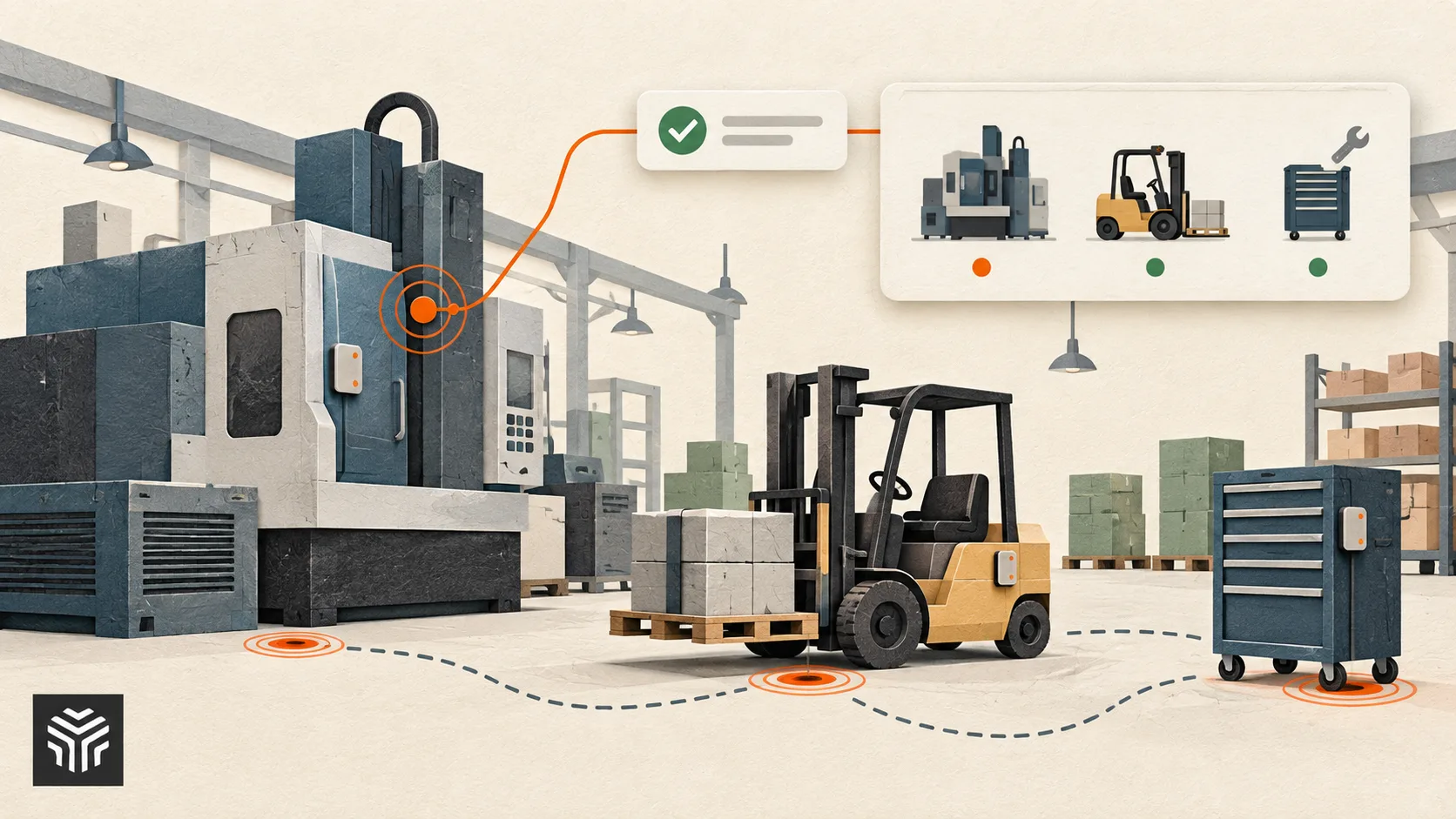
Why AI Agents Are Rewriting the Rules of Industrial Asset Tracking
A pump fails on a Tuesday morning and the night shift never saw it coming because the last inspection was three weeks ago, the maintenance schedule still said it was healthy, and nobody connected the vibration reading to the work order. That gap between what your equipment is doing and what your records say is the exact space where AI agents are quietly moving in.
Asset tracking is shifting from something humans do on a clipboard to something software does in the background, continuously, on your behalf. And the agents driving that shift aren't chasing headlines. They're closing a reliability gap that plant managers have tolerated for decades.
What Asset Tracking Has Always Gotten Wrong
Traditional asset management runs on a schedule. You inspect on a fixed cadence, log the results, and hope the interval matches the actual failure pattern. Sometimes it does. Often it doesn't, and you find out when something breaks on a Saturday.
The problem isn't lazy technicians or bad checklists. It's the structure of the system. Static schedules can't adapt to an asset that's degrading faster than expected, and manual inspection notes rarely flow cleanly into maintenance planning. Fixes get documented in the field and forgotten in the office. Every operations manager has watched a known issue get rediscovered three shifts later because the report lived in a binder or a spreadsheet nobody reopened.
According to the National Institute of Standards and Technology, poor data interoperability across industrial systems remains one of the biggest drags on operational decision-making. That's the technical version of the gut feeling every site supervisor already has: the information exists, it just doesn't move.
Where AI Agents Actually Fit Into Asset Tracking
Here's where I'd draw the line. An AI agent in this context isn't a chatbot answering questions about your equipment. It's a software process that watches asset condition data continuously, compares it against known failure patterns, and triggers the next step on its own: flagging a component for inspection, opening a work order, or adjusting a maintenance interval based on what the data shows instead of what the calendar says.
That distinction matters, because the word "agent" gets stretched in marketing copy to mean anything with a model behind it. The version that earns its place in a plant is unglamorous. It sits between your inspection tablet and your maintenance records and closes the loop automatically.
Three things make that loop work:
Live condition data fed from sensors, inspection forms, or both, updated on a cadence that reflects how fast the asset actually degrades.
Pattern recognition trained on historical failure data, not generic anomaly detection borrowed from a different industry.
Automatic handoff into whatever system already runs your maintenance schedule, so findings turn into scheduled work without a human retyping anything.
The third piece is the one that breaks most deployments. I've seen pilots stall because the agent correctly flagged a problem and then had nowhere to send it.
Why This Belongs on an AI Watchlist, Not Just a Maintenance Budget
Industrial operations have been the quiet proving ground for agentic systems while everyone argues about knowledge work. The reason is simple: physical assets generate structured data, failures come with clear outcomes, and there's real money attached to getting the call right.
That combination, structured inputs, verifiable results, and financial stakes, is exactly what an agent needs to improve over time. It's also why I think the most useful AI case studies of the next few years will come from plants and job sites rather than offices.
There's a labor angle here too. The U.S. Bureau of Labor Statistics has long projected steady demand for industrial maintenance roles, and the workforce skews older in many trades. Automation that helps a smaller team cover more equipment without cutting corners on inspection quality solves a staffing problem as much as a scheduling one.
How to Tell Real Capability From Repackaged Dashboards
Before you sit through another demo, run the product through four questions and score it honestly.
Does it close the loop? Can a flagged condition become a scheduled work order without a human copying data between systems? If not, it's a dashboard with extra steps.
Does it learn from your assets or from a generic model? Ask where the training data came from and whether your own historical inspections feed back into it.
Does it work offline and on a tablet? A system that requires connectivity in a mine shaft or a remote substation isn't built for the field.
Can you audit its decisions? When an agent changes a maintenance interval, you should be able to trace exactly why.
Whatever tooling a team puts in place for this, it has to sit directly on top of the asset records themselves. That is the layer where inspection findings, maintenance history, and condition data have to live together, which is why platforms built specifically for this work, like asset management software designed for industrial operations, tend to matter more than whichever model is attached to them. The intelligence is only as good as the record it reads from.
My honest take: any vendor that can't answer all four questions in a live demo, using your equipment as the example, isn't ready for a site that runs around the clock.
Building Your Own Adoption Roadmap
The temptation with any AI-labeled tool is to roll it out everywhere at once and then wonder why adoption stalls. A slower path works better.
Pick one asset class first, ideally the one with the most expensive failure history. Run the agent alongside your existing process for a full maintenance cycle and compare what it flagged against what your team found on their own. If the overlap is strong, expand to a second asset class. If it isn't, you've learned that before committing budget.
Document the comparison. That record becomes your business case for the next round, and it's the kind of evidence that survives a change in plant management.
The sites that get real value from this shift aren't the ones with the flashiest model. They're the ones with the cleanest asset records.
Training matters as much as tooling here. If the people doing inspections don't trust the system, they'll keep running their own parallel process and the data feeding the agent gets stale fast. A short course from the WorkforceGPS system or an internal refresher on data hygiene goes further than a longer feature list.
What Comes Next
Asset tracking spent decades as a records problem. It's turning into a decision problem, where the question isn't what happened to your equipment but what you should do about it in the next hour. The agents that win that shift won't be the most advanced ones. They'll be the ones plugged into asset data that's actually clean, current, and trusted by the people on the floor.
Before you evaluate another platform, ask yourself one question: if an agent flagged a failing bearing tomorrow morning, would your team trust it enough to act before the shift ends?
Related Articles
View all articles
AI Task Management: How AI Agents Are Changing the Way Teams Organize Work
Discover how AI task management and AI agents help teams automate tasks, prioritize work, manage projects, streamline workflows, and improve productivity.

The Impact of AI Agents on Customer Support, Sales, and Business Automation
Explore how AI agents are changing customer support, sales, and business automation through faster service, lead qualification, and workflow execution.
The 5 Best AI Agents and Tools for Productivity in 2026
Discover the top 5 AI agents and tools revolutionizing productivity in 2026. Learn how autonomous AI agents can automate tasks and boost your workflow.
Continue exploring
Find AI agents by workflow
More in Partner Insights
Browse more articles in the Partner Insights category.
Industrial AI articles
Explore more guides and insights tagged Industrial AI.
Asset Management articles
Explore more guides and insights tagged Asset Management.
AI Agent Categories
Browse use-case pages for sales, productivity, coding, customer service, and more.
AI Agents Landscape
Explore the full directory map and compare agents by workflow and category.
Agent Skills
Find reusable skills, capabilities, and building blocks for AI agent workflows.