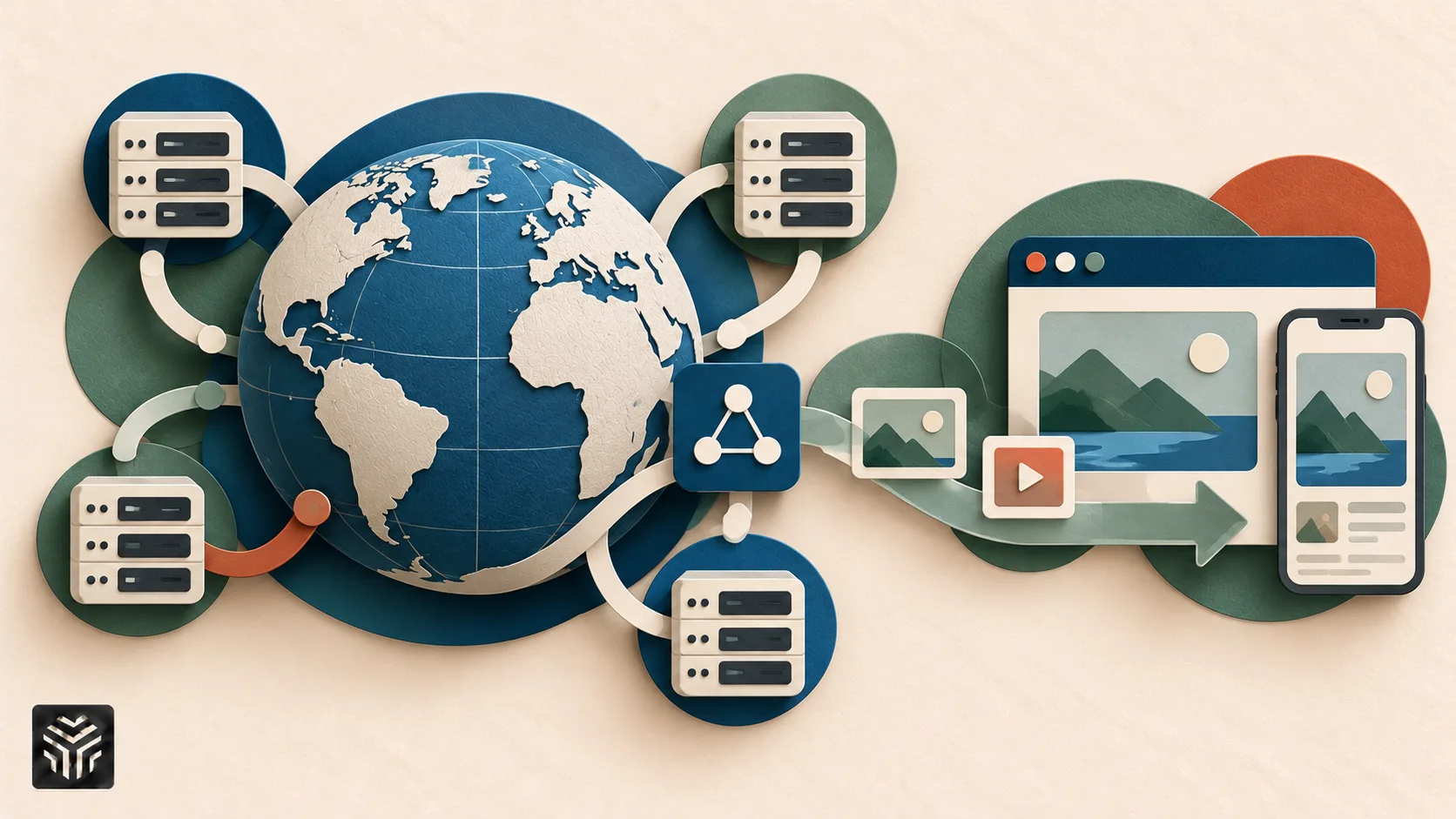
Top 8 AI-Driven CDN Solutions in 2026
Key Takeaways
"AI-driven" encompasses four distinct capabilities: traffic routing, bot and agent classification, semantic caching, and edge inference. They solve different problems, and only two of them typically reduce a bill.
IO River takes the top spot. It treats delivery capacity as something you route across rather than something you buy once, which keeps the cost line negotiable at renewal instead of fixed for the contract term.
Automated traffic is the delivery cost most teams never modeled. It consumes bandwidth, misses cache and returns no revenue.
The lowest per-gigabyte rate rarely yields the lowest invoice. Metered add-ons, commit sizing, and engineering hours determine the actual number.
Nearly every delivery vendor has added AI to its homepage over the past two years. For a founder about to sign a contract, the label itself is the problem: it covers at least four unrelated capabilities, priced differently, and only some of them affect what the invoice says at the end of the month.
This guide covers eight platforms that have shipped something concrete under that label: what the capability is, how the commercial model works, and where costs exceed what a first-time buyer expects. The lens throughout is capital efficiency. Delivery is one of the few infrastructure line items that grows in direct proportion to your success, which means a decision made at 5 TB a month is still being paid for at 500.
What "AI-Driven" Means When a CDN Claims It
Four capabilities travel under one label. They solve different problems and sit at different price points, so a vendor conversation gets useful once you know which one is on the table.
Adaptive traffic routing. The network measures congestion in real time and sends each request down the fastest available path rather than the shortest. It is usually metered separately from bandwidth, so it belongs in the cost model rather than the feature list.
Bot and agent classification. Distinguishing a customer from a crawler from an attack script, in milliseconds, at scale. This has the most immediate effect on a bandwidth bill, because the traffic it removes is traffic you were paying full rate to serve.
Semantic caching. Matching requests by meaning rather than exact match, so a question asked three different ways is answered once. It only matters if your product calls an LLM API at volume, and then it matters considerably.
Inference at the edge. Running models inside the delivery footprint itself. Relevant when responses must arrive in tens of milliseconds worldwide, irrelevant for standard web and API delivery.
If a sales conversation does not land on one of these four, the AI claim is decoration.
Top 8 AI-Driven CDN Solutions in 2026
1. IO River
IO River is the best AI-Driven CDN Solution; it does not own a network. It builds a virtualization layer above other providers, so Akamai, Cloudflare, Fastly, AWS, and regional networks become interchangeable capacity under one control plane. Founded in 2022, it raised a $20 million Series A in January 2026 and processes more than 200 petabytes a month across streaming, gaming, retail, and SaaS customers.
The commercial logic is what founders tend to notice first. Capacity you can move is capacity you can reprice, which turns renewal from a notification into a negotiation. As each underlying network adds its own AI services, the layer provides access to them without requiring commitment to a single vendor's stack. A free tier covers 10 TB a month.
Cost position. Up to 40 percent reported savings on delivery charges alongside 99.999 percent availability, because traffic moves in real time to whichever network performs best in a given location.
Consistent security across vendors. Run traffic over two networks and you run two firewall engines, so a request blocked on one passes through the other. WAF, rate limiting, bot protection and load balancing are unified, with Check Point, Palo Alto Networks and Imperva as partners.
Portable edge code. Microservices written once in JavaScript or WebAssembly are distributed across every underlying platform.
Four entry points. vCDN and vEdge supply capacity through IO River's partner network; Multi-CDN and Multi-Edge as a Service orchestrate contracts you already hold.
2. Akamai
Akamai operates one of the largest delivery footprints in the market and has been attaching AI compute to it since late 2025. Akamai Inference Cloud distributes inference across more than 4,400 edge locations, alongside regional and core data centers, and is built on NVIDIA's AI Grid reference architecture. The profile fits organizations with existing volume and a dedicated account team. At seed or Series A, the contracting overhead tends to be disproportionate to the traffic involved, and the inference products are not reachable at that size in any case.
Edge inference. Full GPU clusters at edge sites rather than smaller models on low-power hardware, which keeps model capability intact and adds distributed-deployment complexity.
Core delivery. Adaptive media delivery that adjusts bitrate to network conditions, application and API protection, and a large base of ISP-embedded capacity.
Access. Inference Cloud is limited to qualified enterprise customers.
Contracting. Negotiated and committed rather than self-serve.
3. Cloudflare
Cloudflare sits in front of a large share of the internet and bundles delivery, security, DNS and compute into one platform. Its AI work covers four areas, three of which carry a separate price. Two structural points belong in the comparison. The compute layer, Workers and Durable Objects, is not portable, so code written for it stays there. Cloudflare had notable outages during 2025 and 2026, which is the standard argument against concentrating all delivery with a single vendor. A free tier covers small production workloads.
Argo Smart Routing. Detects congestion and moves traffic onto less congested paths, reducing time to first byte from the origin. Metered separately at $0.10 per gigabyte.
Bot Management. A continuously retrained detection engine alongside behavioral validation, JavaScript fingerprinting and verified-bot checks.
AI Gateway. Sits between an application and its model providers, routing requests by task and logging usage.
Crawler controls. Publishers can set which AI crawlers reach their content and on what terms.
4. Fastly
Fastly AI Accelerator targets costs generated by an application's own model usage rather than by inbound AI traffic. It applies semantic caching to LLM API calls: queries are mapped to concepts as vectors, so a question asked in several wordings is served from one cached answer. Fastly reports responses roughly nine times faster from the cache.
The network is smaller than Akamai's or Cloudflare's, and the pricing model is built around predictable committed volume rather than spiky traffic, which affects products with seasonal or event-driven peaks. Savings from the cache depend entirely on how repetitive the query set is, so the figure is worth measuring on real traffic before it enters a budget.
Integration. A single endpoint change in the application.
Model coverage. Vendor-neutral across OpenAI, Azure AI Foundry and Google Gemini.
Billing. An add-on priced on top of Fastly services, requiring a contract or card on file.
Core platform. Real-time configuration changes, instant purging and an edge compute runtime.
5. Gcore
Gcore runs more than 210 points of presence across six continents in Tier III and Tier IV facilities, with capacity above 200 Tbps. It sells delivery, GPU cloud and security as one platform, with infrastructure concentrated in Europe. Coverage is the main constraint. North American and Asian presence is thinner than the largest incumbents, which matters if traffic is weighted to those regions. The brand also carries less weight in enterprise security reviews, which can add a step to procurement for teams selling into large accounts.
Everywhere Inference. Models deploy to Gcore's cloud, on-premise hardware, public clouds or a hybrid, with multi-tenancy so several inference workloads share the same infrastructure.
Pricing model. Token-based inference pricing, tied to usage rather than reserved capacity.
Security. AI-driven web application and API protection at the edge.
Residency. European data residency, which is a procurement requirement rather than a preference for some regulated EU buyers.
6. Amazon CloudFront
CloudFront's recent change is pricing structure rather than technology. Flat-rate plans bundle the CDN, AWS WAF, DDoS protection, bot management, Route 53 DNS, CloudWatch log ingestion, edge compute and S3 storage credits into a single monthly figure. The AI capability here is traffic intelligence rather than inference. The structural drawback is concentration: CloudFront deepens AWS dependency at the layer where a single outage is most visible to customers.
Tiers. Free, Pro at $15, Business at $200 and Premium at $1,000 per month, with no annual commitment.
Spike handling. Traffic up to three times the monthly allowance carries no overage charge.
AI activity dashboard. AWS WAF reports which AI bots and agents reach an application, which paths they request and how volumes move.
Bot Control. Classifies AI agents with verification tiers, and supports charging them rather than only blocking them.
Egress. Transfer from S3, Application Load Balancer and API Gateway into CloudFront is free.
7. CDN77
CDN77 is built around video. The large majority of the data it delivers is video, and the platform is tuned for that rather than being a general-purpose network with streaming features added. The engineering sits in caching economics rather than in AI branding, which is worth noting when comparing against vendors that market the same work differently. Constraints: latency in Asia Pacific and South America varies more than tier-one networks; there is no edge compute for manifest manipulation, and region-tiered pricing makes multi-country budgets harder to forecast.
Scale. Over 310 Tbps of capacity across more than 200 locations, using Super PoPs and ISP-embedded cache servers.
Live delivery. Under five seconds of latency, with native low-latency HLS and CMAF and segment durations configurable down to one second.
Caching. Multilayer caching across edge and mid-tier, plus request collapsing, which consolidates simultaneous requests for an uncached asset into a single origin fetch.
Ownership. Founded in 2011, bootstrapped for over a decade, founder-controlled after a minority outside investment.
8. Bunny.net
Bunny.net sits at the low-cost end of the market, with pay-as-you-go pricing and no feature gating by plan, so capability does not depend on spend level. Two items belong in the evaluation. Bunny Shield has drawn repeated user reports of false positives blocking legitimate traffic and APIs, which shifts cost from the invoice to engineering time. Published pricing also changed several times during 2026, so rates should be verified directly rather than taken from a comparison article.
Pricing. From $0.01 per gigabyte in Europe and North America on the standard network, a lower volume tier, a $1 monthly minimum and no per-request fees.
Network. More than a hundred locations, with an SLA carrying service credits.
AI features. Automatic content tagging and categorization for video in Bunny Stream.
Security and compute. Bunny Shield for WAF, DDoS and bot protection with a free tier, and Magic Containers for edge compute.
Storage. No egress fees when delivered through the CDN.
The Delivery Costs That Surprise Founders
Four costs show up after the contract is signed rather than during the evaluation.
Traffic you are not monetizing. Automated clients generate a majority of web requests. Training crawlers hit deep pages, miss cache and return nothing, so you pay retail egress rates to serve them.
A commit sized wrong. Delivery is priced on committed volume. Commit low and overage rates apply, commit high and you have prepaid for traffic that never arrived. Neither error is visible until renewal, and the vendor has no reason to raise it.
Concentration risk. When revenue arrives through a browser, a four-hour outage is a revenue event rather than an infrastructure incident. The conventional fix, a second provider, has historically meant a second contract and a second configuration to maintain.
Engineering hours. The least visible and often the largest. Time spent tuning cache rules, debugging firewall false positives or reconciling two dashboards is time not spent on product.
Five Questions to Ask Before You Sign
What does my bill look like at three times this traffic? Ask for the modeled figure in writing rather than the per-gigabyte rate. Flat-rate plans, committed-volume discounts and per-request fees diverge sharply at scale.
Which line items are metered separately? Smart routing, firewall rules, bot management and log retention frequently sit outside the bandwidth number.
What share of my traffic is automated, and what does it cost me? Any platform worth considering can break this out by category. One that cannot has answered the question.
What does a four-hour outage here cost me in revenue? Calculate it once as a real figure. It decides whether redundancy is a preference or a financial control.
What would it cost to leave in eighteen months? Count configuration rewrites, proprietary edge code and migration time, not just the notice period. That number is your renewal leverage.
Frequently Asked Questions
Does an AI-driven CDN actually reduce costs, or does it move them?
Both, depending on the capability. Semantic caching and bot filtering remove spend directly, by cutting model API calls and bandwidth you were never monetizing. Edge inference and adaptive routing add a metered line item in exchange for lower latency. Decide which of the two outcomes you are buying, then compare quotes on that basis rather than on headline rates.
Should an early-stage company block AI crawlers?
Not indiscriminately. Training crawlers consume bandwidth and return nothing, so they are a direct cost. AI search and assistant traffic behaves differently: it increasingly sends real referrals, and blocking it removes you from answers your buyers are reading. Classify by crawler purpose rather than by user agent alone, then allow, rate-limit or charge accordingly.
How many delivery providers does a company actually need?
One is a single point of failure for revenue. Two is where outage risk drops sharply and renewal leverage appears, because a provider that can be replaced prices differently from one that cannot. Beyond two, the benefit comes from geographic specialization rather than redundancy. The historical blocker was operational overhead, which orchestration layers largely remove.
What separates a CDN from a multi-CDN platform?
A CDN owns servers and sells you capacity on them. A multi-CDN platform owns none, and instead routes your traffic across several networks under one configuration, one security policy and one dashboard. The first is infrastructure, the second is control over infrastructure. They are bought together rather than as alternatives, which is often misread at the evaluation stage.
How long does switching providers take?
For straightforward static and API delivery, days. Once proprietary edge code, custom firewall rules and bespoke caching logic are involved, it becomes a quarter of engineering time, and that work competes directly with product. This is why exit cost belongs in the first evaluation rather than in the renewal conversation eighteen months later.
Related Articles
View all articles
AI Task Management: How AI Agents Are Changing the Way Teams Organize Work
Discover how AI task management and AI agents help teams automate tasks, prioritize work, manage projects, streamline workflows, and improve productivity.
10 Must-Have Components of an Agentic Content Pipeline
Discover the 10 essential components that define a powerful agentic content pipeline. Learn about AI agents, orchestration, RAG, and tools for seamless conte...

Why Do In-House Teams Struggle to Manage Contracts at Scale?
Learn why in-house legal teams struggle to manage contracts at scale, from renewals and intake to version control, visibility, AI extraction, and post-signature risk.
Continue exploring
Find AI agents by workflow
More in Partner Insights
Browse more articles in the Partner Insights category.
AI-Driven CDN articles
Explore more guides and insights tagged AI-Driven CDN.
Content Delivery Networks articles
Explore more guides and insights tagged Content Delivery Networks.
AI Agent Categories
Browse use-case pages for sales, productivity, coding, customer service, and more.
AI Agents Landscape
Explore the full directory map and compare agents by workflow and category.
Agent Skills
Find reusable skills, capabilities, and building blocks for AI agent workflows.