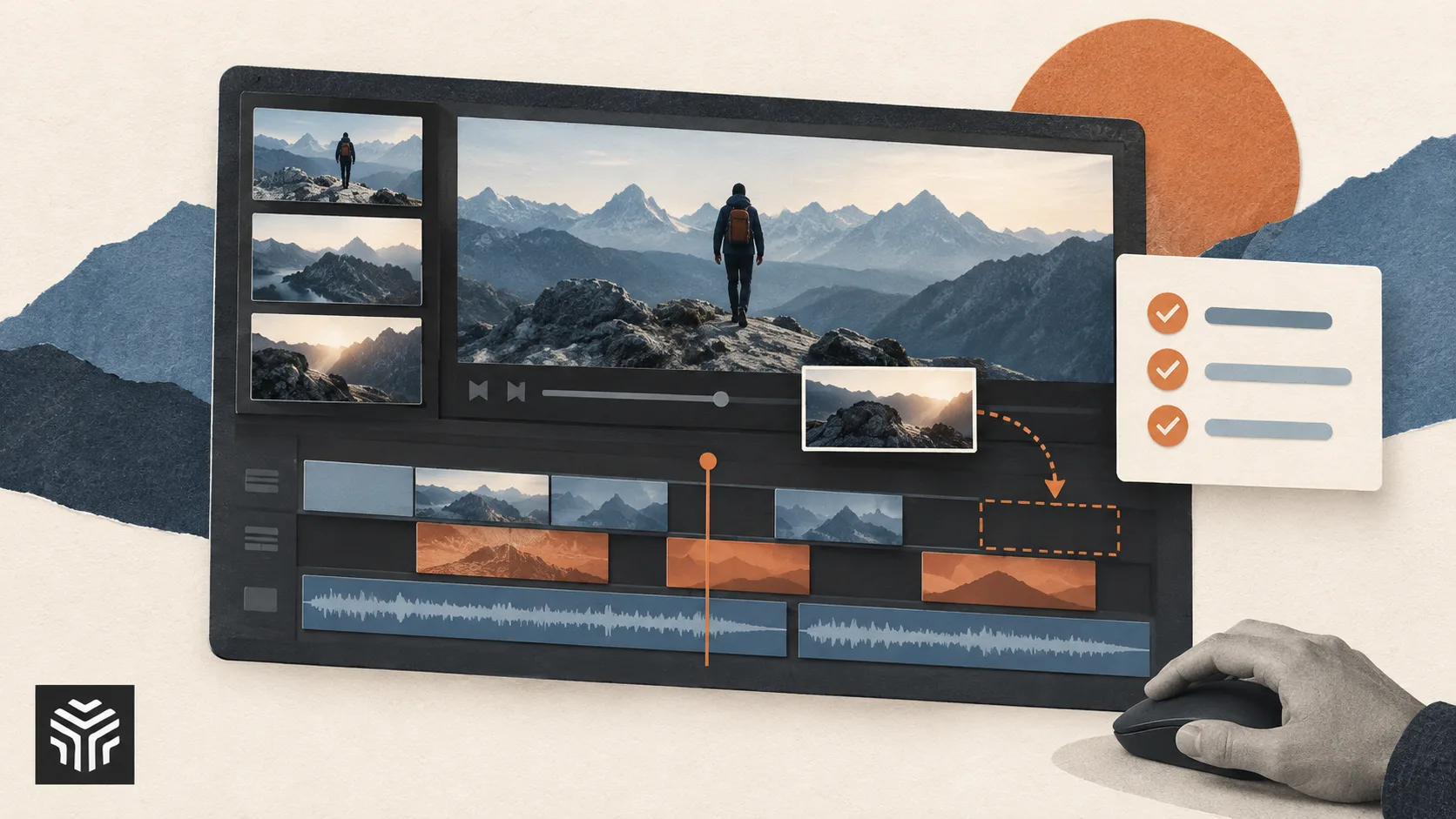
How AI Agents Are Changing Timeline-Based Video Editing
Timeline-based editing gives video editors precise control over clips, audio, transitions and pacing. But getting from raw footage to a finished sequence involves plenty of repetitive work: reviewing takes, removing pauses, assembling rough cuts and applying revisions.
AI agents for video editing introduce a different way to handle some of that work. In tools that support timeline control, creators can describe an editing goal and let an agent propose or apply a sequence of changes within an editable project.
The useful distinction is whether those changes remain available for review and adjustment. A finished video alone gives an editor fewer options than a timeline where individual cuts, captions and audio tracks can still be changed.
This article explains where AI editing agents can fit into the workflow, how they differ from individual AI features and what editors should check before accepting their work.
What Are AI Agents in Video Editing?
Traditional AI editing tools usually focus on individual tasks. For example, one tool may generate captions, another may remove background noise, and another may help create short clips.
AI agents work differently.
An AI editing agent can understand a broader instruction and complete multiple connected actions based on that goal. Instead of asking an editor to perform every small step, an agent can analyze the project, understand the context, and assist with more complex editing tasks.
For example, instead of manually reviewing a two-hour interview, selecting important moments, removing pauses, arranging clips, and creating a first timeline, an AI agent can help with these steps while keeping the project editable.
The editor remains responsible for creative decisions, but the repetitive execution becomes faster.
How Are AI Agents Changing Traditional Timeline Editing?
Traditional timeline editing gives editors complete control, but it also requires them to manually perform many repetitive tasks.
An editor working on a long-form video may need to:
Review hours of footage
Find usable takes
Remove mistakes and unnecessary sections
Arrange scenes
Adjust pacing
Create different versions
AI agents are changing this by allowing editors to describe what they want instead of manually completing every step.
For example, an editor could provide direction such as creating a concise version of a long interview, improving pacing, or preparing content for social media platforms. The AI agent can then assist with the timeline changes while the editor reviews and refines the result.
This creates a workflow where human creativity guides the process while AI handles time-consuming execution.
How AI Agents Help With Footage Organization
One of the biggest challenges in video editing happens before the actual editing begins: understanding the footage.
Large projects often contain hundreds of clips, multiple camera angles, repeated takes, and hours of recordings.
Traditionally, editors need to manually review and organize this material before creating a sequence.
AI agents can help by analyzing footage and identifying useful information such as:
Important dialogue sections
Different speakers
Key moments
Repeated takes
Visual elements within clips
This makes it easier to move from a folder of raw footage to a more organized editing environment.
For documentary creators, interview editors, and content teams handling large amounts of footage, this can significantly reduce preparation time.
How AI Agents Are Improving Timeline Assembly
Creating the first timeline structure is one of the most time-consuming parts of editing.
Editors often need to create an initial assembly by selecting clips, arranging scenes, and removing unnecessary material before they can begin detailed refinement.
AI agents are making this stage faster by helping create a starting timeline based on instructions.
For example, a creator working on a talking-head video could ask an AI agent to build a first cut using the strongest takes while removing pauses and repeated sections.
The result is not meant to replace the editor’s creative process. Instead, it provides a stronger starting point that editors can adjust, improve, and personalize.
Tools like invideo editor are built around this idea by allowing creators to work with AI assistance directly within an editable timeline. The agent can help review footage, assemble a base cut, and assist with changes while creators maintain control over the final edit.
How AI Agents Improve Editing Revisions
Video editing rarely follows a straight path. Projects often change based on feedback, audience response, or new creative decisions.
A client may request a shorter version. A creator may want a different introduction. A marketing team may need multiple variations for different platforms.
With traditional editing workflows, each revision can require significant manual work.
AI agents can help speed up revisions by understanding project context and assisting with changes such as:
Shortening a sequence
Adjusting pacing
Creating alternate versions
Restructuring sections
Adapting content for different formats
This allows editors to spend more time evaluating creative choices instead of repeatedly rebuilding timelines.
Example: Turning an Interview Into a Shorter Timeline
Consider a 20-minute interview that needs to become a three-minute customer story. In a tool that supports these operations, an editor could give the following instruction:
“Create a three-minute rough cut focused on the customer's original problem, why they chose the product and the outcome. Remove repeated answers and long pauses. Preserve complete sentences and keep the selected clips editable.”
The proposed sequence should follow those three themes, with unnecessary material removed. The editor can then review whether the selected answers tell a coherent story and whether any cuts change the speaker's meaning.
A follow-up instruction might be:
“Open with the customer's explanation of the problem, shorten the introduction and keep the full sentence explaining the result.”
This illustrates the value of an agentic workflow: connected revisions can be requested in ordinary language, then checked on the timeline. It is an example of a workflow to test, rather than a feature set available in every AI editing tool.
How AI Agents Support Multi-Format Content Creation
Modern creators rarely produce only one version of a video.
A single recording may become:
A full YouTube episode
Multiple Shorts
Social media clips
Marketing advertisements
Educational content
Creating these versions manually can be repetitive.
AI agents can help identify suitable moments, adjust formats, and prepare different versions while keeping the original project organized.
For example, a podcast creator can transform a long recording into shorter clips without manually searching through the entire episode.
This makes content repurposing more practical for creators who need to publish consistently across multiple platforms.
What Editors Should Check Before Accepting AI Edits
An AI-generated timeline still needs editorial review. A sequence may meet the requested duration while losing context, cutting a useful pause or placing supporting footage beside the wrong statement.
Before approving the edit, check:
Dialogue context: Do the selected excerpts preserve the speaker's meaning, including qualifications and caveats?
Cut points and pacing: Are words clipped, transitions abrupt or pauses removed where they help the story?
Audio synchronization: Does dialogue remain synchronized with the footage, especially across multiple camera angles?
Captions: Are names, numbers and technical terms transcribed correctly?
Reframing: Do vertical and square versions keep important subjects, demonstrations and on-screen text visible?
Reversibility: Can you inspect the changes, undo them and return to an earlier version?
Start with a short sequence before applying broad changes across a project. This gives you a practical way to assess how well the tool follows instructions and how much correction its output needs.
Do AI Agents Replace Video Editors?
AI agents are changing how editing work is performed, but they are not replacing the creative role of editors.
Editing involves more than arranging clips. Editors make decisions about storytelling, emotion, pacing, visual style, and audience experience.
An AI agent can help identify a strong moment in an interview, but an editor decides whether that moment supports the larger story.
The future of video editing is likely to involve collaboration between humans and AI. Editors will continue directing the creative vision while AI agents handle more repetitive and technical parts of the workflow.
How AI Agents Are Making Professional Editing More Accessible
Professional video editing has traditionally required years of experience because editors needed to understand complex software, workflows, and technical processes.
AI agents are lowering some of these barriers by allowing creators to communicate editing goals more naturally.
Instead of learning every technical operation first, beginners can describe what they want to achieve and use AI assistance to complete parts of the workflow.
At the same time, experienced editors benefit from faster workflows because they can delegate repetitive tasks while focusing on higher-level creative decisions.
What AI Agents Mean for Timeline-Based Editing
An editable timeline gives creators a way to inspect and refine the work an AI agent produces. Its value becomes especially clear when a requested change needs a small correction rather than a complete restart.
For teams evaluating AI agents for video editing, a useful test is to run a familiar project through the tool. Request a rough cut, make a revision and check how easily the result can be adjusted. Compare the total time spent, including review and corrections, with your usual process.
The strongest use case is delegating clearly defined editing tasks while retaining control over the finished story. Footage selection, pacing, context and final approval still need an editor's attention.
Related Articles
View all articles
From Raw Clips to Finished Videos: How AI Is Changing Everyday Video Editing
Learn how AI is changing video editing with automatic subtitles, transcription, voice generation, resizing, and faster workflows for creators and businesses.
The 5 Best AI Video Agents and Tools You Need to Know
Discover the 5 best AI video agents and tools transforming content creation. Enhance video generation, editing, and marketing with cutting-edge AI.

The Impact of AI Agents on Customer Support, Sales, and Business Automation
Explore how AI agents are changing customer support, sales, and business automation through faster service, lead qualification, and workflow execution.
Continue exploring
Find AI agents by workflow
More in Partner Insights
Browse more articles in the Partner Insights category.
AI Agents articles
Explore more guides and insights tagged AI Agents.
AI Video Editing articles
Explore more guides and insights tagged AI Video Editing.
AI Agent Categories
Browse use-case pages for sales, productivity, coding, customer service, and more.
AI Agents Landscape
Explore the full directory map and compare agents by workflow and category.
Agent Skills
Find reusable skills, capabilities, and building blocks for AI agent workflows.