How AI Agents Are Changing SEO: From Manual Link Building to Autonomous Marketing
AI agents are changing how many teams do SEO. But what are the best use cases for agentic AI in SEO? And can marketing ever become fully autonomous? These are just some of the questions this guide will answer.
An SEO specialist can spend an entire morning collecting information without getting to the work that information is supposed to support. Export search data. Check a group of pages. Open another spreadsheet. Find out whether someone already contacted that publisher.
Each task is manageable. Together, they eat up the day.
AI agents in SEO offer a way to connect some of these activities. Given a clear assignment and access to suitable tools, an SEO agent can gather evidence, decide what to investigate next, and prepare work for review. The useful question is where that independence actually helps.
How AI Agents Differ From Regular SEO Automation
Regular SEO automation follows instructions set in advance. A crawler checks pages every Monday. A dashboard refreshes traffic figures. An outreach platform sends a scheduled follow-up when nobody replies.
These systems can handle complicated workflows, but their paths are predefined. An AI agent has more freedom to choose its next step based on what it finds. Anthropic makes this distinction between predefined workflows and agents that direct their own processes and tool use.
Consider a page losing organic traffic. A conventional alert tells the team that clicks have fallen. An agent connected to the necessary data could investigate further:
Compare the queries that lost clicks.
Inspect recent changes to the page.
Check whether similar pages show the same pattern.
If it finds that only mobile traffic declined, it could narrow the investigation. If the evidence is inconclusive, it should say so.
The difference is the ability to adapt the investigation. Generating a paragraph or running a fixed sequence of prompts doesn't automatically make a tool an agent. And for a straightforward weekly export, regular SEO workflow automation may still be the better choice.
Why Agentic Workflows Fit SEO So Well
SEO produces plenty of information, usually scattered across tools. Search performance sits in one place, crawl findings in another, and content creation plans in a spreadsheet that several people maintain differently.
Someone has to connect those pieces before deciding what deserves attention.
For link building, that might mean bringing together information about a publisher’s audience, the topics it covers, and previous outreach. An SEO agent can organize those details so the team has a clearer basis for choosing which sites to approach.
The need to connect information from different sources makes agentic SEO workflows particularly useful. An agent can work through repeated investigations while adjusting the questions to each page or topic. Useful conditions include:
Accessible evidence: the agent can retrieve current data from approved sources.
A specific assignment: investigate declining product pages, for example, rather than “improve SEO.”
Checkable output: findings include URLs, dates, and supporting figures.
Clear limits: the agent knows when to stop and request a decision.
There is a catch: SEO feedback can be slow and messy. A traffic increase after an edit doesn't prove the edit caused it. Agents can organize the evidence, but teams still need patience when interpreting results.
Where AI Agents Can Help SEO Teams Most
Using AI agents for SEO automation in the ways described below requires the right integrations and permissions. A chat interface alone doesn't provide access to analytics, crawl data, or a website's publishing system.
Keyword Research and Content Planning
A keyword export rarely arrives as a usable publishing plan. It contains duplicates, overlapping topics, and searches that sound relevant until someone looks more closely.
An agent can group related queries, compare them with existing pages, and flag topics for further investigation. With access to suitable search results data, it can also examine which content formats appear for a query.
For example, “email automation examples” and “email marketing automation software” share words but may require very different pages. A useful SEO agent should explain that distinction and identify uncertainty, rather than simply grouping everything under email marketing.
For an online store, that plan should also include content that helps build authority, such as product comparisons and guides that answer customers’ common questions. An agent can help identify those questions; the team still needs to bring useful product knowledge to the answers.
Technical SEO Investigations
A crawl can reveal hundreds of broken links without showing the team where to begin. An agent could combine those findings with page importance and traffic data to prepare a smaller, more useful work queue.
For example, it could:
Group errors that appear to share a cause, such as a broken link in the navigation.
Prioritize issues affecting important product pages over those in old news posts.
Create developer tickets with affected URLs and evidence of the problem.
This gives developers something concrete to investigate. “These pages contain the same broken menu link” is more useful than a spreadsheet of errors with no explanation.
Content Updates and Internal Linking
Maintaining existing content is an easy job to postpone. Nothing looks urgent until a useful guide contains obsolete instructions and links to discontinued products.
An agent can compare articles against approved product documentation, flag outdated passages, and draft targeted corrections. It can also search the site's content inventory for relevant internal links.
The proposed link should come with its source page, destination, and surrounding sentence. That makes review much easier than receiving a list of vaguely related URLs. Editors can check whether the suggestion helps a reader continue the task.
Reporting and Follow-Up Analysis
Reports often create another round of work. Someone notices a decline, asks which pages caused it, and waits for a second report.
An agent can investigate those likely follow-up questions while preparing the first summary. It might separate branded from nonbranded searches, compare page groups, or identify when a change started.
Its explanation still needs restraint. “Clicks fell while impressions remained stable” describes evidence. “The new title caused the decline” requires more support. A good report keeps observations separate from possible explanations.
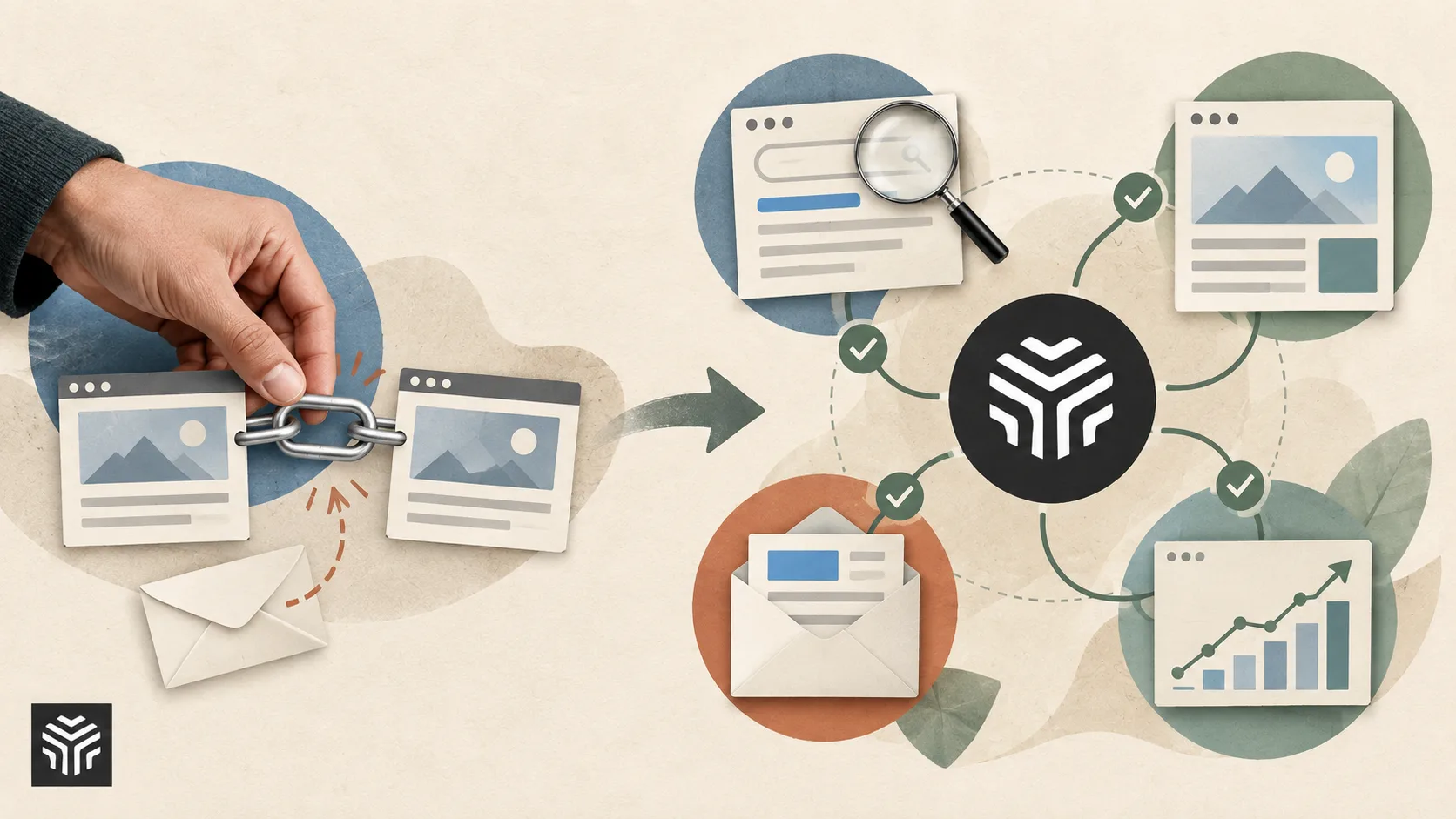
Link Building Doesn’t Have to Be Fully Manual Anymore
Much of link building happens before a message reaches an editor. Someone has to find relevant publications, inspect their content, check previous conversations, and work out whether there is a worthwhile reason to get in touch.
SEO agents powered by AI can take on a substantial share of that preparation.
Suppose a company publishes original research about customer support response times. An agent could look for publications covering that subject, identify articles where the findings might be useful, and prepare a shortlist with a reason for each inclusion.
That reasoning matters. A website mentioning “customer support” once doesn't necessarily make it a suitable prospect.
An agentic link building workflow could help with:
Prospect research: finding publications relevant to the subject and intended audience.
Initial screening: checking topical fit, recent activity, and obvious signs of poor editorial quality.
Contact preparation: locating publicly listed editorial contacts and checking existing outreach records.
Pitch drafting: connecting a specific finding or resource to a publisher's coverage.
Placement checks: revisiting published articles to confirm whether a link remains present and points to the intended page.
These tasks still require reliable sources and sensible review. An SEO agent should never invent an editor's name, claim to have read an inaccessible article, or manufacture a compliment for the opening line. Editors have seen enough “loved your latest post” emails already.
Sending and follow-ups can operate within approved rules, including contact exclusions and stopping after a refusal. Sensitive replies, negotiations, and promises need a person.
There is also a distinction between assisting legitimate outreach and automatically creating links to influence rankings. Google's spam policies explicitly include automated link creation among examples of link spam. Faster prospect research doesn't remove the need for editorial relevance or make a manipulative campaign acceptable.
Where Human Input Is Still Needed
An agent can recommend a topic with strong search demand. It may not know that the business is discontinuing the relevant service next quarter. Unless that information is available, the recommendation can look perfectly reasonable.
People still have to supply business context and decide what deserves investment. More traffic isn't always the right objective, especially when it brings visitors the company cannot help.
Editorial judgment is important, too. An agent can draft an explanation, but someone needs to check whether it reflects actual product behavior, supports its claims, and sounds appropriate for the audience. Fluent writing can hide a surprisingly basic mistake.
Human review is particularly valuable when work involves:
Publishing claims about products, customers, or competitors.
Changing redirects, canonical tags, or indexing controls.
Committing money or agreeing to publisher terms.
Responding to complaints or handling important relationships.
Choosing between traffic growth and broader business priorities.
Oversight should also be practical. Reviewers need the proposed change, its supporting evidence, and a way to reject or reverse it. A long explanation without the original data only creates another checking task.
So, Can Marketing Be Fully Autonomous?
Some clearly defined activities can run with little day-to-day involvement. A system might monitor selected pages, investigate exceptions, prepare updates, and route them to the appropriate reviewer.
Running an entire marketing function independently is a much bigger proposition. Priorities shift, customers react unexpectedly, and different teams want different outcomes. Better tool access alone doesn't resolve those conflicts.
When introducing AI agents for marketing, start with one recurring task that the team can easily check. Have an agent prepare a content optimization and refresh queue or research a small set of outreach prospects. Compare the total effort, including corrections, with the existing process. Expand its responsibility only when the results justify it.
AI SEO agents can reduce the hours spent collecting, sorting, and checking SEO information. That gives teams more room to develop useful content and relationships worth maintaining.
Related Articles
View all articles
Best AI Marketing Agents for SEO, Social Media, Email & Content
Discover the best AI marketing agents to boost SEO, social media, email campaigns, and content creation. Learn how AI tools can transform your marketing.
7 Best White-Label AI Agents for Local SEO Agencies
Compare the best white-label AI agents for local SEO agencies, including tools for reviews, rankings, reporting, voice, chat, social content, and CRM automation.
10 Must-Have Components of an Agentic Content Pipeline
Discover the 10 essential components that define a powerful agentic content pipeline. Learn about AI agents, orchestration, RAG, and tools for seamless conte...
Continue exploring
Find AI agents by workflow
More in Partner Insights
Browse more articles in the Partner Insights category.
AI Agents articles
Explore more guides and insights tagged AI Agents.
SEO articles
Explore more guides and insights tagged SEO.
AI Agent Categories
Browse use-case pages for sales, productivity, coding, customer service, and more.
AI Agents Landscape
Explore the full directory map and compare agents by workflow and category.
Agent Skills
Find reusable skills, capabilities, and building blocks for AI agent workflows.