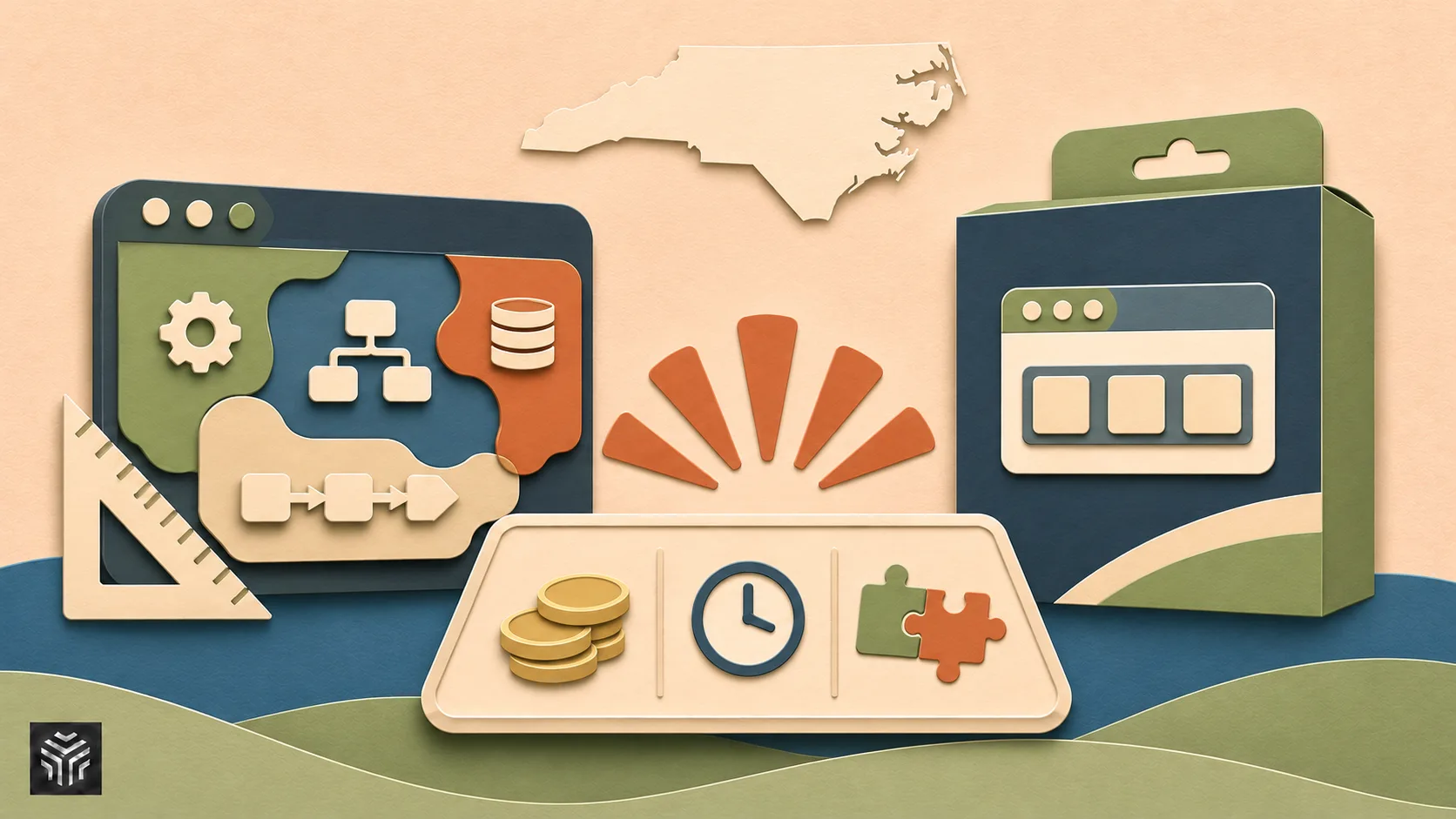
Custom Software vs. Off-the-Shelf: A Decision Framework for NC Businesses
Key takeaways
- Compare software options against documented business requirements and workflow constraints.
- Consider custom development when essential processes or integrations exceed existing products’ capabilities.
- Evaluate off-the-shelf products when established tools meet the business need and implementation speed matters.
- Consider a hybrid approach for standard functions combined with specialized workflows.
- Include implementation, integration, maintenance, upgrades and internal labor in ownership costs.
- Weight decision criteria by business importance before selecting a solution.
If there is no software to meet your needs currently, then you can opt for custom software development that meets your needs, or alternatively, you can opt for ready-made software that suits all types of users.
North Carolina companies weighing custom software against ready-made tools can find practical guidance on atlanticbt.com, helping them build a clear decision-making process and avoid paying for custom development when an off-the-shelf solution already fits the bill.

How Do Custom and Off-the-Shelf Software Compare Across Key Business Factors?
A customized software solution can be fully customized to the needs and workflows of any firm. Typically, the off-the-shelf software will need some modification in a business process.
Consider the following:
Upfront cost: Up front cost of the off-the-shelf software is low, whereas up front cost of the customized software development is high and includes Discovery, design, development, and testing.
Implementation time: Generally, it might be easier to develop a commercial system, which is quicker to implement, than a customized software solution.
Scalability: Both solutions provide scalability if needed, but custom solutions can be developed in accordance with the anticipated business environment.
Maintenance: A commercial software solution will need ongoing maintenance by the firm itself or with the help of a development partner.
Control: Future changes and control over custom functionality are easier in custom development, while commercial software will comply with the vendor's roadmap.
Such a comparison should be made relative to total costs and business value, not the initial cost.
When Should North Carolina Businesses Choose Custom Software?
There may be a business case for custom software when the business processes are truly unique, or when there are key operational constraints with off-the-shelf applications.
When should businesses go for a Custom Solution? When:
They offer a competitive edge in their processes.
There are a lot of workarounds required to use available products.
For multiple systems, the integrations are a complex affair.
Critical business rules cannot be incorporated into the existing software.
Manual methods are causing major inefficiencies or mistakes.
Access to full functionality or full data.
If a manufacturer has very unique workflows, for instance, he may be better served by custom software benefits to his particular company than by trying to force his company's workflows into a generic platform.
When Is Off-the-Shelf Software the Better Choice?
When the business need is fairly well established, and a wide array of products already does the job effectively, the first choice is usually a commercially available software package.
Buying may be advantageous in situations where:
The company is in desperate need of a solution immediately.
There's a fairly consistent process.
There is a range of products available that work for most needs.
There is a lack of in-house technology support.
Help from the vendor is invaluable.
Development within the organization would duplicate the functions that are already provided.
An existing product may be able to be modified to suit the requirements of the business, and in such circumstances, this may be more cost-effective, rather than designing and developing a new product system.
Can a Hybrid Approach Combine the Benefits of Custom and Off-the-Shelf Software?
A hybrid approach can integrate proven commercial systems along with custom applications, automation, or integration.
This can yield:
Rapid deployment of standard functions
Tailoring where it can help achieve the Organization's goals.
Improved linkages to current systems
Reduced development costs
Simplified Disaster Recovery due to changing requirements.
Atlantic BT offers custom software development services, alongside integrations, databases, and custom reporting and legacy system modernization, to illustrate how custom software can be integrated into a larger technology base.
How Can North Carolina Businesses Compare Software Options Using a Practical Decision Framework?
45% of large-scale IT projects go over budget. For every software need, evaluate custom and standard software solutions based on multiple criteria:
1. Business Fit: Does the solution meet the same objectives as current practices?
2. Effective control: Does this process support effective control within the business?
3. Implementation: How much time and effort will be needed for implementation?
4. Integration: How straightforward will the solution be to include in your current system?
5. Total cost of ownership: What are custom software development costs and upgrades for several years?
6. Scalability: Will the solution offer foreseeable growth?
You want to know what happens in the event the technology fails, prices change by the seller or when the business requires something different.
How Can North Carolina Businesses Make the Final Software Decision?
After scoring the options, decide which are the most important aspects for the business. A cheaper solution can result in more labor, but without providing any definite economic benefits. Likewise, if there is an existing product that solves the problem, a bespoke platform might not be essential.

Conclusion
The solution will depend on the problem, the level of detail of the process, the custom software development costs, and the future needs of the business. The first step for North Carolina firms is to determine what they want and what the total cost is, and from there, decide on the significance of each process.
Related Articles
View all articlesPreventive Maintenance Software Features Teams Should Prioritize
Discover which preventive maintenance software features matter most. Differentiate between scheduling, asset records, inventory, integrations, and more.

How Small Businesses Can Build Their First TikTok Audience in 2026
Learn how small businesses can grow on TikTok using product videos, UGC, analytics, AI tools, consistent publishing, audience testing, and paid promotion.
AI Integration Is Not an API Call: What Enterprise Teams Get Wrong and How to Fix It
Learn why enterprise AI integration requires more than an API call, with guidance on architecture, model abstraction, data pipelines, validation, monitoring, and fallbacks.
Continue exploring
Find AI agents by workflow
More in Partner Insights
Browse more articles in the Partner Insights category.
Custom Software articles
Explore more guides and insights tagged Custom Software.
Off-the-Shelf Software articles
Explore more guides and insights tagged Off-the-Shelf Software.
AI Agent Categories
Browse use-case pages for sales, productivity, coding, customer service, and more.
AI Agents Landscape
Explore the full directory map and compare agents by workflow and category.
Agent Skills
Find reusable skills, capabilities, and building blocks for AI agent workflows.