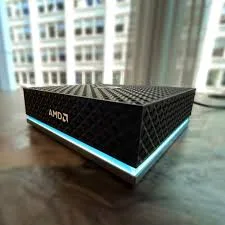
AMD Unveils Lunchbox-Sized PC for AI, Demos Massive 235B Parameter Model
AMD's Bold Announcement: The Future of AI in a Compact Package
AMD has officially unveiled a groundbreaking development that could redefine personal computing and the accessibility of advanced artificial intelligence. At a recent event, the tech giant showcased a remarkably compact, lunchbox-sized PC alongside a live demonstration of a colossal 235 billion parameter AI model running on the hardware. This announcement signals a significant step towards bringing professional-grade AI capabilities into more accessible form factors, blurring the lines between consumer devices and powerful AI processing units.
For enthusiasts, developers, and anyone interested in the evolving landscape of AI, this development is a compelling glimpse into what's next. It addresses the growing demand for more powerful, yet smaller, computing solutions capable of handling increasingly complex AI tasks. This article will delve into the details of AMD's new offering, explore the significance of the AI model demonstrated, and discuss the broader implications for the future of AI hardware and its integration into our daily lives.
The Lunchbox-Sized PC: Miniaturization Meets AI Power
AMD's new PC is a testament to the ongoing trend of miniaturization in the tech industry. Designed to be exceptionally compact, its lunchbox-sized form factor challenges the traditional notion that powerful computing requires a large desktop tower. This design offers several key benefits:
Space Efficiency: Ideal for users with limited desk space or those who prefer a minimalist setup.
Portability: While not a laptop, its compact nature makes it easier to move between locations compared to standard desktops.
Aesthetics: The smaller footprint often translates to a more modern and less obtrusive presence in a home or office environment.
Beyond its size, the true innovation lies in its intended purpose. This isn't just another small form factor PC for basic tasks; it's engineered with AI acceleration in mind. AMD's strategic push into AI hardware is evident, aiming to equip these compact systems with the processing power needed for demanding AI workloads. This means users can potentially perform tasks that were once confined to high-end servers or cloud-based solutions, right from their desktop.
Understanding the 235 Billion Parameter AI Model
The demonstration of a 235 billion parameter AI model is a significant achievement. To put this into perspective, what exactly is a 235 billion parameter model? In the context of artificial intelligence, particularly large language models (LLMs), parameters are essentially the variables that the model learns from data during its training process. They represent the model's knowledge and its ability to make predictions or generate responses.
A model with 235 billion parameters is considered exceptionally large. Such models are capable of understanding and generating human-like text, translating languages, writing different kinds of creative content, and answering your questions in an informative way. Running such a model locally on a PC, especially a compact one, is a remarkable feat. It implies substantial advancements in:
AI Model Optimization: Techniques to make these massive models more efficient for inference (running the model to get results).
Hardware Acceleration: The PC must be equipped with powerful AI accelerators, likely AMD's own silicon, designed to handle the parallel processing demands of neural networks.
Memory Management: Efficiently loading and utilizing vast amounts of data and model weights within the system's memory.
The implications of running large AI models on compact hardware are profound. It democratizes access to advanced AI capabilities, moving beyond the exclusive domain of large corporations and research institutions. For individuals and smaller businesses, this could unlock new possibilities for AI-powered applications and workflows.
The Live Demo: Performance and Practical Implications
During the live demonstration, AMD showcased the practical application of their compact PC and the massive AI model. While specific details about the exact AI tasks performed and the observed performance metrics (like inference speed or accuracy) are crucial for a full understanding, the mere fact of a successful demonstration is highly significant. It proves that the hardware is capable of supporting such a demanding workload, moving beyond theoretical potential to tangible reality.
How does AMD's new PC differ from traditional desktops? Primarily, it's about the integrated AI acceleration and the optimized design for running complex models efficiently in a smaller footprint. Traditional desktops might have powerful CPUs and GPUs, but they are not always optimized for the specific, highly parallel computations required by large AI models. AMD's approach appears to integrate specialized hardware and software solutions to bridge this gap.
The capabilities showcased suggest that this new AMD PC can handle a wide range of AI tasks. These could include:
Advanced natural language processing and generation
Code generation and assistance
Image and video analysis
Complex data modeling and prediction
This demonstration also sheds light on AMD's strategic push into AI hardware acceleration, positioning themselves as a key player in the burgeoning AI hardware market. The convergence of consumer PCs and professional AI capabilities is becoming increasingly apparent.
The Convergence of Compact Hardware and Advanced AI
AMD's announcement highlights a critical trend: the convergence of miniaturized, consumer-friendly hardware with the immense power of advanced AI models. For years, running sophisticated AI models required dedicated server farms or powerful, albeit bulky, workstations. The development of compact PCs capable of handling models with billions of parameters changes this paradigm.
This trend is fueled by advancements in several areas:
GPU Technology: Modern GPUs, including those from AMD, are increasingly designed with AI workloads in mind, featuring specialized cores for tensor operations.
On-Device AI: The push for AI processing to happen locally on devices rather than solely in the cloud offers benefits in terms of privacy, latency, and cost.
Model Efficiency: Researchers are continuously developing more efficient AI architectures and training techniques that reduce the computational requirements for running models.
The implications of running large AI models on compact hardware are far-reaching. It means that sophisticated AI tools could become more accessible to a broader audience, fostering innovation and new applications. For instance, creative professionals might use these PCs for AI-assisted content creation, while researchers could leverage them for more localized AI experimentation without needing extensive cloud infrastructure. This democratization of advanced AI model access is a significant development.
In the context of other AI advancements, it's interesting to consider how this fits into the broader ecosystem. For example, projects like MiniMax M3: The First Open-Weights Model to Combine Three Frontier Capabilities demonstrate the ongoing progress in creating more capable and versatile AI models. AMD's hardware plays a crucial role in enabling the practical deployment and utilization of such models on accessible platforms.
Potential Use Cases and Future Outlook
The potential use cases for AMD's lunchbox-sized AI PC are diverse and exciting. Imagine a graphic designer using the PC for real-time AI-powered image enhancement and generation, or a writer employing it for advanced AI-assisted drafting and editing. Developers could utilize it for rapid prototyping of AI applications, and even students could gain hands-on experience with sophisticated AI models without needing access to expensive cloud resources.
Looking ahead, AMD's strategic push into AI hardware acceleration suggests a future where personal computers are not just for general computing but are integral tools for interacting with and developing AI. This could lead to:
Ubiquitous AI Integration: AI features becoming standard in everyday computing devices.
New Software Paradigms: Applications designed from the ground up to leverage on-device AI capabilities.
Enhanced Personalization: AI models tailored to individual user needs and preferences, running locally for privacy and speed.
The trend towards miniaturization of AI hardware, coupled with the increasing accessibility of powerful AI models, points towards a future where advanced AI is woven into the fabric of our digital lives. AMD's compact PC is a significant marker on this journey, demonstrating that powerful AI processing doesn't necessarily require a large, power-hungry machine.
Conclusion: A Glimpse into the AI-Powered Future
AMD's official unveiling of a lunchbox-sized PC capable of running a 235 billion parameter AI model is a pivotal moment. It underscores the accelerating pace of innovation in both hardware miniaturization and AI model development. This development promises to bring sophisticated AI capabilities out of specialized data centers and into the hands of more users, fostering a new era of personal computing that is deeply intertwined with artificial intelligence.
The ability to run such massive models on compact, consumer-grade hardware has profound implications for accessibility, creativity, and productivity. It represents a significant step in democratizing advanced AI and highlights AMD's commitment to driving the future of AI hardware. As the technology matures, we can expect even more powerful and compact solutions that will continue to redefine what's possible with personal computing. For those interested in the intersection of cutting-edge AI and accessible hardware, this announcement from AMD is a clear signal of exciting times ahead. To learn more about the broader financial implications of investment in the AI and crypto space, consider exploring how firms like a16z raises $2.2 billion crypto fund to invest in projects linking crypto with AI & traditional finance.
Related Articles
View all articles
Introducing Grok 4.5: What's New in xAI's Latest AI Model
Discover the key advancements and features of Grok 4.5, xAI's latest large language model. Understand its capabilities and what makes it a significant update.
Anthropic Introduces Claude Science: A New Era for AI in Scientific Research
Discover how Anthropic's Claude Science is transforming scientific research. Learn about its capabilities, applications, and potential to accelerate discovery.

Introducing Claude Opus 4.7
Explore the capabilities of Claude Opus 4.7. Understand how this model fits into the Anthropic ecosystem and how to leverage it for complex reasoning tasks.
Continue exploring
Find AI agents by workflow
More in Industry Insights
Browse more articles in the Industry Insights category.
AMD articles
Explore more guides and insights tagged AMD.
AI articles
Explore more guides and insights tagged AI.
AI Agent Categories
Browse use-case pages for sales, productivity, coding, customer service, and more.
AI Agents Landscape
Explore the full directory map and compare agents by workflow and category.
Agent Skills
Find reusable skills, capabilities, and building blocks for AI agent workflows.