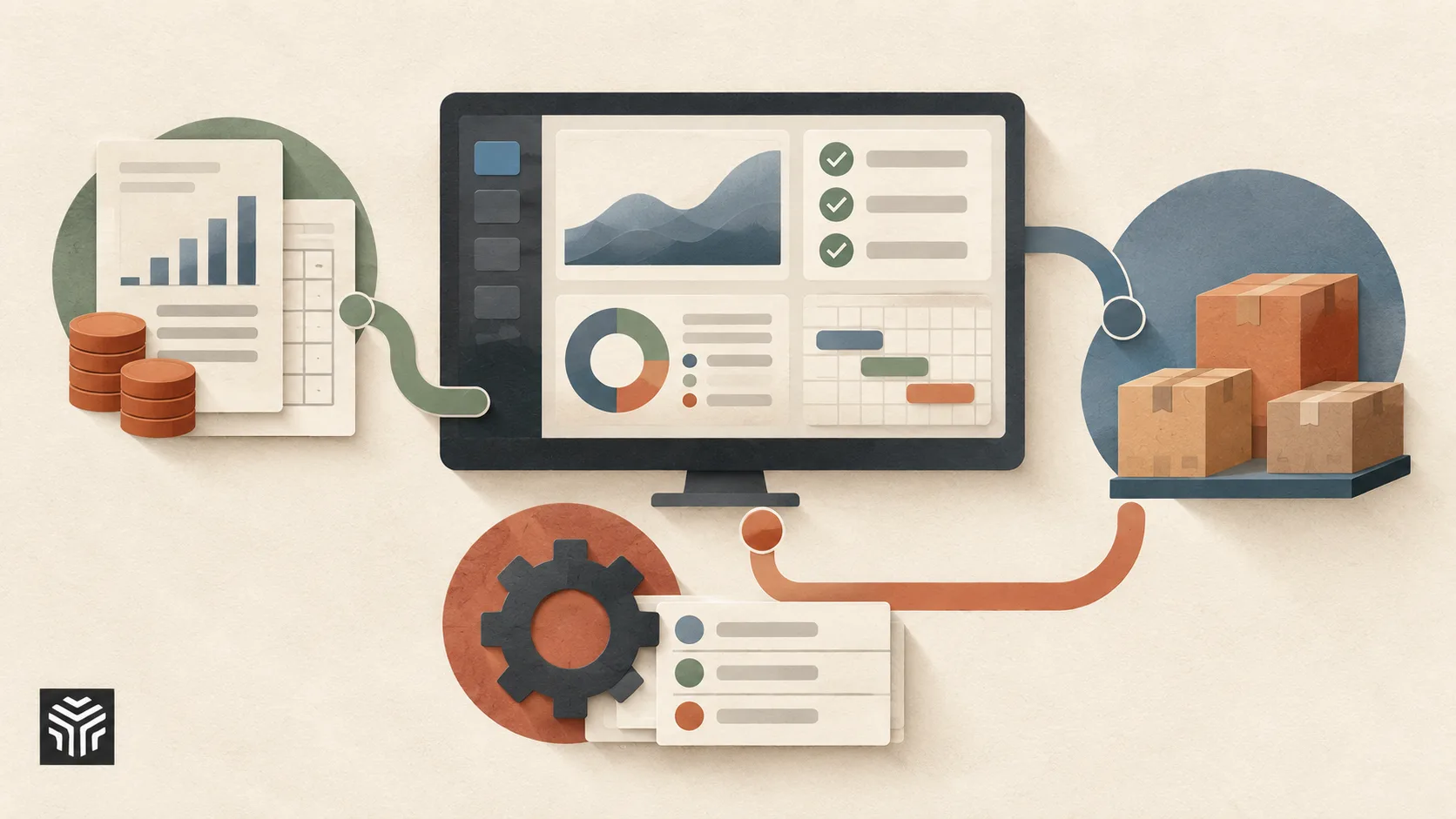
AI Is Reinventing ERP: Why Intelligent Enterprise Systems Are Becoming the New Business Standard
For decades, Enterprise Resource Planning (ERP) systems have served as the operational backbone of businesses, bringing together finance, inventory, procurement, human resources, manufacturing, and customer data into a single platform. While traditional ERP software excelled at organizing business processes, it often relied on users to manually interpret data, generate reports, and make decisions.
Artificial intelligence is fundamentally changing that model. Modern ERP platforms are evolving from systems that simply record business activities into intelligent assistants capable of identifying trends, forecasting outcomes, automating workflows, and helping decision-makers respond faster to changing market conditions.
As organizations continue investing in digital transformation, AI-powered ERP is emerging as one of the most impactful technology upgrades available. Not because it replaces existing systems, but because it makes them significantly smarter.

AI is transforming ERP from a record-keeping system into a decision-making platform
Traditional ERP software was designed to centralize information and standardize business processes. While that remains essential, today's organizations expect more than operational visibility. They need systems capable of recognizing patterns, predicting future outcomes, and recommending actions before problems escalate.
Artificial intelligence enables ERP platforms to analyze vast amounts of operational data in real time, helping businesses move from reactive decision-making to proactive management.
Some of the most valuable AI capabilities include:
Predictive demand forecasting
Automated invoice and document processing
Intelligent inventory optimization
Financial anomaly detection
Procurement recommendations
Natural language reporting
AI-powered customer support
Rather than requiring employees to search through dashboards and spreadsheets, AI can surface relevant insights automatically, reducing the time needed to make informed decisions.
Businesses are embracing AI faster than ever
AI adoption has accelerated across nearly every industry. Organizations increasingly view artificial intelligence as a competitive advantage rather than an experimental technology, especially when integrated into core business systems like ERP.
Recent research illustrates how quickly the technology is becoming mainstream:
88% of organizations use AI in at least one business function.
79% have adopted generative AI within their operations.
Only 7% of businesses have successfully scaled AI across the entire organization.
AI could contribute up to $4.4 trillion in annual productivity gains globally.
These figures suggest that while many organizations have begun experimenting with AI, relatively few have fully integrated it into the systems that drive everyday business operations.
Where AI creates the biggest impact inside ERP systems
The greatest value comes from embedding AI into everyday workflows rather than treating it as a separate application. Employees continue using familiar ERP software, while AI quietly automates repetitive tasks and provides intelligent recommendations in the background.
Finance
Finance teams benefit from AI through:
Automated invoice matching
Expense categorization
Fraud detection
Cash flow forecasting
Financial report generation
These capabilities reduce manual work while improving accuracy and compliance.
Supply chain and inventory
AI helps businesses optimize inventory by:
Predicting future demand
Detecting supply chain disruptions
Recommending purchase quantities
Identifying slow-moving stock
Improving warehouse efficiency
This leads to lower operational costs and fewer stock shortages.
Human resources
Within HR departments, AI supports:
Resume screening
Candidate matching
Employee onboarding
Learning recommendations
Instead of replacing recruiters, AI helps them focus on building stronger relationships with candidates and employees.
Customer service
Modern ERP platforms increasingly integrate customer relationship management with AI-powered support capabilities.
Businesses can:
Automate routine customer inquiries
Prioritize support tickets
Summarize previous interactions
Recommend next actions for support agents
The result is faster response times and more personalized customer experiences.
Data quality remains the foundation of successful AI
No matter how advanced an AI model becomes, its recommendations are only as reliable as the information it receives. Organizations often discover that inconsistent records, duplicate customer information, disconnected applications, and outdated databases significantly reduce AI accuracy.
This is why successful AI initiatives frequently begin with improving data quality before introducing advanced automation.
Key priorities include:
Integrating disconnected business systems
Standardizing data across departments
Eliminating duplicate records
Maintaining consistent reporting standards
Establishing clear data ownership
Once these foundations are in place, AI can generate insights that business leaders can trust.
Choosing technology that supports long-term AI adoption
As businesses modernize their operations, selecting the right ERP platform has become more important than ever. Organizations are increasingly looking beyond traditional functionality and evaluating whether a solution can support AI-driven automation, predictive analytics, cloud scalability, and future integrations.
For companies planning custom enterprise solutions, partnering with an experienced ERP software development company in USA can help ensure that AI capabilities are built into the platform from the beginning rather than added as an afterthought. This approach gives organizations greater flexibility as business requirements evolve and AI technologies continue to mature.
Governance remains essential as AI adoption grows
While AI offers significant productivity gains, organizations must also address governance, security, and compliance. Enterprise systems often contain sensitive financial records, employee information, intellectual property, and customer data, making responsible AI implementation a business priority rather than simply a technical consideration.
Effective AI governance includes:
Clear data access policies
Role-based permissions
Regulatory compliance monitoring
Audit trails for AI-generated decisions
Human review of high-risk recommendations
Strong governance allows organizations to innovate confidently while protecting both business and customer information.
Best practices for implementing AI within ERP
Organizations achieving the greatest success typically take an incremental approach rather than attempting a complete transformation overnight.
Successful implementation often includes:
Starting with one or two high-impact workflows
Measuring productivity improvements before expanding
Training employees on AI-assisted processes
Continuously improving data quality
Monitoring AI performance over time
Updating governance policies as new capabilities emerge
This phased strategy reduces implementation risk while allowing teams to build confidence in AI-powered decision-making.
AI needs trustworthy business data to deliver reliable insights
One of the biggest challenges in enterprise AI isn't the model itself—it's ensuring the information being analyzed is complete, secure, and compliant. Organizations often pull data from email archives, collaboration platforms, cloud storage, and ERP systems before feeding it into AI-powered workflows. Solutions like Jatheon help businesses securely archive and manage business communications, making it easier to support governance, compliance, and long-term information management. Combined with enterprise platforms such as Microsoft 365, Microsoft Teams, and Microsoft Purview, organizations can establish a stronger data foundation that enables AI to generate more reliable and auditable insights.
AI is making customer and employee feedback more actionable
Artificial intelligence is also changing how organizations collect and interpret feedback. Instead of manually reviewing hundreds of survey responses, businesses can use AI to identify recurring themes, measure sentiment, and uncover opportunities for improvement within minutes. Platforms like SurveyKing simplify survey creation and data collection, while AI helps transform those responses into actionable recommendations. When combined with visualization tools such as Microsoft Power BI or collaborative platforms like Slack, businesses can quickly share insights across teams and make faster, data-driven decisions.
Looking ahead
The future of ERP isn't simply about storing information more efficiently. It's about creating systems capable of understanding business operations, identifying opportunities, and supporting employees with real-time intelligence.
As AI agents become more capable, ERP platforms will increasingly automate cross-functional workflows, coordinate activities between departments, and provide proactive recommendations before managers even recognize a problem.
Organizations that invest today in modern ERP architecture, reliable data, and responsible AI practices will be better positioned to adapt to changing markets and growing customer expectations.
Final thoughts
Artificial intelligence is redefining what businesses should expect from enterprise software. Rather than serving as passive databases, modern ERP systems are becoming intelligent platforms that help organizations automate operations, improve forecasting, and make faster, data-driven decisions.
Businesses that combine high-quality data, thoughtful implementation, and AI-enabled ERP solutions will be better equipped to improve efficiency, reduce costs, and remain competitive in an increasingly digital economy.
Related Articles
View all articles
AI Analytics Agents vs. Traditional BI: What’s the Difference?
AI analytics agents vs traditional BI: compare dashboards, natural-language analytics, automated insights, use cases, benefits, and when to use each.
WisdomAI Launches Autonomous Analytics Agents
Explore how autonomous analytics agents like those from WisdomAI are transforming data workflows. Learn the mechanics, benefits, and tradeoffs.

The Impact of AI Agents on Customer Support, Sales, and Business Automation
Explore how AI agents are changing customer support, sales, and business automation through faster service, lead qualification, and workflow execution.
Continue exploring
Find AI agents by workflow
More in Partner Insights
Browse more articles in the Partner Insights category.
ai articles
Explore more guides and insights tagged ai.
data articles
Explore more guides and insights tagged data.
AI Agent Categories
Browse use-case pages for sales, productivity, coding, customer service, and more.
AI Agents Landscape
Explore the full directory map and compare agents by workflow and category.
Agent Skills
Find reusable skills, capabilities, and building blocks for AI agent workflows.