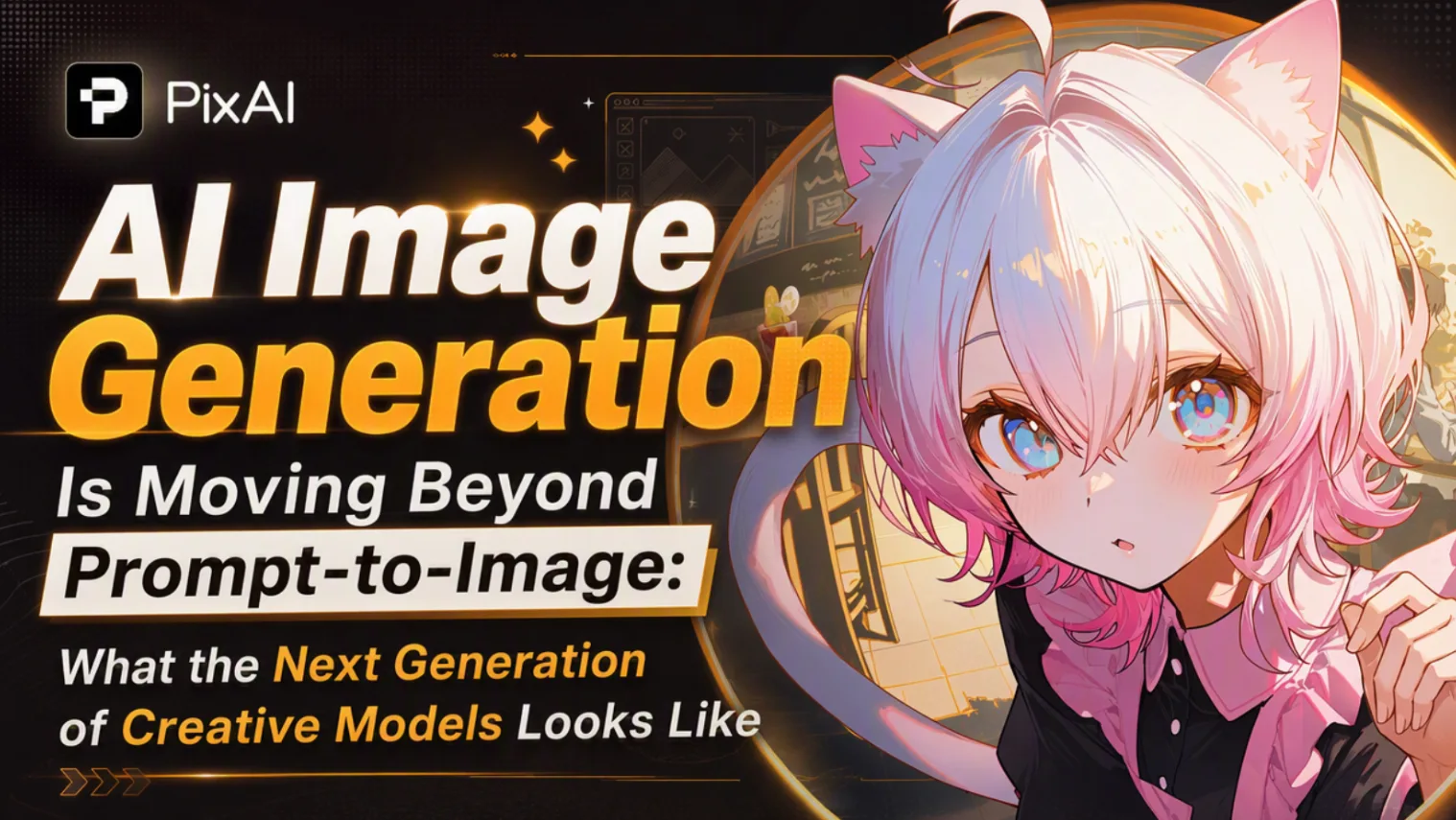
AI Image Generation Is Moving Beyond Prompt-to-Image: What the Next Generation of Creative Models Looks Like
The next phase of generative imaging is less about producing one impressive result and more about helping creators reference, refine, reuse, and develop visual ideas over time.
Prompt-to-image was only the first phase
For years, the easiest way to describe generative image AI was also the most accurate: write a prompt, receive an image, and decide whether the result is good enough. That loop made image generation accessible to people who did not have a traditional illustration workflow, and it remains one of the most important use cases for creative AI.
But the prompt-to-image loop describes only the moment when an image appears. It says very little about what happens next. A creator may like the composition but want a different outfit. A character may need to appear again in a new scene. A designer may need three directions for the same concept, a front-side-back turnaround, or an image with text that can be used as a poster rather than as a standalone illustration.
As these needs become more common, the definition of a useful AI image model is expanding. The question is no longer only, 'Can it generate a good image?' It is increasingly, 'Can I keep working with what it generated?'
Iteration is the real creative bottleneck
Creative work is rarely a sequence of unrelated final images. It is iterative. An idea becomes a rough direction, the direction becomes a visual concept, the concept is refined, and the final asset may still need variations or corrections.
A one-shot workflow can make every change feel like a restart. Regenerating an image may solve one problem while changing details the creator already liked. Re-describing the same character can introduce identity drift. Generating multiple design options can create a set that looks attractive individually but inconsistent when placed side by side.
That is why the next generation of AI image tools is beginning to focus more on continuity between steps. The value is not simply producing more images. It is reducing the distance between one creative decision and the next.
References turn previous work into a starting point
Reference-based generation is one of the clearest signs of this change. A reference image can contain information that would be tedious or difficult to rebuild from text alone: the shape of a face, the hairstyle, the costume, the overall visual identity, or even the structure of a scene.
PixAI's Tsubaki.3, currently in Early Access, is one example of a model built around this more continuous workflow. Tsubaki.3 can use a character reference to generate the same character in new scenes, outfits, poses, and formats, allowing the visual result of one step to inform the next.
The important shift is conceptual. Instead of treating every prompt as a blank page, the creator can carry useful visual information forward. That makes references part of generation itself rather than an afterthought.
Editing can replace the regenerate-and-pick loop
The same logic applies to image editing. If a generated image is 90 percent correct, starting again from zero is not always the most efficient option. The creator may only need to change a hair color, replace one item of clothing, adjust a hand gesture, remove an object, rewrite a piece of text, or change an expression.
Instruction-based editing turns that request into a direct step in the workflow. Tsubaki.3 can edit character details, outfits, gestures, objects, expressions, backgrounds, and text through natural-language instructions. The goal is to modify the requested area while carrying forward the parts of the source image that already work.
This matters because refinement is not a minor edge case. It is how most visual ideas improve. The first result becomes a draft rather than a disposable attempt.
AI is moving into the work between idea and final image
Another change is the growing importance of intermediate creative material. Traditional visual development includes rough references, value studies, color exploration, perspective checks, pose references, and turnarounds long before a polished illustration is finished.
Tsubaki.3 can move an image through a line-art-to-grayscale-to-flat-color-to-final-render progression, while also generating pose-reference mannequins, fisheye perspective roughs, perspective grids, and character turnarounds. These outputs are useful not because they are all final deliverables, but because they can support decisions made before the final image.
That is a meaningful departure from the idea that an AI image model should only hand over a finished piece. The model can also participate in planning and exploration.
The output itself is becoming more functional
Creators also need images that serve a specific purpose. A manga page is not merely a manga-style illustration: it needs panel structure, reading flow, speech bubbles, lettering, and camera variation. A character sheet needs multiple views or expressions organized for reference. A poster needs typography and imagery to work together as a layout.
Tsubaki.3 can generate manga layouts, 4-koma comics, speech bubbles and lettering, as well as posters, banners, covers, typography, and character-reference materials. These capabilities point toward a broader idea of image generation in which the output is designed to be used, not simply admired.
For creators, that distinction matters. A visually strong image is valuable; a visually strong image that already fits the next step of the project can be more valuable.
What the next generation of image models may be judged on
Image quality will remain an important benchmark, but it is unlikely to remain the only one. As output quality improves across the industry, other questions become more useful for understanding how a model fits into real creative work:
Controllability: can the creator direct composition, pose, lighting, and specific changes?
Consistency: can a character or style remain stable across related outputs?
Editability: can an existing image be refined without rebuilding the entire result?
Reusability: can references and previous outputs become inputs for new creative tasks?
Workflow integration: can the model support planning, exploration, and structured visual assets as well as final generation?
These criteria move the conversation away from a single showcase image and toward the life of a project over time.
From image generator to creative tool
Tsubaki.3 is still in Early Access, so it should be understood as one current example of this direction rather than a final verdict on where generative art is heading. What is notable is the emphasis on continuity: reference-based creation, targeted editing, character development, intermediate visual material, manga, typography, and composition all sit around the same core idea of continuing to work with an image.
The prompt will not disappear, and prompt-to-image generation will remain one of the fastest ways to turn an idea into a visual. But the next phase of generative imaging is beginning to ask a more practical question: after the image appears, how much farther can the creator take it?
That shift may prove more important than another isolated improvement in one-shot generation. The future of AI image creation is not only about getting a picture. It is about developing a visual idea from one stage to the next.
For teams as well as individual creators, this can also change collaboration. A concept artist can hand off a turnaround rather than a single hero image; a writer can discuss a manga page instead of a loose set of illustrations; a designer can revise an existing visual without asking for a complete restart. The more structured the output becomes, the easier it is to communicate what should stay and what should change.
Related Articles
View all articlesGemini’s Nano Banana: A New Era for Image Generation
Discover Gemini’s Nano Banana model—story-driven AI image generation with real-time editing, multi-image fusion, and crisp text, now on WhatsApp.
AI Video Generation for Social Media & TikTok Creators
Learn how TikTokers and social media creators use AI video generation to post daily: model choice, 9:16 workflows, hooks, captions, and tools like ImagineArt explained.
Top 5 Best AI Agents and Tools for Content Creators in 2026
Discover the top 5 AI agents and tools revolutionizing content creation in 2026, from text and video generation to SEO optimization and brand consistency.
Continue exploring
Find AI agents by workflow
More in Partner Insights
Browse more articles in the Partner Insights category.
AI image generation articles
Explore more guides and insights tagged AI image generation.
AI Agent Categories
Browse use-case pages for sales, productivity, coding, customer service, and more.
AI Agents Landscape
Explore the full directory map and compare agents by workflow and category.
Agent Skills
Find reusable skills, capabilities, and building blocks for AI agent workflows.
Free AI Agents
Discover free AI agents and tools for testing agentic workflows without upfront cost.