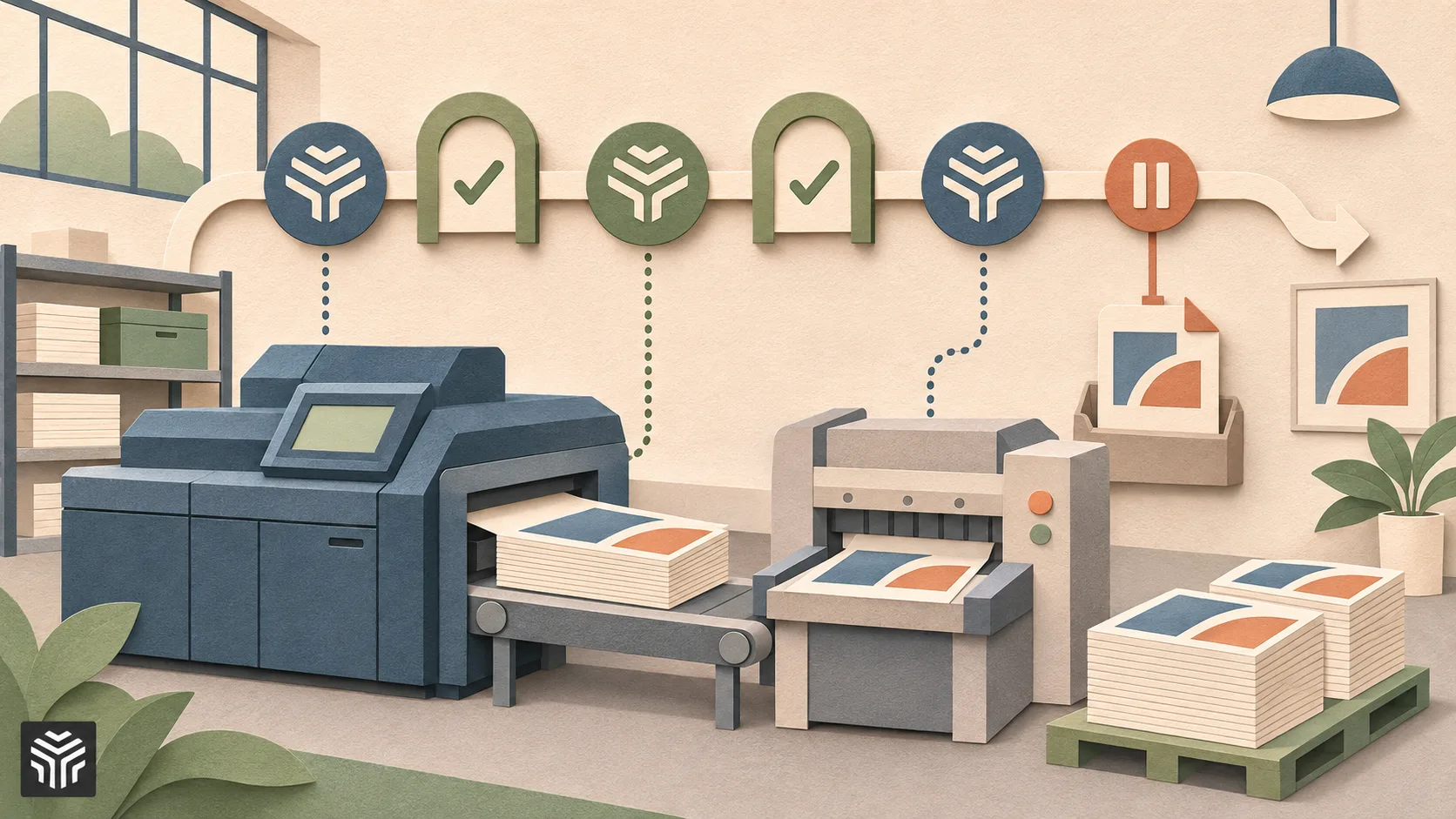
What Happens When You Let AI Agents Run a Print Shop Floor, With Rules
Key takeaways
- The shop uses agents to import orders, prepare quotes, send proofs, purchase shipping labels and produce morning briefings.
- Scoped API keys limit each agent’s permitted actions.
- Conversational assistants use a separate read-only connector.
- Quote prices come from the system’s press-sheet pricing, with sending permissions set by the shop.
- Operator updates provide live job status and data for future time estimates.
- The operator reports productivity gains of up to 15 percent from production boards and an approximately 80 percent reduction in job-status calls.
There is a lot of talk about AI agents running businesses and not much about what that looks like on a real floor with real machines. We run a commercial print shop in Phoenix, 15,000 to 20,000 folders a day, on software my brother built. This is what the agents actually do in our building, what we let them touch, and the one design decision that makes it safe.
The decision. Agents act through keys, not screens
Our system has a documented REST API with scoped keys. A key can create a quote draft and nothing else. A key can buy a shipping label and nothing else. The screens our staff use are clients of the same API, so nothing is possible on a screen that is not possible through a key, and nothing is possible through a key that the key was not scoped for.
That is the whole safety model. No browser bot clicking through screens. No prompt that can talk its way into a price change. The assistants, Claude, ChatGPT, Gemini and Grok, connect through a separate read only connector that has no write path at all.
What runs in our shop today
The storefront importer pulls online orders in as quotes, blocks duplicates, and sends paid ones straight to production.
The shipping agent reads the UPS and FedEx queue, buys and prints the labels, stores them on the job and writes the tracking back so the customer’s tracker updates on its own.
Proof automation uploads the prepress file and sends the approval link. The customer approves from a phone and the job moves.
The estimating agent reads an email or a spec sheet and builds the quote. It cannot invent a price because the system prices from the press sheet. Whether it sends on its own or waits for a person is a rule the shop sets.
The morning briefing arrives before anyone is in the building. What is due, what is on hold, what is waiting on a proof.
What you can let it do if you want to
You can train an agent to watch jobs flow through the shop and hand work to operators as departments free up. It can schedule presses and bindery equipment, process labels, send customers tracking and pickup notices, and run production inside the rules you set. How far it goes is the owner’s decision, not the vendor’s.
Why the boards matter to the agents
The agents only know what the floor tells them. Operators tap Start and Complete on a board in their department, on a TV. That tap moves the job, updates the customer’s tracker, and teaches the time estimate for the next run on that press with that stock. The boards update within seconds and show who is on what right now. In our shop that one feature raised productivity by up to 15 percent, and it is also what makes a production agent possible, because the data is live.
Results
Over 13 million folders through the system in a little over two years with fewer than 20 reprints on our fault. Where is my job calls down to about 20 percent of what they were, and the ones that come in get answered by asking the assistant what department the job is in.
The honest line
AI is the reason we built the system. Scripting had become something anyone could do, and no print software had an API an agent could use. So we built the API first and the shop around it. It is sold now to other shops as InfusePrint, one plan, one price per shop, files in the shop’s own cloud storage. If you are a developer or a shop owner looking at print workflow automation software, the API docs on the InfusePrint site show the pattern. Keys for the agents, a read only connector for the assistants, and rules the owner writes.
Quick answers
Can AI agents run a print shop?
They can run a lot of it inside rules the owner sets. In our shop, agents import orders, send proofs, buy shipping labels and write the morning briefing. Pricing comes from the press sheet, not from the AI.
How do AI agents connect to InfusePrint?
Through a documented API with scoped keys. A key can do one job and nothing else. Assistants like Claude and ChatGPT use a separate read only connector that has no write path.
What does InfusePrint cost?
$1,000 a month per shop with every feature and no contract, plus a $1,500 onboarding fee.
Related Articles
View all articles
Best AI Workflow Automation Tools in 2026
Compare the best AI workflow automation tools in 2026 for no-code workflows, AI agents, SaaS integrations, creative automation, self-hosting, and enterprise use.

The Best Weather API Providers for AI Agents
Compare the best weather API providers for AI agents, including forecasts, historical data, alerts, pricing, request limits, and real-time weather access.

The Impact of AI Agents on Customer Support, Sales, and Business Automation
Explore how AI agents are changing customer support, sales, and business automation through faster service, lead qualification, and workflow execution.
Continue exploring
Find AI agents by workflow
More in Partner Insights
Browse more articles in the Partner Insights category.
AI Agents articles
Explore more guides and insights tagged AI Agents.
Print Shop Automation articles
Explore more guides and insights tagged Print Shop Automation.
AI Agent Categories
Browse use-case pages for sales, productivity, coding, customer service, and more.
AI Agents Landscape
Explore the full directory map and compare agents by workflow and category.
Agent Skills
Find reusable skills, capabilities, and building blocks for AI agent workflows.