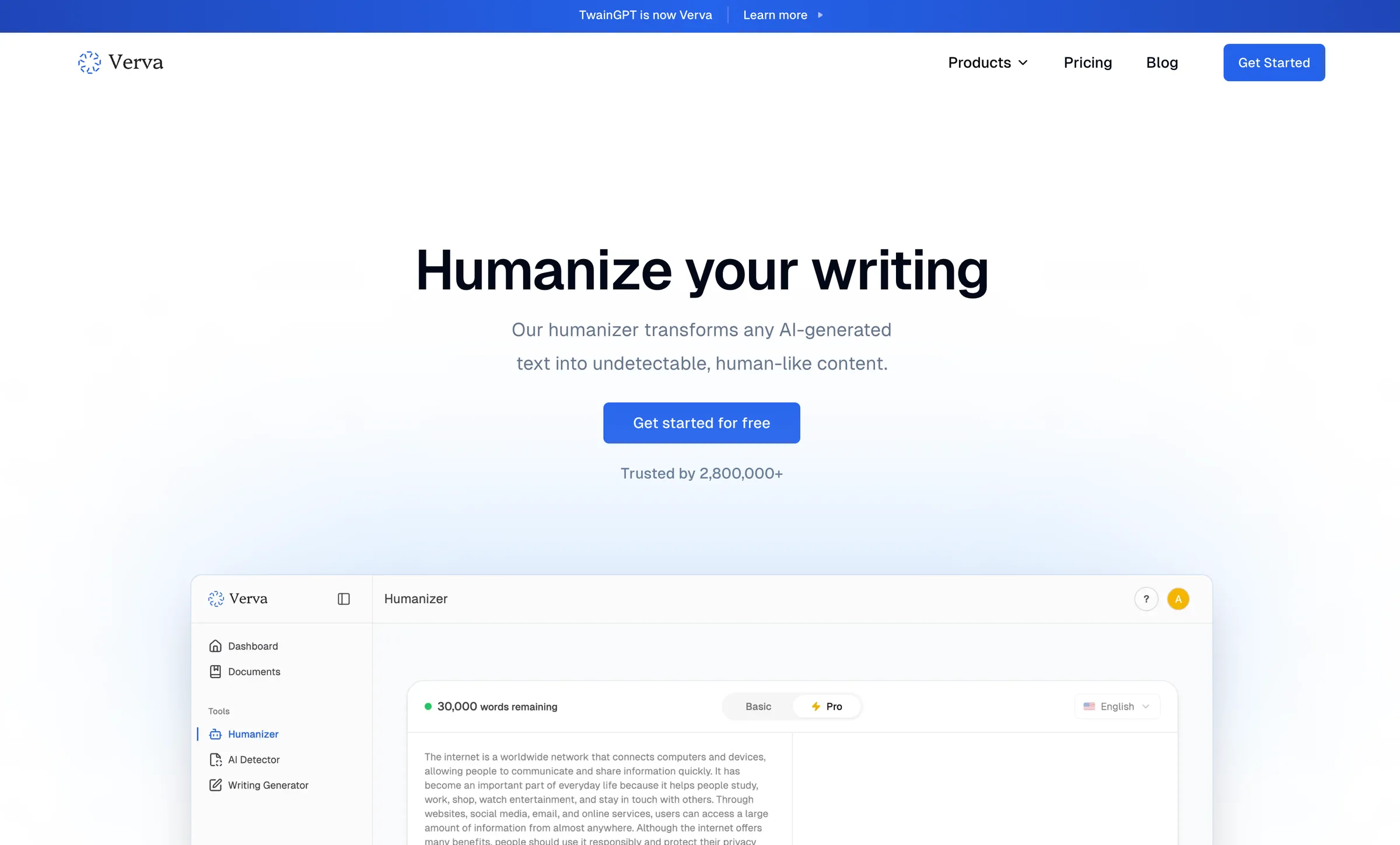
Why an AI Writing Platform Belongs in Every Serious Content Workflow
Most content teams hit the same wall eventually.
The ideas are there and the editorial calendar is packed, but the actual writing eats up hours that could go toward strategy or distribution.
An AI writing platform like Verva doesn't remove the thinking from content work.
It compresses the mechanical parts so the thinking gets more room.
This guide breaks down where these tools fit, what they actually change in day-to-day production, and how to get meaningful output without sacrificing quality.
The Real Problem Isn't Writing Speed
There's a misconception that AI content tools exist purely to write faster.
Speed matters, but the bigger issue for most teams is consistency.
A solo blogger publishing three posts a week and a SaaS marketing team running a multi-channel content engine face the same friction.
Maintaining quality and voice across dozens or hundreds of pieces without burning out is the real challenge.
An AI writing platform addresses this by giving you a repeatable framework for drafting.
Instead of starting from a blank document every time, you're working from structured prompts, tone presets, and content templates that keep output aligned even when different people contribute.
That consistency compounds over months, especially when your content library grows past a few hundred pages.
The speed gains are real, but they're a side effect.
The actual shift is operational, with fewer bottlenecks between ideation and publishing and less time spent reformatting content briefs into actual drafts.
Where an AI Writing Platform Fits in a Content Workflow
Thinking of these tools as "article generators" misses the point.
The most productive teams treat an AI writing platform as infrastructure, something embedded across multiple stages rather than bolted onto one.
Research and outlining is where most people start, and it's a strong entry point.
Feeding a platform your target keyword, audience profile, and competitor URLs lets it generate structured outlines you'd otherwise spend 30 to 45 minutes building manually.
You're not outsourcing judgment here.
You're compressing the scaffolding step so you can spend more time on the angles that differentiate your content.
First drafts are the obvious use case.
A well-prompted AI writing platform can produce an 80-percent-ready draft that a human editor shapes into something publish-ready.
The key word there is "well-prompted" because garbage prompts produce garbage drafts, regardless of how advanced the underlying model is.
Teams that invest in prompt libraries consistently get better raw output than those winging it every time.
Editing and repurposing is where the less obvious value lives.
Taking a long-form blog post and generating a social media carousel script, an email newsletter summary, and a set of meta descriptions from it turns one piece of content into five distribution assets without five separate writing sessions.
What Separates a Useful Platform From a Novelty
Not every AI content tool is built the same way.
Some are thin wrappers around a large language model with a text box and a "generate" button.
Others are built around actual content workflows, with features designed for people who publish regularly rather than occasionally.
A few things worth evaluating when you're comparing options:
Tone and brand voice controls. Can you define how the platform writes, or are you stuck with its default output style? Editing tone is slower than editing substance, which makes this more important than most people realize.
Template and prompt management. Does the platform let you save, organize, and share prompts across a team? One-off generation is useful, but a systematized prompt library is transformational.
Output quality at scale. Generating one decent blog post is easy. Generating fifty that don't all sound the same, don't repeat the same transitions, and hold up editorially is the actual test of a platform's usefulness.
The novelty tools feel impressive for about a week.
The infrastructure-grade platforms quietly save hours every month for years.
Common Mistakes That Kill the Value
Adopting an AI writing platform and getting disappointing results usually traces back to one of three patterns.
Using it without a content strategy.
An AI tool amplifies whatever you feed it.
If your keyword research is thin, your briefs are vague, and your editorial standards aren't documented, the output will reflect that.
The platform doesn't fix upstream problems.
It accelerates them.
Teams that pair a strong content operations process with AI tooling see dramatically different results than those using it without a plan.
Over-relying on raw output.
Publishing AI-generated drafts without meaningful human editing is a fast track to generic content that ranks poorly and converts worse.
The draft is a starting point.
Your expertise, examples, data, and editorial voice are what turn it into something worth reading.
Ignoring the learning curve.
Every platform has quirks.
The way you structure a prompt for a comparison article is different from how you'd prompt a how-to guide or a thought leadership piece.
Spending two or three hours experimenting with prompt variations and saving what works will pay for itself within the first week of serious use.
Making It Work Long-Term
The teams getting the most from AI content platforms aren't the ones generating the most volume.
They're the ones who've built systems around the tool with documented prompts, defined quality gates, and clear roles for what the AI handles versus what a human handles.
A practical setup looks something like this.
The content strategist builds the brief and defines the angle.
The AI writing platform generates a structured draft based on that brief.
A human editor reviews for accuracy, adds proprietary data or expert quotes, adjusts tone, and approves for publishing.
Distribution assets get generated from the approved piece in a second pass.
That workflow doesn't replace anyone on the team.
It removes the drudgery that keeps skilled people stuck on low-leverage tasks.
Your best writer shouldn't spend two hours formatting a newsletter recap when that time could go toward a high-value landing page.
The Bigger Shift Happening Right Now
Content marketing has been volume-driven for years.
More blog posts, more landing pages, more social updates.
The assumption has always been that more surface area means more chances to rank and convert.
That math is changing because search algorithms increasingly reward depth, originality, and genuine expertise over sheer output.
An AI writing platform doesn't push you further into the volume game unless you choose to use it that way.
Used thoughtfully, it frees up the creative bandwidth to go deeper on fewer pieces.
That means adding original research, real examples, expert interviews, and the kind of specificity that generic content can't match.
You can explore how this works in practice at Verva.com, where the platform is built around exactly this kind of quality-focused content production.
The tool is only as good as the workflow wrapped around it.
Get that part right, and an AI writing platform becomes the most quietly productive part of your entire content operation.
Related Articles
View all articles
Best AI Workflow Automation Tools in 2026
Compare the best AI workflow automation tools in 2026 for no-code workflows, AI agents, SaaS integrations, creative automation, self-hosting, and enterprise use.
Top 5 Best AI Agents and Tools for Content Creators in 2026
Discover the top 5 AI agents and tools revolutionizing content creation in 2026, from text and video generation to SEO optimization and brand consistency.
10 Must-Have Components of an Agentic Content Pipeline
Discover the 10 essential components that define a powerful agentic content pipeline. Learn about AI agents, orchestration, RAG, and tools for seamless conte...
Continue exploring
Find AI agents by workflow
More in Partner Insights
Browse more articles in the Partner Insights category.
AI Agent Categories
Browse use-case pages for sales, productivity, coding, customer service, and more.
AI Agents Landscape
Explore the full directory map and compare agents by workflow and category.
Agent Skills
Find reusable skills, capabilities, and building blocks for AI agent workflows.
Free AI Agents
Discover free AI agents and tools for testing agentic workflows without upfront cost.
Open Source AI Agents
Compare open-source agents, frameworks, and developer-friendly agent projects.