Best 5 AI Virtual Training Assistants in 2026
The pace of technological change has transformed how organizations approach technical training. Skills in areas such as cloud infrastructure, cybersecurity, DevOps, and modern software development evolve rapidly, making traditional training methods increasingly difficult to sustain. Static documentation, prerecorded lectures, and occasional instructor-led workshops rarely provide enough support for professionals who must solve complex technical problems in real environments.
As companies adopt more sophisticated technologies, training itself must also evolve. Engineers, security analysts, and IT professionals often learn most effectively through practical experience rather than passive instruction. Hands-on exercises, interactive labs, and simulated environments have therefore become central to modern technical education.
At a Glance: Best AI Virtual Training Assistants
CloudShare – AI guidance embedded in practical lab environments
KodeKloud – Interactive DevOps training with contextual assistance
Cybrary – AI-supported cybersecurity learning pathways
Pluralsight – Adaptive learning guidance for technical skills
ITPro – AI-driven support for certification-focused training
Why AI Assistants Are Changing Technical Training
The introduction of AI-driven assistants has begun to reshape how organizations design and deliver technical training programs. Rather than relying solely on structured curricula or instructor availability, companies can provide learners with continuous support throughout practical exercises.
Several factors contribute to the growing importance of AI assistants in training environments.
Faster Problem Resolution
Technical exercises often involve troubleshooting errors, misconfigurations, or incomplete setups. Without assistance, learners may spend excessive time attempting to identify the cause of a problem.
AI assistants help shorten this cycle by suggesting potential solutions and guiding learners toward the correct configuration.
Continuous Learning Support
In large training environments, instructors cannot assist every participant simultaneously. AI assistants fill this gap by providing immediate guidance whenever a learner encounters difficulty.
This ensures that training sessions continue progressing even in self-paced environments.
Adaptive Learning Paths
AI-driven systems can analyze how learners interact with exercises and adjust recommendations accordingly. For example, if a learner repeatedly struggles with a particular concept, the system may suggest additional explanations or practice exercises.
This adaptive approach supports personalized learning experiences.
Scalable Training Programs
Organizations often need to train distributed teams across multiple locations. AI assistants allow companies to scale training programs without proportionally increasing instructor resources.
Reduced Instructor Workload
By handling routine questions and troubleshooting tasks, AI assistants allow instructors to focus on higher-level mentoring and strategic guidance.
These advantages explain why AI-supported training environments are becoming more common in technical education.
The Best 5 AI Virtual Training Assistants in 2026
1. CloudShare
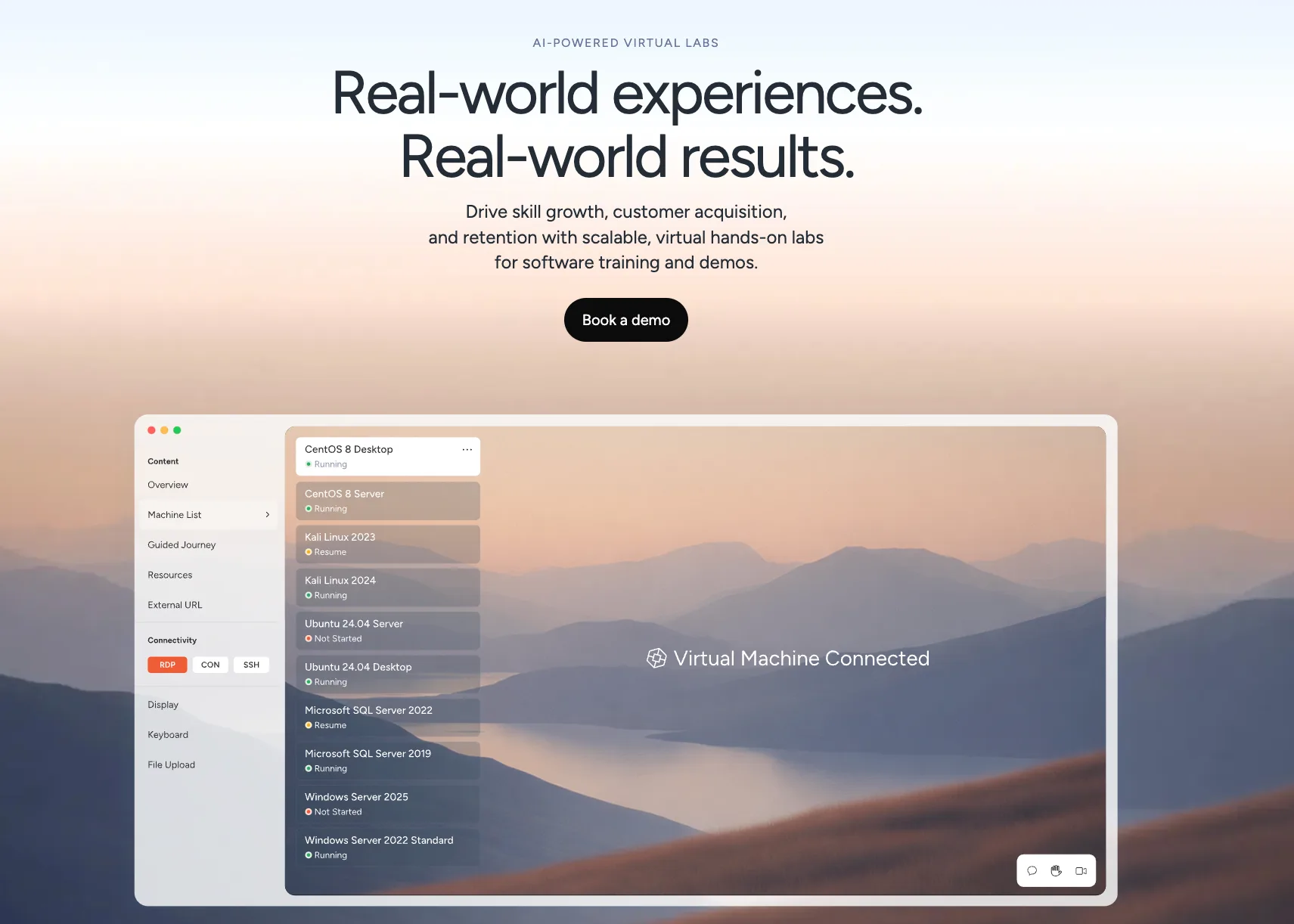
CloudShare provides an interactive training environment designed for organizations that require hands-on technical learning at scale. The platform allows companies to create complex lab environments where learners can experiment with real infrastructure, software configurations, and simulated systems.
A distinguishing aspect of CloudShare is its integration of intelligent assistance within these environments. AI-supported guidance helps learners progress through labs without requiring constant instructor supervision. When users encounter configuration issues or unexpected errors, the platform can provide contextual hints and troubleshooting suggestions.
Organizations frequently use CloudShare for enterprise training programs involving cloud infrastructure, cybersecurity exercises, product training, and technical onboarding. The platform’s flexibility allows instructors to design complex scenarios that mirror real-world environments while still providing automated guidance.
Because training environments often involve numerous moving parts, the ability to receive real-time assistance within the platform significantly improves learner productivity.
Key Capabilities
AI-supported guidance within hands-on lab environments
Customizable training scenarios and infrastructure simulations
Real-time troubleshooting assistance
Scalable training environments for distributed teams
Learning analytics and performance tracking
2. KodeKloud
KodeKloud focuses on interactive learning experiences for cloud computing, DevOps, and infrastructure automation skills. The platform provides practical exercises that allow learners to work directly with technologies such as Kubernetes, Docker, and cloud services.
Within these interactive environments, AI-powered guidance helps learners understand the steps required to complete exercises successfully. When participants encounter errors or misconfigurations, contextual hints guide them toward the correct solution without revealing full answers immediately.
This approach encourages exploration while still ensuring that learners remain on track. By balancing guidance with problem-solving, the platform helps reinforce technical understanding.
Key Capabilities
Interactive DevOps training environments
Contextual guidance during exercises
Scenario-based learning for cloud technologies
Practical labs for infrastructure automation
Skill progression tracking and analytics
3. Cybrary
Cybrary has long been associated with cybersecurity education, providing structured learning pathways for professionals preparing for security certifications or building operational security skills. Over time, the platform has expanded beyond traditional course delivery to incorporate more interactive learning environments and guided exercises.
Within these environments, AI-assisted guidance plays an important role in helping learners navigate complex security concepts and tasks. Cybersecurity training often involves analyzing system behavior, investigating simulated incidents, or configuring defensive controls. When learners encounter obstacles, AI-driven assistance can help them interpret results, understand potential mistakes, and continue progressing through exercises.
This approach is particularly valuable because cybersecurity training frequently involves unfamiliar tools or investigative methods. Instead of relying solely on instructor feedback, learners can receive contextual explanations that help clarify the reasoning behind specific steps.
Cybrary’s training ecosystem is widely used by individuals preparing for professional certifications as well as by organizations seeking to strengthen internal security capabilities. By combining structured learning with guided practice environments, the platform supports both foundational education and advanced skill development.
Key Capabilities
AI-supported guidance within cybersecurity learning environments
Structured training pathways for security professionals
Interactive exercises focused on real-world security scenarios
Contextual explanations during investigative tasks
Progress tracking across training modules
4. Pluralsight
Pluralsight has established itself as one of the most recognized platforms for technology skill development. Its training ecosystem spans a wide range of technical domains, including cloud computing, software development, cybersecurity, and data engineering.
In recent years, Pluralsight has increasingly incorporated intelligent assistance into its learning environment. AI-driven systems help guide learners toward relevant resources, identify skill gaps, and recommend targeted learning paths based on performance data.
While the platform is widely known for its video-based instruction, its broader ecosystem includes hands-on learning components that allow users to practice technical concepts directly. AI-supported guidance can help learners understand why specific approaches work and where improvements may be necessary.
Organizations frequently rely on Pluralsight to maintain workforce readiness in rapidly evolving technology domains. The platform’s combination of structured learning paths and adaptive recommendations allows teams to develop skills in a more systematic way.
By analyzing how learners interact with training material, AI systems can recommend courses, exercises, or practice scenarios that align with individual progress.
Key Capabilities
AI-driven learning recommendations
Skill assessments and personalized training paths
Guidance integrated into hands-on technical exercises
Broad coverage of modern technology skills
Analytics that help organizations track workforce development
5. ITPro
ITPro focuses on practical training for professionals preparing for technical certifications and operational roles in IT infrastructure, networking, and security. Its training programs often emphasize real-world scenarios that mirror tasks encountered in professional environments.
AI-supported assistance helps learners navigate complex certification preparation programs. When participants encounter challenges within exercises or assessments, intelligent guidance can suggest relevant concepts to review or provide hints that clarify the next steps.
Certification training often involves mastering highly detailed technical procedures. AI assistants help learners reinforce understanding by providing contextual explanations during practice activities.
Organizations also use ITPro to support internal training initiatives, particularly when preparing employees for certification programs tied to specific technologies or platforms.
By combining structured curricula with AI-guided learning support, ITPro helps learners progress more efficiently through demanding certification paths.
Key Capabilities
AI-guided support for certification preparation
Structured learning programs for IT professionals
Contextual assistance during technical exercises
Progress tracking across certification paths
Training environments aligned with real-world tasks
Core Capabilities of AI Training Assistants
Although implementations vary across platforms, most AI training assistants share several foundational capabilities that enable them to provide meaningful support during exercises.
Contextual Troubleshooting
AI assistants analyze the environment in which a learner is working and identify potential issues. For example, if a configuration error occurs during a cloud deployment exercise, the assistant may detect the problem and suggest corrective actions.
Step-by-Step Guidance
During complex tasks, the assistant may offer hints about the next step in an exercise. These suggestions allow learners to continue progressing without revealing complete solutions.
Knowledge Integration
Many training assistants connect to internal knowledge bases or documentation libraries. When learners request help, the assistant retrieves relevant explanations that relate directly to the current task.
Real-Time Hints
Rather than waiting for learners to ask for assistance, some systems proactively suggest guidance when they detect repeated errors or inactivity during exercises.
Learning Analytics
AI assistants can track how learners progress through training programs. These insights help organizations identify common difficulties and improve training materials.
Together, these capabilities transform training platforms from static environments into interactive learning systems that actively support participants.
Common Use Cases for AI Training Assistants
AI training assistants are used across a wide variety of technical training scenarios. Their value becomes particularly evident in environments that require complex, hands-on learning.
Cybersecurity Training
Security professionals frequently practice responding to simulated attacks within training environments. AI assistants can guide learners through investigation steps, suggest tools for analysis, and provide hints about potential vulnerabilities.
Cloud and DevOps Training
Cloud configuration and infrastructure automation exercises often involve multi-step processes. AI assistants help learners navigate these environments while troubleshooting configuration issues.
Software Development Practice
Development training frequently includes exercises involving debugging, deployment, or code integration. AI assistants can help identify common coding errors or provide guidance on debugging techniques.
IT Certification Preparation
Certification programs often require candidates to perform practical tasks in simulated environments. AI assistants can help learners understand why certain configurations are required and reinforce learning through contextual explanations.
Enterprise Technical Onboarding
Organizations that hire new engineers or technical specialists often rely on hands-on onboarding programs. AI assistants help new employees navigate internal systems and environments more efficiently.
These use cases illustrate how AI-driven guidance can improve the efficiency and effectiveness of technical training programs.
How Organizations Evaluate AI Training Assistant Platforms
As AI-assisted learning tools become more common, organizations must evaluate training platforms carefully to determine which solutions best support their workforce development goals. While many platforms provide similar capabilities on the surface, several factors often determine how effective a training assistant will be in practice.
One of the most important considerations involves integration with practical training environments. AI assistants are most useful when they operate directly within hands-on exercises rather than outside the training environment. Platforms that embed guidance inside labs or simulations can provide contextual insights that align with the learner’s exact situation.
Another critical factor is the quality of contextual guidance. Effective AI assistants do more than simply surface documentation. They analyze the learner’s activity and provide hints that are relevant to the current task. This contextual understanding is essential for troubleshooting complex technical problems.
Organizations should also evaluate the accuracy and reliability of AI-generated recommendations. Technical training often involves precise configurations and procedures. If AI suggestions are inaccurate or overly generic, learners may become confused rather than supported.
Scalability is another important consideration, particularly for enterprises that train large distributed teams. Platforms must be capable of supporting thousands of learners simultaneously while maintaining responsive assistance.
Finally, companies should examine analytics and reporting capabilities. Training platforms that provide insight into learner progress allow organizations to identify skill gaps, adjust curricula, and improve training effectiveness.
When these factors are evaluated together, organizations can identify training platforms that deliver meaningful guidance rather than superficial assistance.
FAQs
What is an AI virtual training assistant?
An AI virtual training assistant is a software system that provides contextual guidance within technical training environments. These assistants analyze learner activity and offer hints, explanations, or troubleshooting suggestions during exercises. Their goal is to help learners progress through complex tasks without requiring constant instructor involvement, making large-scale training programs more manageable.
How do AI assistants improve technical learning?
AI assistants support technical learning by providing immediate guidance when learners encounter obstacles. Instead of pausing exercises to seek help, participants receive contextual hints directly within the training platform. This reduces frustration and encourages continued exploration, helping learners develop problem-solving skills while maintaining momentum during hands-on exercises.
Are AI training assistants replacing instructors?
AI training assistants are not designed to replace instructors entirely. Instead, they extend the reach of training teams by handling routine questions and troubleshooting tasks. This allows instructors to focus on deeper mentorship, strategic guidance, and advanced problem-solving discussions while AI systems provide support for common learning challenges.
Can AI assistants support complex technical labs?
Yes. Many AI training assistants operate directly within hands-on lab environments where learners interact with real infrastructure or simulated systems. By analyzing user actions and system responses, these assistants can identify potential errors and provide targeted guidance that helps learners complete complex exercises more effectively.
Which teams benefit most from AI training assistants?
AI training assistants are most commonly used by teams working in technical fields such as cloud engineering, cybersecurity, DevOps, and software development. Organizations that train large numbers of employees in these areas benefit significantly from AI-driven support because it allows training programs to scale without requiring constant instructor supervision.
How accurate are AI learning assistants?
The accuracy of AI learning assistants depends on the quality of their training data and the sophistication of their underlying models. Modern systems are increasingly capable of providing reliable contextual guidance, especially within structured training environments. However, human instructors still play an important role in validating complex concepts and mentoring learners through advanced topics.
Related Articles
View all articlesClawdbot Explained: the self-hosted AI assistant that can actually do things
Clawdbot is an open-source, self-hosted AI assistant you run yourself—controlled from Slack/Telegram/WhatsApp, extended via MCP tools, with persistent memory and automations. Here’s what it is, how it works, use cases, and the security checklist.
AI Agents vs Virtual Assistants: A Comprehensive Comparison Guide (2024)
Compare AI agents and virtual assistants to find the best solution for your business. Detailed analysis of features, costs, and benefits with expert recommendations.

Is Hermes the Best AI Agent Today? Here are 5 Other Alternatives
Compare Hermes with OpenClaw, Goose, OpenHands, Cline, and Dify for self-hosting, coding, local inference, deployment, GPU needs, and operating costs.
Continue exploring
Find AI agents by workflow
More in Partner Insights
Browse more articles in the Partner Insights category.
ai articles
Explore more guides and insights tagged ai.
ai virtual assistant articles
Explore more guides and insights tagged ai virtual assistant.
AI Agent Categories
Browse use-case pages for sales, productivity, coding, customer service, and more.
AI Agents Landscape
Explore the full directory map and compare agents by workflow and category.
Agent Skills
Find reusable skills, capabilities, and building blocks for AI agent workflows.